Direct road alignment
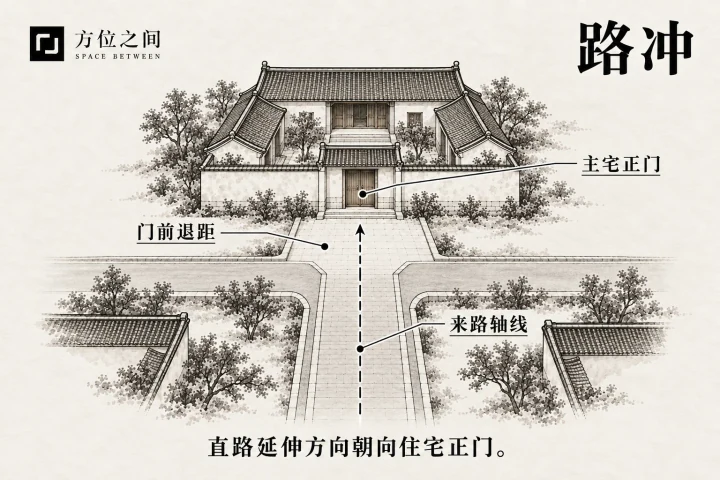
A straight road facing the front of a home resembles a spear aimed at its openings. Traditional responses soften the direct approach; practical choices focus on the entrance, sightlines and space to pause.
 方位之间
方位之间Start with visible roads, buildings and interior layouts to understand sha names and their origins, category by category. Turn to directions, calendars and other fundamentals when needed.
Practical methods focus on information you can record and verify. Cultural entries explain traditional terms and conventions without treating auspicious or inauspicious labels as predictions of real outcomes. Where approaches differ, check the measurement method, time boundary, and source edition first.
Entries found 223 entries
A straight road facing the front of a home resembles a spear aimed at its openings. Traditional responses soften the direct approach; practical choices focus on the entrance, sightlines and space to pause.
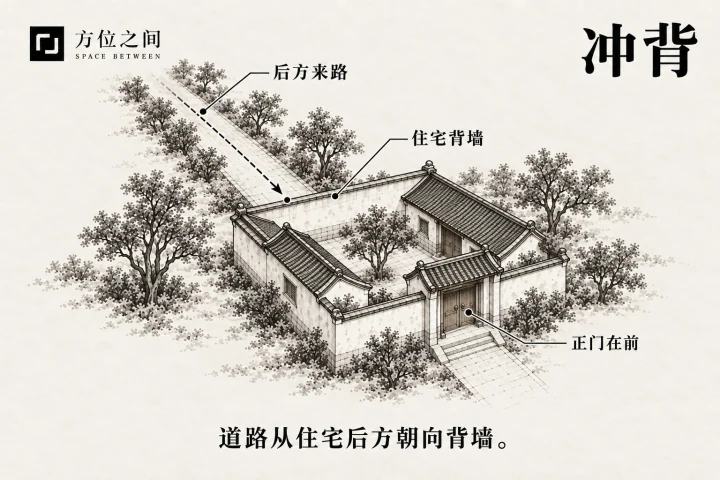
A straight road facing a rear door, window or wall is also called rear-spear sha. Tradition associates an approach from behind with weak support; responses focus on rear boundaries, access and resting rooms.
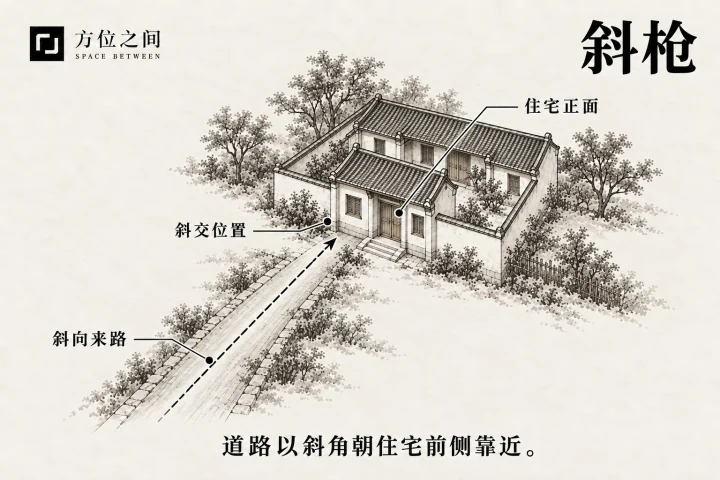
An oblique road whose extended axis faces a corner, side door or window is called oblique-spear sha. The side-spear metaphor suggests local redirection and screening at the affected position.
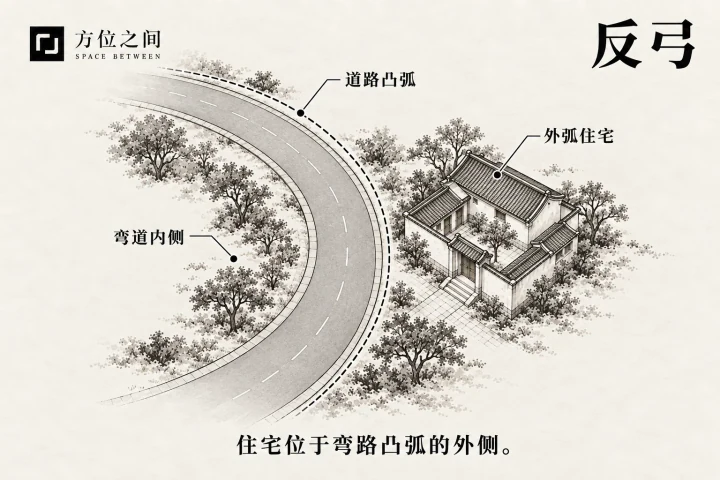
A home outside a bend faces the convex back of a bow. Tradition links this image of turning away and dispersal with unstable finances and relationships; practical responses depend on setback, openings and use.
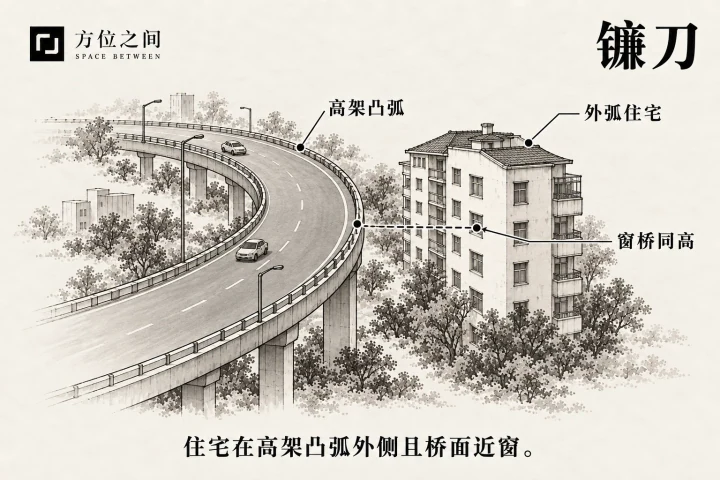
Sickle sha names a curved bridge edge close to windows at occupied floors. The key features are the outside curve, distance and deck height; folk accounts associate the blade image with injury, financial loss and illness.
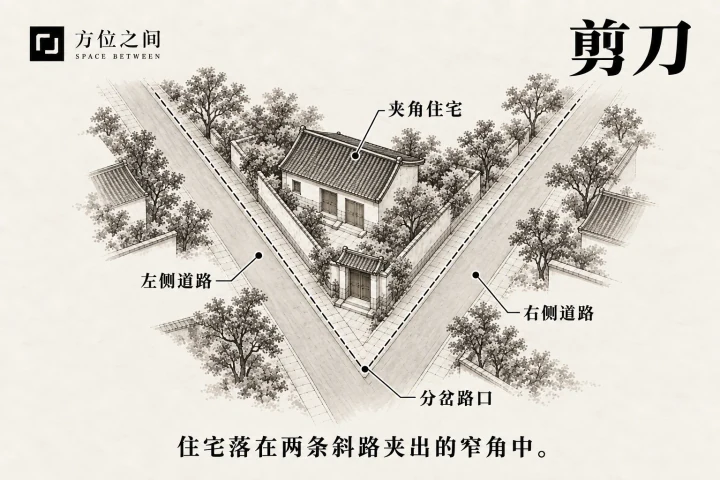
Scissors sha describes a home or shop between two oblique roads, likened to two blades. The plot’s tip, entrance and access route determine how this relationship is experienced.
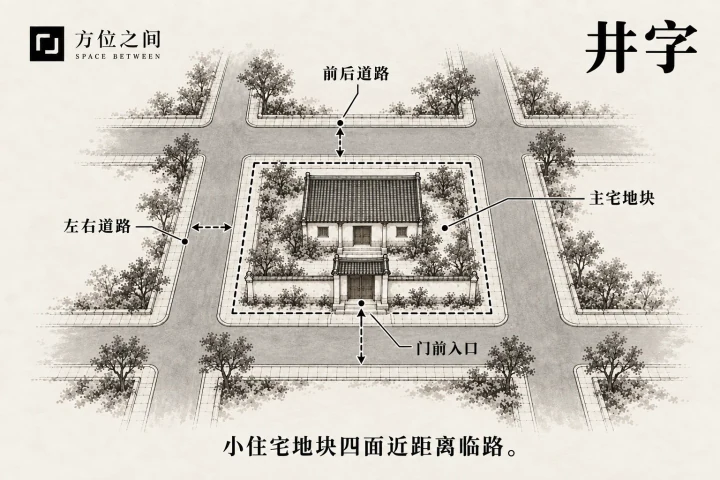
Grid-road sha describes a home closely enclosed by roads on four sides. Tradition associates it with passing wealth and an unsettled interior; responses prioritise a clear entrance, private boundary and quiet space.
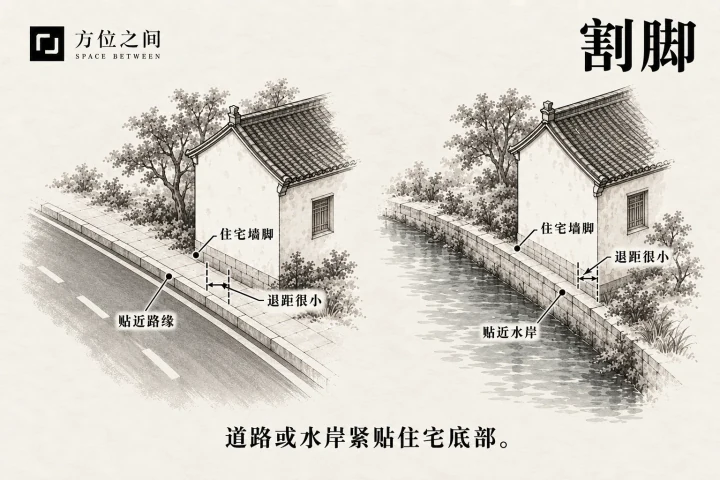
Foot-cutting sha means a road or bank close to the dwelling’s base with little buffer, associated in folklore with changing fortune. Roadside responses create entrance space; waterfront responses address drainage and bank conditions.
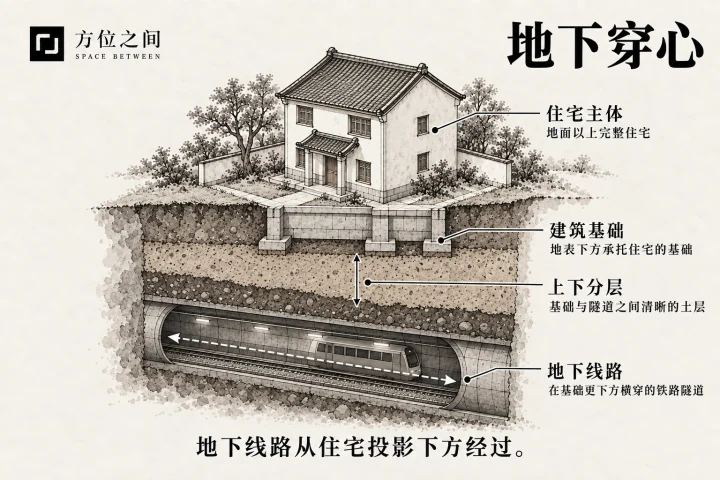
Underground through-heart sha is a modern metaphor for a tunnel or line passing beneath a home’s footprint. Tradition emphasises household stability; actual sound and vibration depend on their transmission conditions.
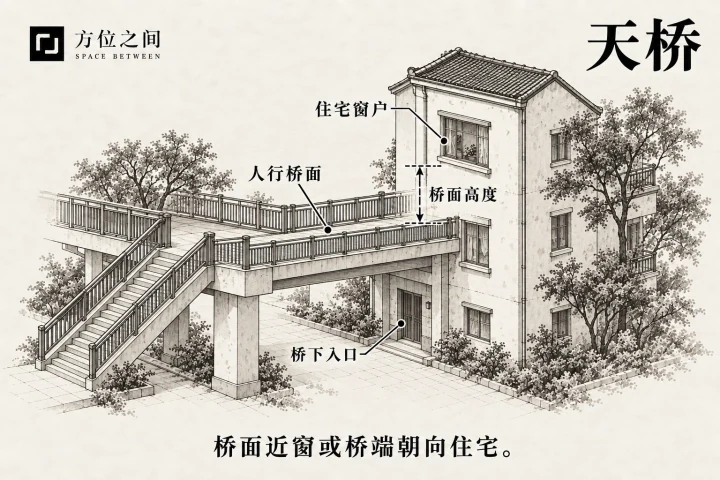
Overpass sha covers decks beside windows, bridge ends facing doors and piers crowding entrances. Homes prioritise privacy and quiet, while shops also consider customer access; responses depend on bridge type and floor.
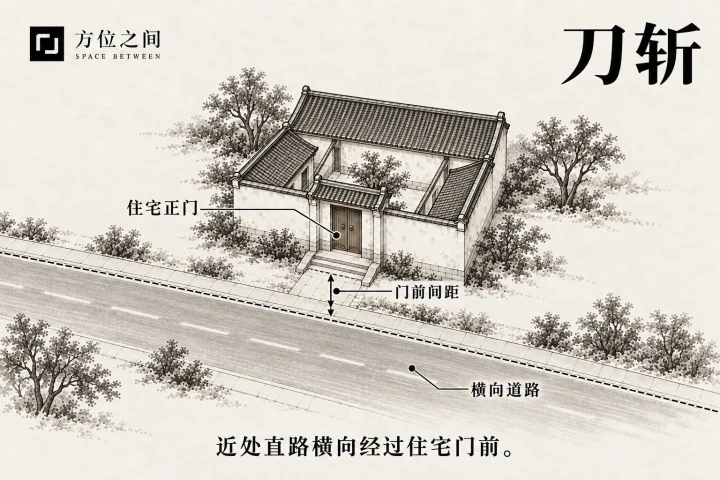
Knife-cut sha uses the image of a road like a blade approaching a home. This entry illustrates one form with a road across the frontage, focusing on the space between the threshold, footpath, and carriageway.
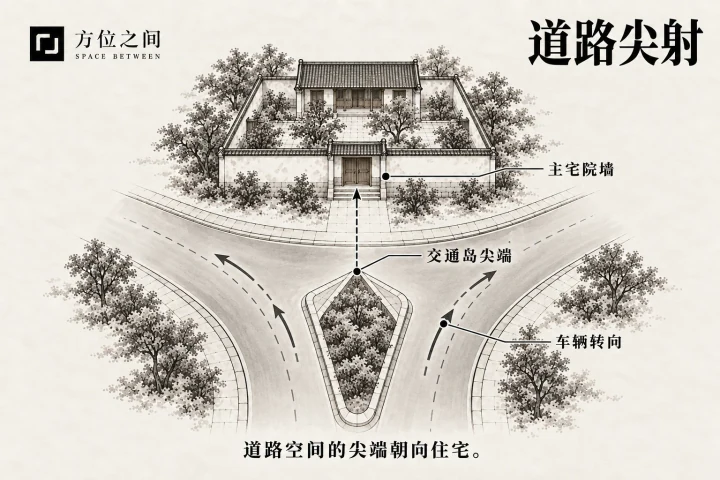
Road-tip sha typically describes two roads meeting in a triangular form whose tip points toward a home. Road edges or traffic islands may show a similar alignment. Folk accounts use arrow imagery to associate it with financial loss and poor health.
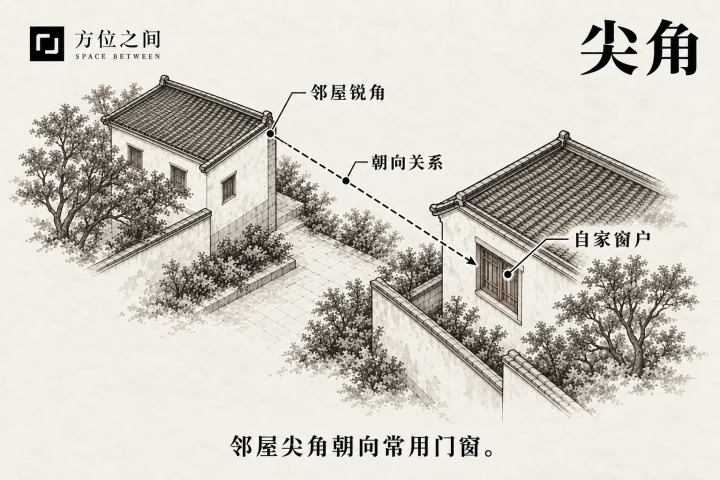
Sharp-corner sha describes a neighboring wall or eave point facing a home’s doors or windows. Direction and visibility matter; folk names such as chicken-beak and neighboring-corner sha often overlap.
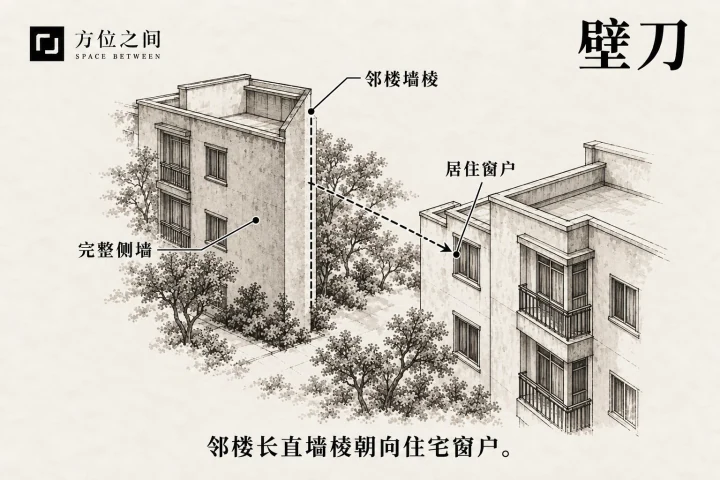
Wall-edge sha describes a long neighboring wall end or facade edge facing a door or window like an upright blade. It concerns a solid edge, unlike a projecting corner point or a gap between towers.
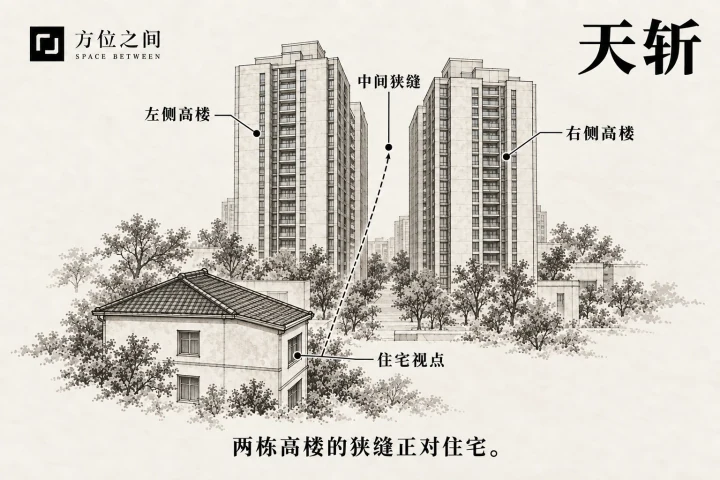
Sky-cleft sha is a narrow vertical gap between taller buildings facing a home, named for a sky split by a blade. It concerns the gap; actual wind conditions depend on wind direction and the surrounding buildings.
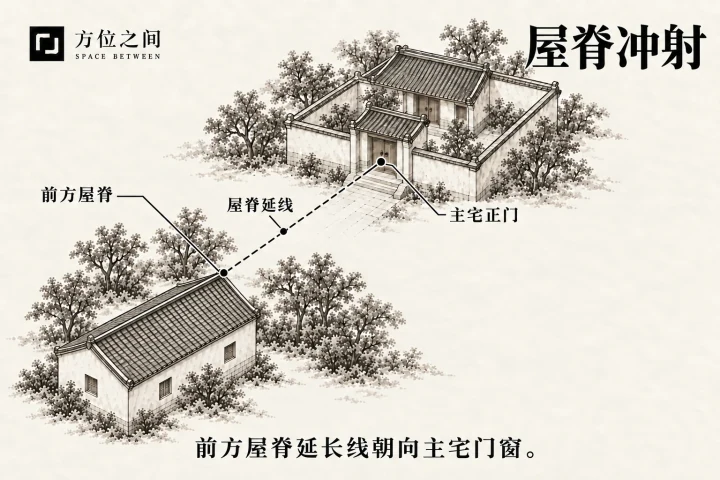
A front-facing roof projection occurs when a neighboring ridge end or eave point faces a home’s front openings. It concerns a line or tip directed toward the home, distinct from a pole before the door also called heart-piercing sha.
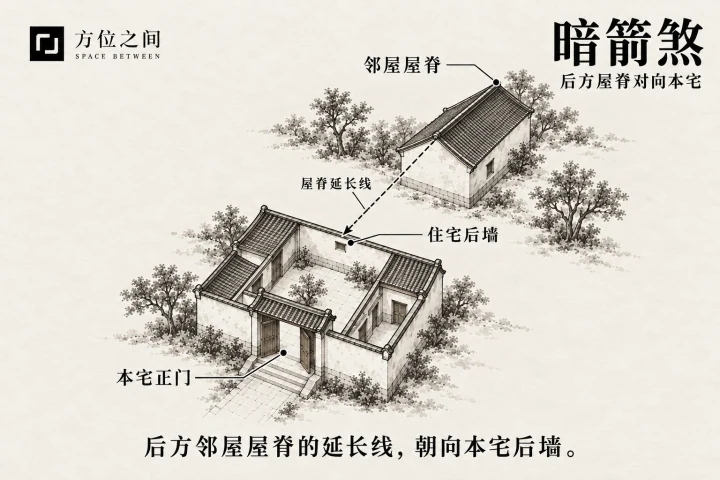
Hidden-arrow sha, also called back-piercing sha, means a roof ridge directed toward the rear of the main hall in Yangzhai Cuoyao. It concerns a ridge approaching from behind, distinct from a rear road or an indoor corridor.
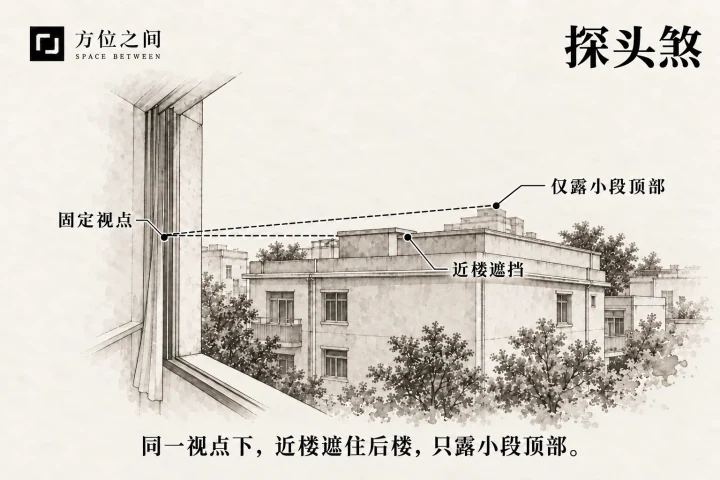
Peeking-roof sha describes a nearer roof concealing most of a building behind it, leaving a small upper portion visible. Folklore associates this silhouette with spying and disputes; actual overlooking and shading are separate matters.
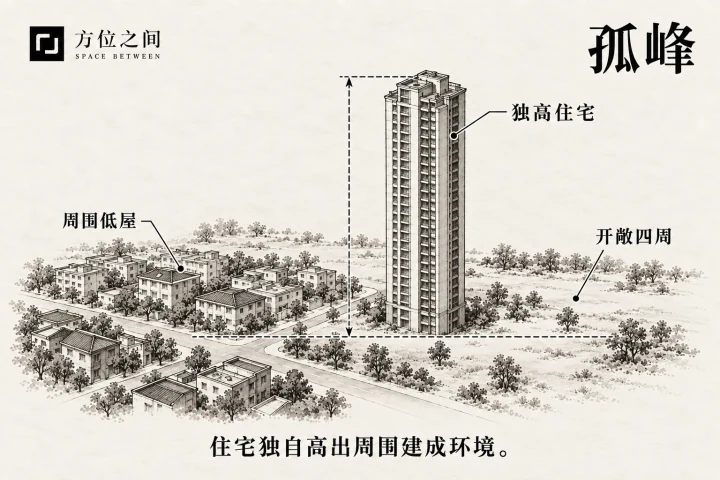
Isolated-tower sha describes a building rising conspicuously above low neighbours or open land. Tradition sees a lack of surrounding support; practical assessment concerns wind, sun and exposure at the occupied floor.
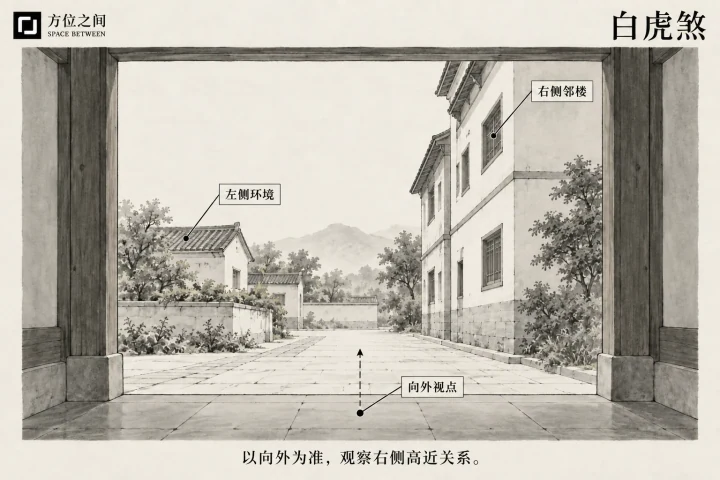
White-tiger sha refers broadly to a home’s right side being considered too tall, close or active. Left and right are taken from inside looking out; the issue is the relationship between sides, not merely a building on the right.
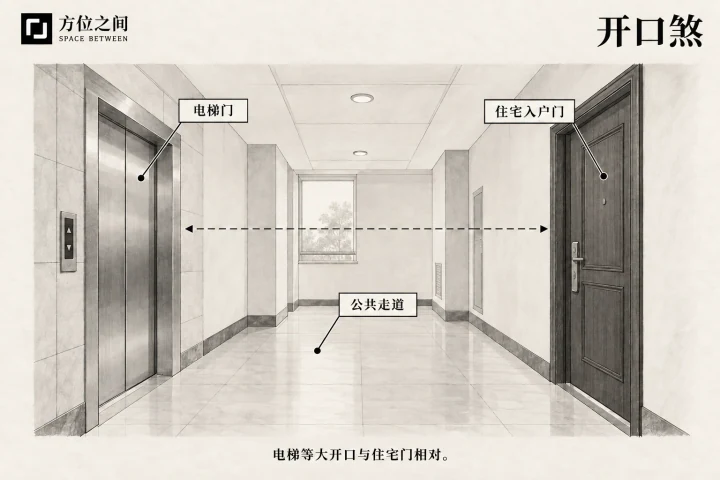
Open-mouth sha commonly describes a home entrance facing lift doors. The opening-and-closing image expresses a clash of activity and quiet; distance, sightlines, and use of the lift lobby shape the actual experience.
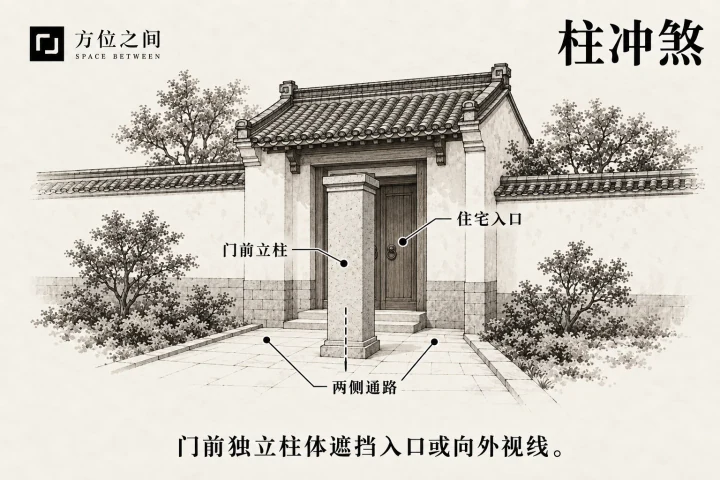
Pillar-facing-door sha describes a post obstructing an entrance axis or view. Freestanding pillars, porch columns, and utility poles serve different purposes; width, setback, and passage on either side matter more than one alignment line.
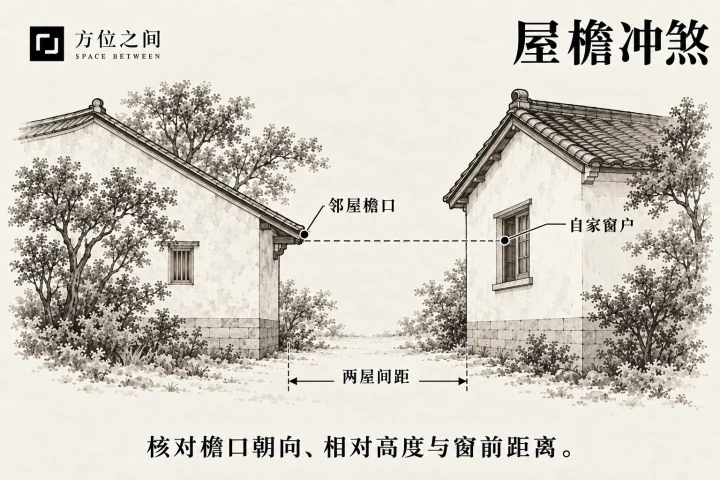
Eave-facing-window sha concerns a neighboring projecting eave edge or end directed toward a frequently used window. Height, spacing, and viewpoint shape the appearance; rainwater paths and maintenance need separate assessment.
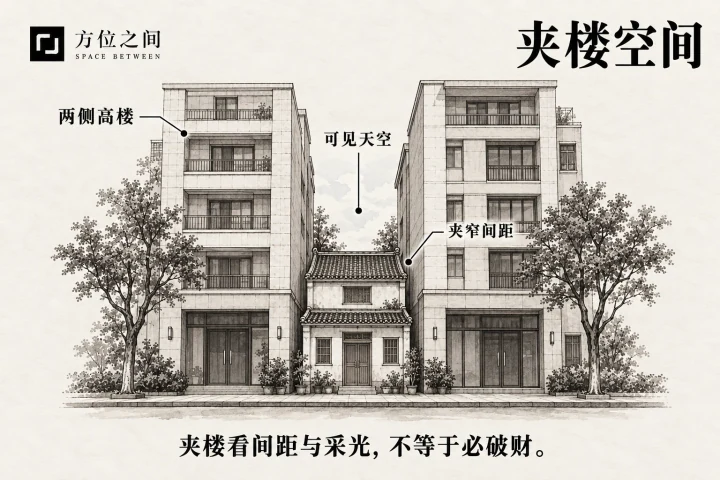
A compressed-between-buildings arrangement places a low home between two taller masses. Side setbacks and front/rear openings determine the enclosure; folklore uses the image of being squeezed to discuss blocked progress and finances.
Showing 24 / 223
A straight road facing the front of a home resembles a spear aimed at its openings. Traditional responses soften the direct approach; practical choices focus on the entrance, sightlines and space to pause. · Direct road alignment · Spear sha · Frontal spear sha
A straight road facing a rear door, window or wall is also called rear-spear sha. Tradition associates an approach from behind with weak support; responses focus on rear boundaries, access and resting rooms. · Rear road alignment · Rear spear sha
An oblique road whose extended axis faces a corner, side door or window is called oblique-spear sha. The side-spear metaphor suggests local redirection and screening at the affected position. · Oblique road alignment · Angled road approach
A home outside a bend faces the convex back of a bow. Tradition links this image of turning away and dispersal with unstable finances and relationships; practical responses depend on setback, openings and use. · Reverse-bow form · Reverse-bow road · Reverse-bow watercourse
Sickle sha names a curved bridge edge close to windows at occupied floors. The key features are the outside curve, distance and deck height; folk accounts associate the blade image with injury, financial loss and illness. · Sickle Sha · Curved-bridge sickle · Curved-road sickle
Scissors sha describes a home or shop between two oblique roads, likened to two blades. The plot’s tip, entrance and access route determine how this relationship is experienced. · Scissors Sha · Scissors roads · Intersecting roads flanking an entrance
Grid-road sha describes a home closely enclosed by roads on four sides. Tradition associates it with passing wealth and an unsettled interior; responses prioritise a clear entrance, private boundary and quiet space. · Grid Sha · Sedan-chair Sha · Roads on four sides
Foot-cutting sha means a road or bank close to the dwelling’s base with little buffer, associated in folklore with changing fortune. Roadside responses create entrance space; waterfront responses address drainage and bank conditions. · Foot-cutting Sha · Water at the base · Road at the base
Underground through-heart sha is a modern metaphor for a tunnel or line passing beneath a home’s footprint. Tradition emphasises household stability; actual sound and vibration depend on their transmission conditions. · Underground Piercing Sha · Subsurface piercing · Underground passage beneath a home
Overpass sha covers decks beside windows, bridge ends facing doors and piers crowding entrances. Homes prioritise privacy and quiet, while shops also consider customer access; responses depend on bridge type and floor. · Overpass Sha · Elevated road beside windows · Bridge facing a home
Knife-cut sha uses the image of a road like a blade approaching a home. This entry illustrates one form with a road across the frontage, focusing on the space between the threshold, footpath, and carriageway. · Horizontal-cut Sha · Road crossing the frontage · Horizontal-blade road
Road-tip sha typically describes two roads meeting in a triangular form whose tip points toward a home. Road edges or traffic islands may show a similar alignment. Folk accounts use arrow imagery to associate it with financial loss and poor health. · Pointing-road-tip Sha · Pointing road tip · Acute road angle
Sharp-corner sha describes a neighboring wall or eave point facing a home’s doors or windows. Direction and visibility matter; folk names such as chicken-beak and neighboring-corner sha often overlap. · Sharp-corner Sha · Chicken-beak Sha · Neighboring-corner Sha · Chicken-beak corner (wording variant)
Wall-edge sha describes a long neighboring wall end or facade edge facing a door or window like an upright blade. It concerns a solid edge, unlike a projecting corner point or a gap between towers. · Wall-blade Sha · Wall-edge blade · Wall blade
Sky-cleft sha is a narrow vertical gap between taller buildings facing a home, named for a sky split by a blade. It concerns the gap; actual wind conditions depend on wind direction and the surrounding buildings. · Sky-cleft Sha · Building-gap Sha · Directly facing a narrow gap
A front-facing roof projection occurs when a neighboring ridge end or eave point faces a home’s front openings. It concerns a line or tip directed toward the home, distinct from a pole before the door also called heart-piercing sha. · Dingxin Sha · Mingtang Sha · Pole facing an entrance
Hidden-arrow sha, also called back-piercing sha, means a roof ridge directed toward the rear of the main hall in Yangzhai Cuoyao. It concerns a ridge approaching from behind, distinct from a rear road or an indoor corridor. · Rear Ridge Alignment (Anjian) · Rear Ridge Alignment (Cibei) · Rear roof-ridge approach
Peeking-roof sha describes a nearer roof concealing most of a building behind it, leaving a small upper portion visible. Folklore associates this silhouette with spying and disputes; actual overlooking and shading are separate matters. · Peeking-roof Sha · Peeking building · Rear building with an exposed top
Isolated-tower sha describes a building rising conspicuously above low neighbours or open land. Tradition sees a lack of surrounding support; practical assessment concerns wind, sun and exposure at the occupied floor. · Isolated-tower Sha · Isolated-yang Sha · Wind exposure · Solitary lodging · Guasu: isolated-height scene
White-tiger sha refers broadly to a home’s right side being considered too tall, close or active. Left and right are taken from inside looking out; the issue is the relationship between sides, not merely a building on the right. · White-tiger Sha · White tiger raising its head · White tiger pressing close
Open-mouth sha commonly describes a home entrance facing lift doors. The opening-and-closing image expresses a clash of activity and quiet; distance, sightlines, and use of the lift lobby shape the actual experience. · Open-mouth Sha · Lift facing an entrance · Door facing a large opening
Pillar-facing-door sha describes a post obstructing an entrance axis or view. Freestanding pillars, porch columns, and utility poles serve different purposes; width, setback, and passage on either side matter more than one alignment line. · Pillar alignment · Pillar before a door · Pillar obscuring an entrance
Eave-facing-window sha concerns a neighboring projecting eave edge or end directed toward a frequently used window. Height, spacing, and viewpoint shape the appearance; rainwater paths and maintenance need separate assessment. · Eave alignment · Eave facing a window · Neighboring overhanging eave
A compressed-between-buildings arrangement places a low home between two taller masses. Side setbacks and front/rear openings determine the enclosure; folklore uses the image of being squeezed to discuss blocked progress and finances. · Environmental sha glossary · Between taller buildings: a sense of enclosure · Between-building enclosure · Folklore of financial loss between buildings
Distant alignment describes a tower, chimney, or other vertical feature aligned with a doorway or window view. Distance, screening, and viewpoint affect its appearance; pollution, light, and sound each require site evidence. · Environmental sha glossary · Distant alignment: towers and chimneys in the sightline · Distant alignment · Distant tower alignment · Distant chimney alignment
Here solitary-yin sha describes a low dwelling enclosed by taller blocks on several sides, with a restricted sky opening, often discussed alongside dimness. Prison imagery is metaphorical; daylight, ventilation and damp require separate responses. · Isolated-yin Sha · Prison Sha · Four-harms Sha · Enclosure by taller buildings
Names such as soaring sha, centipede sha, fire-form sha and ritual-furnace sha often group together chimneys, utility poles, pointed elements and ritual burning facilities. · Soaring sha (tall chimney imagery) · Centipede sha (repeated projecting elements) · Fire-form sha (a broad symbolic category) · Ritual-furnace sha · Projecting eaves and animal-head ornament sha · Utility-pole sha · Roof-ridge sha · Tree-cluster sha · Recessed or returning-wind sha · Flying-blade sha (a term with varying meanings)
This name often evokes a tall chimney. Record its shape, alignment with windows, and actual emissions separately instead of predicting consequences from height alone. · Soaring sha (tall chimney imagery)
This visual metaphor concerns repeated arms, pipes, or fittings along a main spine. Identify the actual facility before checking obstruction, maintenance, and use. · Centipede sha (repeated projecting elements)
Fire-form may describe a pointed silhouette or classify a combustion or electrical facility by association. Separate symbolic resemblance from the actual equipment. · Fire-form sha (a broad symbolic category)
This name concerns an upturned eave or animal-shaped ornament facing an opening. Understand decorative meaning, actual obstruction, and maintenance separately. · Projecting eaves and animal-head ornament sha
Identify the purpose, operation, and actual smoke of a nearby offering furnace. A religious site's name cannot determine the fortunes of neighboring residents. · Ritual-furnace sha
Separate a pole blocking an entrance, its utility function, and maintenance condition. A pole in view is not an exposure measurement or a prediction of health. · Utility-pole sha
Feiren has competing interpretations involving a thin gap or a wall edge. This entry prioritizes the supplied building-gap meaning and compares it with narrow-gap and wall-edge names. · Flying-blade sha (a term with varying meanings)
Lianzhen is one of the nine traditional mountain forms, associated with tall, pointed, rocky peaks. Modern usage also describes rugged backing hills; distant ridgelines and slopes beside a home require different scales of observation. · Lianzhen Sha · Broken mountain form · Craggy backing slope
Tree-facing-door sha describes a substantial trunk close before an entrance, obstructing view or access. Shade, roots and paving, and dead branches are separate matters; alignment alone does not require removing a healthy tree. · Tree-facing-door Sha · Large tree before a door · Tree aligned with an entrance
Water-directed sha describes channels, slope runoff, or eave water flowing toward an entrance, wall base, or yard. Actual direction, collection, and outlets matter; still water and a river merely passing by are different forms. · Direct-water Sha · Water-arrow Sha · Eave runoff toward a door
This entry interprets the supplied name as clustered trees forming enclosure or screening near a home. Distinguish trunks, canopy, openings, and paths rather than treating trees as inherently unfavorable. · Tree-cluster sha
Through-hall sha describes an unobstructed line between front and rear openings across the main interior. Tradition links passing qi with difficulty retaining wealth; entrance buffers, seats off the axis and selective screening are common responses. · Chuantang Sha · Aligned doors and windows · Front-to-back opening alignment
Facing-door sha describes two doorways opposite one another across a hall or passage. Folklore imagines competing mouths; practical responses reduce direct views and circulation conflicts while respecting each space. · Door-facing-door Sha · Opposing doors · Facing-door Sha
Wukou sha is a folk name for a bathroom door facing the entrance, a bedroom door or a main living area, using clean-versus-unclean symbolism. Direct views, odour sources, ventilation and drainage are separate matters. · Bathroom-opening Sha · Bathroom door facing another door · Impure opening
Three aligned doors means three real doorways in sequence, allowing a continuous view when open. Also called three linked or piercing doors, it symbolises qi passing straight through; privacy and circulation are the practical concerns. · Three-door Alignment · Three doors in one line · Three successive aligned doors
Stairs facing a door means a doorway directly aligned with an ascending or descending flight. Tradition uses arriving pressure or outward loss as metaphors; practical concerns are the landing, door conflicts and recognising level changes. · Stairs-facing-door Sha · Stair approach · Door facing stairs
In home-layout writing, the heart-piercing sword usually means a long straight corridor or passage whose extended axis points at the entrance. · Heart-piercing sword · Corridor facing an entrance · Long corridor aligned with a door
A door cannot fully open when a shoe cabinet, bed, wall corner or other object blocks its intended range of movement. · Door cannot fully open · Blocked entrance · Blocked room door
Seeing a stove, dining table or refrigerator upon entering concerns the initial sightline, but each case has a different object. · Stove visible on entering · Opening the door reveals the stove · Door facing a stove · Door edge cutting toward a stove · Dining table visible on entering · Dining table facing the entrance · Refrigerator visible on entering
Door-bed alignment means the bed is directly visible through a doorway or the doorway points toward the bed's side. · Bed visible on entering · Door aligned with the bed's side · Bedroom sha · Bedroom door facing the bed
A bedhead by a window places the pillow near a window opening. An unsupported bed often describes a bed centered in the room, lacking a stable headboard or accessible on all sides. · Bedhead by a window · Open space around the bed · Bed without backing · Bed centered in the room
A mirror facing a door or bed reflects that opening or bed. Mirror sha is a broader label that may refer to glare, repeated images or uncomfortable placement. · Mirror facing door and bed · Mirror sha · Mirror reflecting the bed · Mirror facing a door
A bedhead wall blade usually means a wall end, projecting column or sharp vertical edge directed toward the pillow. · Bedhead wall-blade sha · Coffin sha · Headboard form
A stove near water usually means one beside a sink or splash area. An aquarium facing a stove brings the placement of a tank relative to cooking into water/fire symbolism. · Stove near water · Water/fire clash · Aquarium facing a stove
These three descriptions concern airflow paths, window position and overhead components respectively. · Stove facing an air opening · Window behind the stove · Beam above the stove
Kitchen doors facing bedroom or toilet doors are often grouped as door or water/fire clashes, but cooking emissions, bathroom moisture and bedroom privacy are different issues. · Kitchen door facing a room door · Toilet door facing the kitchen door · Toilet aligned toward a kitchen · Kitchen at the center
A toilet occupying the central palace, also called a polluted center, describes a toilet in the dwelling's supposed central zone. A bathroom facing a bed describes the relationship between doorway and bed. · Polluted center · Toilet in the central palace · Bathroom facing a bed · Toilet facing a door · Toilet facing a bedroom
A dark bedroom or living room may result from few windows, deep obstruction, a deep plan, dark finishes or insufficient lighting; these should not all be called invisible yin energy. · Dark bedroom · Dark living room · Dim interior
A sofa without backing has no solid wall behind it; a seat with a window or door behind describes the seated person's relationship to that opening; a bedroom larger than the living room compares room area or scale. · Sofa without backing · Seat with a window behind · Desk with a door behind · Bedroom larger than the living room
An overhead-beam layout places a projecting beam above a bed, sofa or work seat. Tradition reads it as symbolic pressure; responses prioritize moving regular seats, softening the beam’s appearance and protecting structural safety. · Overhead-beam Sha · Beam over a bed · Beam over a seat
A missing corner is a recess in a dwelling’s actual outline relative to a stated reference shape. Traditional directional readings vary; practical improvements depend on daylight, circulation and use. · Missing-corner Sha · Recessed dwelling outline · Recessed plan
A central-palace stair occupies the middle zone of a home’s plan. Tradition contrasts a stable centre with vertical movement; the chosen centre rule and each floor’s boundary matter, without determining structural safety or health. · Central-stair Sha · Stairs occupying the center · Central staircase
An irregular room has angled, stepped, recessed or polygonal boundaries. Triangle, knife handle and T shape are different shape metaphors. · Irregular bedroom shape · Irregular room used as a kitchen · Triangular floor plan · Knife-handle floor plan · T-shaped house · Tui-tian-bi: variant house-form term
Some lists explain house forms with brief phrases such as wandering airflow, yin-yang imbalance or turtle-like feet, which are insufficient to reconstruct one definite plan. · Gu Xu: solitary and empty sha · You Dang: wandering sha · Zhan Men: contending doors sha · Ji Shang: agitating-injury sha · Yin Liu: hidden-flow sha · Mixed male/female sha · Four-pillar deficiency sha · Po Hao sha (vacant-house analogy) · Luo Gui Zu: turtle-foot form sha · Yin-yang paired form · Tiger entering the front court sha
Indoor liqi places furniture, openings or rooms within a directional system before interpreting them. · Stove sitting south and facing north · Peach-blossom sha · Liu Sha direction · Jue Ming position · Wu Gui position · Huo Hai position · Opposing-palace clash · Same-palace conflict · Sanhe form sha · Earth-plate Tai Sui sha · Bing Fu star sha: wording to verify · Time-period clash sha · Directional clash sha
Blade-edge sha describes a projecting partition edge, wall edge or furniture corner facing a regularly used position. Distinguish visual alignment from physical contact before choosing repositioning, edge treatment or a different route. · Interior-edge Sha · Interior sharp corner · Cabinet corner facing a bed
Confinement sha often describes repeated ceiling or wall grids that create enclosure; ceiling height concerns clear height and scale; furniture-corner sha concerns projecting table or cabinet corners. · Confinement sha · Ceiling too high or too low · Sky-roaring house · Furniture-corner sha
Placement of shrines and ancestral tablets first concerns family beliefs, ritual habits and agreement among household members. · Shrine facing a door · Shrine facing a toilet · Shrine facing a bed · Shrine without backing · Disordered ancestral tablets · Aquarium facing a shrine · Aquarium facing a bed
Compare actual volumes of the hall, wings and gate pavilion to distinguish five traditional hierarchy labels. · Taller Side Wings (Qizhu) · Small Side Wings (Hanjian) · Absent Central Hall (Wuyi) · Oversized Entrance Pavilion (Motou) · Unbuilt Main Hall (Wuzhu)
Natou: high-building wording variant in the supplied list: a tall main building and a lower hall. Separate physical form, version differences and practical improvements; the name is not a prediction of fate. · Individual dwelling forms · Comparing versions · Observing the home · Natou: high-building wording variant
Compare front, middle and side height sequences and distinguish the version-specific conditions of Tuishen. · Front Higher than Rear (Guotou) · High Middle Segment (Qubei) · Low Middle Segment (Zheyao) · Stepped Row of Houses (Lixiang) · Front-Heavy Profile (Tuishen) · Left Higher than Right (Huangmang)
Separate depth, frontage and neighboring lengths while preserving uncertainty in incomplete terminology. · Undefined Inner and Outer Proportion (Hengxiong) · Wide Front, Narrow Rear (Daoao) · Short Middle House (Changduan) · Interpreting the Form · Kankou (traditional descriptive name)
Prison Sha in the supplied list: a low house with higher surrounding “beasts”. Separate physical form, version differences and practical improvements; the name is not a prediction of fate. · Individual dwelling forms · Comparing versions · Observing the home · Prison Sha
Four-harms Sha in the supplied list: higher neighboring houses on all four sides of a lower home. Separate physical form, version differences and practical improvements; the name is not a prediction of fate. · Individual dwelling forms · Comparing versions · Observing the home · Four-harms Sha
Exposed-wind sha in the supplied list: a high house with lower surrounding “beasts”. Separate physical form, version differences and practical improvements; the name is not a prediction of fate. · Individual dwelling forms · Comparing versions · Observing the home · Exposed-wind sha
Azure Dragon envying the host in the supplied list: higher left and lower right. Separate physical form, version differences and practical improvements; the name is not a prediction of fate. · Individual dwelling forms · Comparing versions · Observing the home · Azure Dragon envying the host
White Tiger holding a body in the supplied list: higher right and lower left. Separate physical form, version differences and practical improvements; the name is not a prediction of fate. · Individual dwelling forms · Comparing versions · Observing the home · White Tiger holding a body
Vermilion Bird broken wing in the supplied list: unequal heights of front-left and front-right buildings. Separate physical form, version differences and practical improvements; the name is not a prediction of fate. · Individual dwelling forms · Comparing versions · Observing the home · Vermilion Bird broken wing
Black Tortoise broken foot in the supplied list: unequal heights of rear-left and rear-right buildings. Separate physical form, version differences and practical improvements; the name is not a prediction of fate. · Individual dwelling forms · Comparing versions · Observing the home · Black Tortoise broken foot
Azure Dragon lowering its head in the supplied list: a low building on the left. Separate physical form, version differences and practical improvements; the name is not a prediction of fate. · Individual dwelling forms · Comparing versions · Observing the home · Azure Dragon lowering its head
White Tiger lowering its head in the supplied list: a low building on the right. Separate physical form, version differences and practical improvements; the name is not a prediction of fate. · Individual dwelling forms · Comparing versions · Observing the home · White Tiger lowering its head
Separate nearby facing buildings from tall-building obstruction; fixed distances are not universal fortune boundaries. · Near Facing Buildings (Cixiong) · Distant Facing Buildings (Cile) · Frontal Obstruction (Saixiong) · Frontal Obstruction · Hanxiong: frontal obstruction variant
Record front-rear positions and ridge extensions while comparing the Cibei and Anjian definitions across versions. · Oblique Frontal Ridge (Cimian) · Rear Ridge Alignment (Cibei) · Rear Ridge Alignment (Anjian) · Roof-Ridge Alignment · Anjian (an alternative name in Yangzhai Cuoyao) · Ciji (modern alternative spelling, pending collation)
Mingtang Sha in the supplied list: a building directly facing the hall from the front. Separate physical form, version differences and practical improvements; the name is not a prediction of fate. · Individual dwelling forms · Comparing versions · Observing the home · Mingtang Sha
Ciji: rear oblique alignment in the supplied list: a building or other object facing the rear obliquely. Separate physical form, version differences and practical improvements; the name is not a prediction of fate. · Individual dwelling forms · Comparing versions · Observing the home · Ciji: rear oblique alignment
Vermilion Bird protruding tongue in the supplied list: an elongated building facing the entrance. Separate physical form, version differences and practical improvements; the name is not a prediction of fate. · Individual dwelling forms · Comparing versions · Observing the home · Vermilion Bird protruding tongue
Separate doorway dimensions from the open area before the entrance instead of merging two proportions into one standard. · Undersized Doorway (Chuitou) · Oversized Forecourt (Sanqi) · Constricted Forecourt (Biqi) · Forecourt Dimensions · Zhongtou: low-gate wording variant
Distinguish this below-hall passage from aligned doors, and record the real functions of exterior stairs and front gateways. · Chuantang Sha · Exterior Side Stair (Liuyi) · Dingdao Longchun Sha · Building Circulation
Dingdao Longchun Sha in the supplied list: a row of buildings before the main entrance. Separate physical form, version differences and practical improvements; the name is not a prediction of fate. · Individual dwelling forms · Comparing versions · Observing the home · Dingdao Longchun Sha
Record the annex positions of Shiqi, Dingtou, Dandan, Tanqi, Xuhao, Gugua and Luzu separately. · Rear Small Annex (Shiqi) · Small Buildings at Both Ends (Dingtou) · Rear Chain of Small Rooms (Dandan) · Lateral Rear Annex Row (Tanqi) · Small Front Building (Xuhao) · Gugua Sha · Corner Annexes (Luzu) · Huanqi: rear-annex wording variant
Separate a courtyard-center addition from a rooftop room; the names are not predictions of harm. · Courtyard Infill (Maier) · Small Room over a Large Roof (Shixu) · Courtyard Additions · Rooftop Additions
Black Tortoise hidden head in the supplied list: a small house behind the main building. Separate physical form, version differences and practical improvements; the name is not a prediction of fate. · Individual dwelling forms · Comparing versions · Observing the home · Black Tortoise hidden head
Compare low forward wings, equal-height forward wings and rear attachments while preserving the historical Tuiche difference. · Long Low Side Wings (Tuiche) · Long Equal-Height Wings (Shenshou) · Rear-Attached Side Wings (Fanshou) · Side-Wing Layouts
Identify each cross-building end from a fixed viewpoint while retaining all eight named subtypes. · Cross-Building Turns · Front Left End Outward (Qinglong Fanshou) · Front Right End Outward (Baihu Wantou) · Front Left End Inward (Qinglong Yaowei) · Front Right End Inward (Baihu Hanxiao) · Rear Left End Outward (Qinglong Fanzu) · Rear Right End Outward (Baihu Fanzu) · Rear Left End Inward (Qinglong Zhuanwei) · Rear Right End Inward (Baihu Zhangwei) · Baihu Luantou (modern alternative spelling, pending collation)
Azure Dragon without feet in the supplied list: no building or a gap on the left. Separate physical form, version differences and practical improvements; the name is not a prediction of fate. · Individual dwelling forms · Comparing versions · Observing the home · Azure Dragon without feet
White Tiger without feet in the supplied list: no building or a gap on the right. Separate physical form, version differences and practical improvements; the name is not a prediction of fate. · Individual dwelling forms · Comparing versions · Observing the home · White Tiger without feet
Azure Dragon peeking in the supplied list: a projecting left building. Separate physical form, version differences and practical improvements; the name is not a prediction of fate. · Individual dwelling forms · Comparing versions · Observing the home · Azure Dragon peeking
White Tiger peeking in the supplied list: a projecting right building. Separate physical form, version differences and practical improvements; the name is not a prediction of fate. · Individual dwelling forms · Comparing versions · Observing the home · White Tiger peeking
Azure Dragon broken waist in the supplied list: a break in the middle of the left building. Separate physical form, version differences and practical improvements; the name is not a prediction of fate. · Individual dwelling forms · Comparing versions · Observing the home · Azure Dragon broken waist
White Tiger broken waist in the supplied list: a break in the middle of the right building. Separate physical form, version differences and practical improvements; the name is not a prediction of fate. · Individual dwelling forms · Comparing versions · Observing the home · White Tiger broken waist
Vermilion Bird broken wings in the supplied list: left–right asymmetry in front of the entrance. Separate physical form, version differences and practical improvements; the name is not a prediction of fate. · Individual dwelling forms · Comparing versions · Observing the home · Vermilion Bird broken wings
Black Tortoise broken wings in the supplied list: left–right asymmetry behind the house. Separate physical form, version differences and practical improvements; the name is not a prediction of fate. · Individual dwelling forms · Comparing versions · Observing the home · Black Tortoise broken wings
Azure Dragon without a head in the supplied list: no principal building on the left. Separate physical form, version differences and practical improvements; the name is not a prediction of fate. · Individual dwelling forms · Comparing versions · Observing the home · Azure Dragon without a head
White Tiger without a head in the supplied list: no principal building on the right. Separate physical form, version differences and practical improvements; the name is not a prediction of fate. · Individual dwelling forms · Comparing versions · Observing the home · White Tiger without a head
Identify character-like plans through junctions and opening directions while preserving ambiguity in Chuanzi and Laodu. · Rear-Corner Junction (Boyi) · Joined Heads, Diverging Wings (Shutou) · T-Shaped House (Dingzi) · Open-Sided Linked Halls (Louqi) · Ambiguous Three-Range Form (Chuanzi) · Irregular Connected Massing (Laodu) · Boyi (alternative character spelling) · Zhuangyao (linked to a T-shaped house in Yangzhai Cuoyao) · Laoshe (disputed characters, not a confirmed synonym)
Distinguish traditional hall hierarchy from modern room use while preserving the unresolved meanings of head room and center. · Shared Hall and Sleeping Use (Mojian) · Front Sleeping, Rear Reception (Guchen) · Reception in the Center (Duozhu) · Hall and Bedroom Zoning · Guzhang: front-bedroom wording variant
Separate a detached single room from neighboring vacant rooms, including cross-system meanings of Kongwang and the disputed Xulao spelling. · Detached Single-Room House (Kongwang) · Neighboring Empty Rooms (Xulao) · Single-Room Dwellings · Neighboring Vacant Rooms · Xupi (disputed characters, not a confirmed synonym)
Use roof sections and real rainwater paths to identify five eave and building-junction relationships. · Overlapping Eaves (Tuobian) · Partial Rear Lean-To (Pima) · Meeting Eave Drips (Anjian) · Conflicting Eave Runoff (Xiangji) · New-to-Old Roof Junction (Poji) · Tuoban (modern alternative spelling, pending collation)
Clarify the boat-related ambiguity and distinguish a front water pavilion from the same-named facing-small-building form. · Unresolved Boat or Boat-House Form (Zhangchun) · Gugua Sha · Boat and Boat-House Terminology · Pavilion Before the Entrance
Separate construction age, irregular form and actual damage, prioritizing observable maintenance problems. · Old House Between New Buildings (Sunren) · Damaged Foundation (Poshang) · Unresolved Misalignment or Leaning (Buzheng) · Left-Side Disrepair (Qinglong Posui) · Right-Side Disrepair (Baihu Posui) · Damaged Entrance Steps (Louhao)
Vermilion Bird open mouth in the supplied list: a deteriorated building before the entrance. Separate physical form, version differences and practical improvements; the name is not a prediction of fate. · Individual dwelling forms · Comparing versions · Observing the home · Vermilion Bird open mouth
Azure Dragon broken arm in the supplied list: damaged or missing fabric in the left building. Separate physical form, version differences and practical improvements; the name is not a prediction of fate. · Individual dwelling forms · Comparing versions · Observing the home · Azure Dragon broken arm
White Tiger broken arm in the supplied list: damaged or missing fabric in the right building. Separate physical form, version differences and practical improvements; the name is not a prediction of fate. · Individual dwelling forms · Comparing versions · Observing the home · White Tiger broken arm
Azure Dragon open mouth in the supplied list: a deteriorated building on the left. Separate physical form, version differences and practical improvements; the name is not a prediction of fate. · Individual dwelling forms · Comparing versions · Observing the home · Azure Dragon open mouth
White Tiger open mouth in the supplied list: a deteriorated building on the right. Separate physical form, version differences and practical improvements; the name is not a prediction of fate. · Individual dwelling forms · Comparing versions · Observing the home · White Tiger open mouth
Distinguish decorative preferences, facing chimneys and flue count; visual symbols do not establish pollution. · Decorated Walls and Beams (Huafen) · Chimney in Front (Zhuque Tuqi) · Multiple Chimneys on a Small House (Xingzhang) · Chimneys and Exhaust
Compare the new eighty-name list with existing entries, distinguishing the four symbols as positional metaphors, historical contexts and modern house descriptions. · Four-symbol metaphor · Variant sha names · Comparative observation
Black Tortoise refusing the body in the supplied list: no backing behind the house. Separate physical form, version differences and practical improvements; the name is not a prediction of fate. · Individual dwelling forms · Comparing versions · Observing the home · Black Tortoise refusing the body
Vermilion Bird falling into a well in the supplied list: a deep pit or well before the entrance. Separate physical form, version differences and practical improvements; the name is not a prediction of fate. · Individual dwelling forms · Comparing versions · Observing the home · Vermilion Bird falling into a well
Black Tortoise falling into a well in the supplied list: a deep pit or well behind the house. Separate physical form, version differences and practical improvements; the name is not a prediction of fate. · Individual dwelling forms · Comparing versions · Observing the home · Black Tortoise falling into a well
Vermilion Bird holding tears in the supplied list: water flowing directly toward the entrance. Separate physical form, version differences and practical improvements; the name is not a prediction of fate. · Individual dwelling forms · Comparing versions · Observing the home · Vermilion Bird holding tears
Black Tortoise holding tears in the supplied list: water flowing directly toward the house from behind. Separate physical form, version differences and practical improvements; the name is not a prediction of fate. · Individual dwelling forms · Comparing versions · Observing the home · Black Tortoise holding tears
Vermilion Bird scratching its head in the supplied list: scattered stones before the entrance. Separate physical form, version differences and practical improvements; the name is not a prediction of fate. · Individual dwelling forms · Comparing versions · Observing the home · Vermilion Bird scratching its head
Black Tortoise scratching its head in the supplied list: scattered stones behind the house. Separate physical form, version differences and practical improvements; the name is not a prediction of fate. · Individual dwelling forms · Comparing versions · Observing the home · Black Tortoise scratching its head
Vermilion Bird without a head in the supplied list: no facing hill before the entrance. Separate physical form, version differences and practical improvements; the name is not a prediction of fate. · Individual dwelling forms · Comparing versions · Observing the home · Vermilion Bird without a head
Black Tortoise without a head in the supplied list: no backing hill behind the house. Separate physical form, version differences and practical improvements; the name is not a prediction of fate. · Individual dwelling forms · Comparing versions · Observing the home · Black Tortoise without a head
Azure Dragon broken foot in the supplied list: foundation settlement on the left. Separate physical form, version differences and practical improvements; the name is not a prediction of fate. · Individual dwelling forms · Comparing versions · Observing the home · Azure Dragon broken foot
White Tiger broken foot in the supplied list: foundation settlement on the right. Separate physical form, version differences and practical improvements; the name is not a prediction of fate. · Individual dwelling forms · Comparing versions · Observing the home · White Tiger broken foot
Vermilion Bird broken foot in the supplied list: foundation settlement in front. Separate physical form, version differences and practical improvements; the name is not a prediction of fate. · Individual dwelling forms · Comparing versions · Observing the home · Vermilion Bird broken foot
Black Tortoise broken foot in the supplied list: foundation settlement behind the house. Separate physical form, version differences and practical improvements; the name is not a prediction of fate. · Individual dwelling forms · Comparing versions · Observing the home · Black Tortoise broken foot
Incomplete four-symbol shelter in the supplied list: no symbolic protection at front, rear, left or right. Separate physical form, version differences and practical improvements; the name is not a prediction of fate. · Individual dwelling forms · Comparing versions · Observing the home · Incomplete four-symbol shelter
Here a dilapidated house means a visibly neglected building, not an old home, vacancy or disadvantaged resident deemed unlucky. Identify damage before assessing its effects. · Environmental sha glossary · Dilapidated houses: appearance and safety · Dilapidated-house sha · Depletion folklore · Coffin-resting associations · Ting Jiu sha (vacant-house analogy) · Po Hao sha (vacant-house analogy)
Wall damage may occur indoors, on façades or at boundaries. The label describes visible defects, not fortune, and a photograph cannot certify structural safety. · Environmental sha glossary · Damaged walls: cracks, spalling and neglected boundaries · Damaged-wall sha · Wall damage
A scarred hillside describes an excavation, notch or exposed slope. It does not determine a home’s fortune; first establish its monitoring, maintenance and stability assessment. · Environmental sha glossary · Scarred hillsides: exposed slopes and excavation · Scarred-hillside sha · Hillside excavation
Here construction means actual disturbance from nearby excavation, demolition or renovation. Record its compass direction separately from whether dust, noise or vibration reaches the home. · Environmental sha glossary · Construction disturbance near a home · Construction sha · Construction disturbance
This combines overlapping outdoor “filth sha” and “odor sha” labels, tracing how wastewater, refuse or cooking exhaust affects a home without stigmatizing cleaners, businesses or neighbors. · Environmental sha glossary · Outdoor odors: wastewater, refuse and sources · Filth sha · Odor sha · Outdoor odors
Indoor “odor sha” is not one substance. New furniture, cooking smoke, drains and cleaning products have distinct sources; identify them separately rather than calling them one bad atmosphere. · Environmental sha glossary · Indoor pollution: odors, smoke and volatile compounds · Indoor odor sha · Indoor pollution · Drain back-odor
A basement is not inherently ominous. Check light, ventilation, moisture, drainage and escape conditions for its intended use rather than judging from its floor name or an impression. · Environmental sha glossary · Basements: conditions below ground · Basement sha · Underground space
Shade can offer comfort or worsen limited daylight. This entry examines canopy, window and sun relationships, without calling trees themselves unlucky. · Environmental sha glossary · Tree shade: canopy and indoor daylight · Tree shading · Heavy-tree-shade folklore
Dampness and mold are observable maintenance issues, not a diagnosis of “heavy yin.” Find the continuing moisture source rather than merely restoring a clean wall color. · Environmental sha glossary · Dampness and mold: trace the water source · Dampness sha · Mold · Damp-yin folklore
Labels such as “yin influence” and “isolation” mix associations with personal unease. This entry examines them culturally; proximity to a cemetery, hospital or temple does not itself establish harm or bad fortune. · Environmental sha glossary · Yin and ominous-place folklore: cemeteries, hospitals and temples · Yin-ominous sha terminology · Yin-qi terminology · Isolation-related sha terminology · Unoccupied dark houses, former battlefields, airflow recirculation between towers · Ominous yin folklore · Yin influence · Isolation-and-conflict folklore · Cemetery, hospital and temple surroundings
This combines “reflection,” “bright-white” and “light-shot” labels for reflected bright patches entering normal views. Check the light path, timing and glare, not white objects themselves. · Environmental sha glossary · Reflected glare: bright surfaces in the sightline · Reflection sha · Bright-white sha · Light-shot folklore · Reflected glare
This means external light keeping a bedroom bright at night. Assess actual hours and receiving positions, without treating city night views or necessary safety lighting as inherently problematic. · Environmental sha glossary · Artificial daylight: nighttime light entering resting spaces · Artificial daylight · Artificial-daylight sha · Nighttime light intrusion
Colored light is not an omen. This entry distinguishes changing signs, strips and screens in the home’s view, including visible changes and instrument-measured modulation. · Environmental sha glossary · Flashing colored light: changing color and brightness · Colored-light sha · Flashing colored light · Lighting flicker
This concerns afternoon sun, glare and heat gain, not the belief about sleeping with one’s head west. Window direction, season and the actual light path determine whether the pillow receives sun. · Environmental sha glossary · Afternoon sun at the headboard · Afternoon sun at the headboard · West-sun light-sha folklore
Sound sha is a folk category for uncomfortable sound. Here assess external traffic, construction, amplification and equipment by source, level, duration and the activity affected. · Environmental sha glossary · External sound sha: traffic, construction and activities · Sound sha · External noise
This concerns sounds from household equipment and activities, not judgments about neighbors. Finding sources and transmission is more useful than labelling an entire room a restless atmosphere. · Environmental sha glossary · Internal sound sha: equipment, pipes and reverberation · Internal sound sha · Equipment noise · Indoor reverberation
This combines overlapping “electromagnetic,” “magnetic” and “power-line sha” labels without merging all electromagnetic phenomena. A tower, a deflected phone compass or discomfort alone cannot establish exposure risk. · Environmental sha glossary · Electromagnetic fields and power lines: identify the frequency and source · Electromagnetic sha · Magnetic sha · Power-line sha
Black and dark colors are design choices, not inherently ominous. Assess extensive low-lightness surfaces together with lighting, proportions and tasks. · Environmental sha glossary · Extensive black: dark surfaces and visibility · Extensive black · Dark-color oppression folklore
Red may express celebration, warmth or preference, not conflict or disaster. Assess large areas of saturated red together with light, material and time of use. · Environmental sha glossary · Extensive red: saturation, area and context · Extensive red · Excess fire-color folklore
Color conflict projects five-phase relationships onto colors. It can be discussed culturally, but does not replace hue, lightness, saturation and material under real lighting. · Environmental sha glossary · Color conflict: symbolic correspondences and actual combinations · Color conflict · Clashing-color folklore
This concerns color and light appearance, not air temperature. Blue-gray and orange-yellow, or warm and cool lamps, can produce varied effects without predicting health or fortune. · Environmental sha glossary · Warm–cool color imbalance: visual tone and lighting · Warm–cool color imbalance · Warm–cool palette imbalance
In folklore, returning air can mean swirling air or odors coming back; in HVAC, return air may be a normal system function. Distinguish the context before treating the term as a defect. · Environmental sha glossary · Returning airflow: circulation and ventilation paths · Returning airflow · Returning-air sha · Odor recirculation
This describes wind in recesses, setbacks or inward courtyards. A concave shape alone cannot establish stagnant or accelerated air; consider openings, surrounding mass and current wind direction. · Environmental sha glossary · Recessed spaces: local wind conditions · Recess wind · Recess-wind sha · Wind in recessed spaces
A recessed space and returning air are different observations. This compound name needs the original context and actual wind conditions before it can be explained. · Recessed or returning-wind sha
Determine whether qi means a stuffy, little-used setting or a declining phase in a traditional calculation system. · Understanding qi terminology · Environmental observation
Separate yin–yang concepts, dark or damp conditions and feelings; the identity of a nearby institution is not evidence of pollution. · Understanding qi terminology · Environmental observation
Locate actual sources rather than judging air quality through a folklore label, odor or pleasant fragrance. · Understanding qi terminology · Environmental observation · Impure qi
This is not an air constituent; identify the tradition’s rules for colors, forms, directions or time before interpreting the term. · Understanding qi terminology · Environmental observation
Separate traditional qi symbolism, actual indoor air conditions and directional rules instead of treating one word as one measurable substance. · Multiple meanings of qi · Environment and directional rules · Separating concepts · Qi-sha concepts
The Tai Sui direction is a traditional correspondence between calendar and direction, not a visible object. To check its position in a given year, first state the year boundary and how branches map to directions. · Directional systems and personal gua · Tai Sui: establish the year branch before the direction · Tai Sui direction · Tai Sui sha · Distinguishing meanings of offending Tai Sui
Sui Po is the branch opposite the current year’s Tai Sui, a changing date-selection symbol. Its name does not mean that a room must cause financial loss or suffer damage. · Directional systems and personal gua · Sui Po: the annual branch direction opposite Tai Sui · Sui Po direction · Sui Po sha · Da Hao in the Sui Po system
Here the Three Sha follow the annual-deity directional system: the current year’s three-harmony group determines three separate positions. They are neither three visible shapes nor a universal personal verdict based only on someone’s zodiac animal. · Directional systems and personal gua · The Three Sha: distinguish Jie, Zai and Sui · Three Sha directions · Jie Sha · Zai Sha · Sui Sha
Five Yellow is a number and correspondence in the Nine Stars, not a yellow object or fifth floor. Before discussing Five Yellow sha or an overlap, identify the chart and time layer involved. · Directional systems and personal gua · Five Yellow: chart position and overlapping layers · Five Yellow sha · Overlapping Five Yellow · Lian Zhen in the Nine Stars
Bing Fu, the “illness talisman,” does not use one algorithm across traditional systems. Two Black is a Nine Star number; the annual deity Bing Fu follows a different branch rule. Check the source rather than treating an alarming room label as a diagnosis. · Directional systems and personal gua · Two Black: two different meanings of Bing Fu · Two Black illness symbolism · Bing Fu in the Nine Stars · Bing Fu as an annual deity
Popular sources call Three Jade the “dispute star.” It is first a number and correspondence in a Nine Star chart. A “dispute position” is not a scientific room category that automatically creates arguments, nor a basis for judging residents’ character. · Directional systems and personal gua · Three Jade: dispute symbolism and real communication · Three Jade dispute star · Dispute position · Lu Cun in the Nine Stars
Seven Red is called Po Jun in the Nine Stars, and popular accounts associate it with theft or disputes. Check chart layers and traditional context; a number 7 cannot establish that a home will be burgled. · Directional systems and personal gua · Seven Red: Po Jun symbolism and practical security · Seven Red Po Jun · Thief-star interpretation · Po Jun in the Nine Stars
Specify which hour branch is compared with which condition. Suipo and Yuepo are year- and month-level rules, not alternative names for a two-hour period. · Time-period clash sha
Separate physical facing from traditional directional rules. Taisui, Suipo, and the Three Sha require their own time and directional inputs; one fixed compass cannot represent every year. · Directional clash sha
Zodiac clash claims commonly borrow the Six Clashes of the twelve branches. The pairs are explicit, but they do not prove that two people cannot get along. A calendar’s “clashes with this zodiac” label is not automatically a harmful direction in a home. · Directional systems and personal gua · Zodiac clashes: Six Clashes do not establish incompatibility · Zodiac opposition · Six Clashes · Distinguishing day–zodiac clashes
The four unfavorable Eight Mansions names describe traditional relationships between a base gua and eight directions. They do not literally mean death, ghosts or real disasters. Verify the personal-gua calculation before using its wandering-star table. · Directional systems and personal gua · Personal-gua directions: Jue Ming, Wu Gui, Liu Sha and Huo Hai · Four unfavorable Eight Mansions directions · Jue Ming · Wu Gui in Eight Mansions · Liu Sha in Eight Mansions · Huo Hai in Eight Mansions
“Birth-year sha” does not refer to one universal table across traditions. Some sources use the birth-year branch, others mix zodiac harmony groups with the current year. Without a source and input definition, leave the result unresolved rather than immediately assigning someone a harmful label. · Directional systems and personal gua · Birth-year sha: first ask what “birth” refers to · Distinguishing birth-year returns · Distinguishing zodiac three-harmony sha · Distinguishing personal directional claims
Read imagery of water, fire, deities and time separately; understand folklore and textual variations without judging a child’s fate. · Guansha terminology · Childhood folklore · Comparing versions · Childhood guansha · Guansha passes
Explore the anxiety expressed by this historical name, separating folklore lists, literal associations and practical childcare. · Childhood guan-sha · Comparing versions
Separate the collision metaphor from real accidents and understand the limits of folklore labels and everyday safety. · Childhood guan-sha · Comparing versions
Read the regional symbolism of hot liquids and fire while addressing real heat and fire hazards separately. · Childhood guan-sha · Comparing versions · Hot-Water-and-Fire Sha
Distinguish this name’s suspended-danger imagery from unverified stories and actual household cords and hanging objects. · Childhood guan-sha · Comparing versions
Separate the mythical-animal label, eclipse legends and real contact with animals. · Childhood guan-sha · Comparing versions · Heavenly-Dog Sha
Understand this strongly worded historical label without assigning a child a lifespan. · Childhood guan-sha · Comparing versions
Distinguish the childhood label from the Eight-Mansions Five-Ghosts direction and read spirit imagery without inducing fear. · Childhood guan-sha · Comparing versions
Separate the childhood term from an everyday metaphor, a real doorway and a supposedly fixed direction. · Childhood guan-sha · Comparing versions
Read the identity symbolism without deciding a child’s religious future, family relationships or access to religious places. · Childhood guan-sha · Comparing versions
Compare the long name with Thunder-Lord Gate; deity imagery cannot diagnose brain conditions or lightning risk. · Childhood guan-sha · Comparing versions · Thunder-deity pass
Read an animal-and-metal image whose reliability was questioned historically, without predicting bites or metal injuries. · Childhood guan-sha · Comparing versions
A name involving hurried feet cannot diagnose gait, development or inevitable falls. · Childhood guan-sha · Comparing versions
Distinguish the childhood label from the house’s White-Tiger side and avoid turning spatial relationships into a child’s fate. · Childhood guan-sha · Comparing versions
Preserve the submitted spelling and compare the more common Broken-Bridge Gate without assuming all editions mean the same thing. · Childhood guan-sha · Comparing versions · Broken-bridge pass
Keep the water-risk image distinct from actual depth, barriers and supervision. · Childhood guan-sha · Comparing versions
A seasonal folklore label cannot set universal seasonal taboos or replace attention to actual climate. · Childhood guan-sha · Comparing versions
Distinguish lock symbolism, regional prohibitions, protective keepsakes and real jewelry use. · Childhood guan-sha · Comparing versions
The hundred days are a folklore marker, not a medical risk boundary or an end to everyday care. · Childhood guan-sha · Comparing versions
Distinguish a calendrical guan-sha term from four building columns, structural safety and a full Four-Pillars interpretation. · Childhood guan-sha · Comparing versions
Make orientation records reproducible by distinguishing the measured object, north reference and boundary uncertainty. · Sitting and facing · Magnetic and true north · Measurement records
Understand the names, 15° sectors and boundary handling of the twenty-four directional mountains. · Twenty-four mountains · Direction sectors · Luopan
Separate Earlier Heaven positions, Later Heaven directions and Luoshu numbers before mapping a chart onto a floor plan. · Later Heaven bagua · Nine palaces · Luoshu
Identify the classification system before distinguishing generating, controlling, being generated and being controlled. · Five phases · Generating and controlling · Traditional classification
Check the sexagenary cycle through paired sequences, parity and time scales, rather than memorizing a list. · Stems and branches · Sexagenary cycle · Calendar systems
Use solar position and calendar examples to distinguish lunar-year, divinatory-year and solar-term month boundaries. · Twenty-four solar terms · Start of Spring · Year boundary
Separate the nested 180-, 60- and 20-year cycles from the historical inputs of a house chart. · Three cycles and nine periods · Cycle and period · House cycles
Audit a traditional chart by identifying orientation, period, base chart, mountain and facing layers, and visiting stars. · Xuan Kong flying stars · Mountain and facing charts · Chart reading
Understand the Zhengzhen, Zhongzhen and Fengzhen layers without confusing fixed plate offsets with magnetic declination. · Three luopan plates · Zhengzhen, Zhongzhen and Fengzhen · Layer coordinates
Distinguish fine divisions, sixty-dragon layers and the twenty-eight lodges as different types of marks and references. · Fenjin divisions · Twenty-eight lunar lodges · Luopan scales
Understand changing lines, starting trigrams and star mappings while distinguishing fangua, You Nian and Purple-White systems. · Trigram transformations · Nine stars · Trigram lines
Read Qiankun Guobao water methods through sitting trigrams, Earlier/Later Heaven mappings and incoming versus outgoing water. · Longmen eight formations · Qiankun Guobao · Earlier and Later Heaven water
Understand adjacent mountain pairs before Sanhe branch groupings, keeping different phase tables separate. · Paired mountains · Sanhe four formations · Water-method categories
Treat the twelve stages as a conditional cycle and distinguish water, landform and other systems’ starting rules. · Twelve stages · Water-method starting rules · Forward and reverse order
Turn incoming water, outgoing water and outlets into site records while separating form from traditional interpretation. · Water-form observation · Incoming and outgoing water · Surface runoff
Trace each pillar to its inputs and check time zone, leap month, solar month and day boundary before interpreting a chart. · Four Pillars · Birth time · Calendar inputs
Separate the day stem, phase direction, polarity and concealed stems to understand relational labels. · Ten Gods · Day master · Hidden stems
Distinguish stem-branch phases, nayin phases and twelve-stage tables instead of merging their outputs. · Nayin · Twelve stages · Phase classifications
Distinguish birth-year groupings from house orientation when reading eastern/western groups and reassigned central results. · Personal gua · Eight Mansions · Eastern and western groups
Separate annual and monthly stars from a house chart, checking the central starting value, backward time sequence and forward palace sequence. · Annual stars · Monthly stars · Nine palaces
Understand five named relationships through an explicit reference point, keeping phase relations separate from period status and Eight Mansions categories. · Sitting trigram · Five qi · Host–guest relations
Distinguish twenty-year periods, building and occupancy dates, and historical courtyard depth before applying traditional house-layer methods to apartments. · House cycles · Courtyard layers · Building stories
Understand traditional water-method terms by checking their subject, flow direction and textual version before interpreting a bearing. · Basha · Huangquan water methods · Incoming and outgoing water
Separate Taisui, Suipo, Sansha and Wuhu Dun, checking their inputs and steps with a Jiazi-year example. · Taisui · Sansha · Wuhu Dun
Distinguish the inputs for noble, virtue and Luma symbols, and separate annual, monthly, natal and flying-palace layers. · Tianyi noble · Tiande and Yuede · Lu and Ma symbols
Organize monthly markers by inputs and sources, distinguishing Yuejian, Anjian, monthly Five Yellow, Wenchang, Hongluan and unresolved traditions. · Yuejian · Monthly Five Yellow · Sources of symbolic markers
Trace Dutian and Wuji Sha in texts and compare minimal inputs to identify different starting rules without combining undocumented algorithms. · Dutian · Wuji Sha · Comparing versions
Read the twelve officers through a Yin-month example and distinguish calendar labels from universal auspiciousness scores. · Twelve officers · Traditional almanac · Traditional date selection
Understand the compilation, rule explanations and monthly tables of Xieji Bianfang Shu, locating entries by volume, month branch and day stem-branch. · Xieji Bianfang Shu · Reading historical texts · Monthly tables
Build a checkable reading process for traditional date selection using a specific activity, calendar inputs, sources and conflict rules. · Date-selection methods · Traditional suitability labels · Activity being considered
Read traditional form atlases through separate observations of building shape, enclosure, alignment, gaps, roads, runoff and physical damage. · Form atlas · Roads and buildings · Site observation
Understand traditional five-phase shape metaphors while distinguishing outline, material, scale and phase relationships. · Five-phase forms · Metal, wood, water, fire and earth · Shape metaphors
Record viewpoints, times, spatial relationships and follow-up observations for roads, openings, light, noise and dampness, so that a home-viewing assessment can be checked. · Home-viewing records · On-site checks · Housing observations
Distinguish scene categories, viewpoints and school-specific terms, and understand how forms, alignments, historic house diagrams and directional rules relate without counting one issue several times. · Terminology distinctions · Classification methods · Overlapping entries
Try a shorter search term or browse all topics.