
Name and specific form
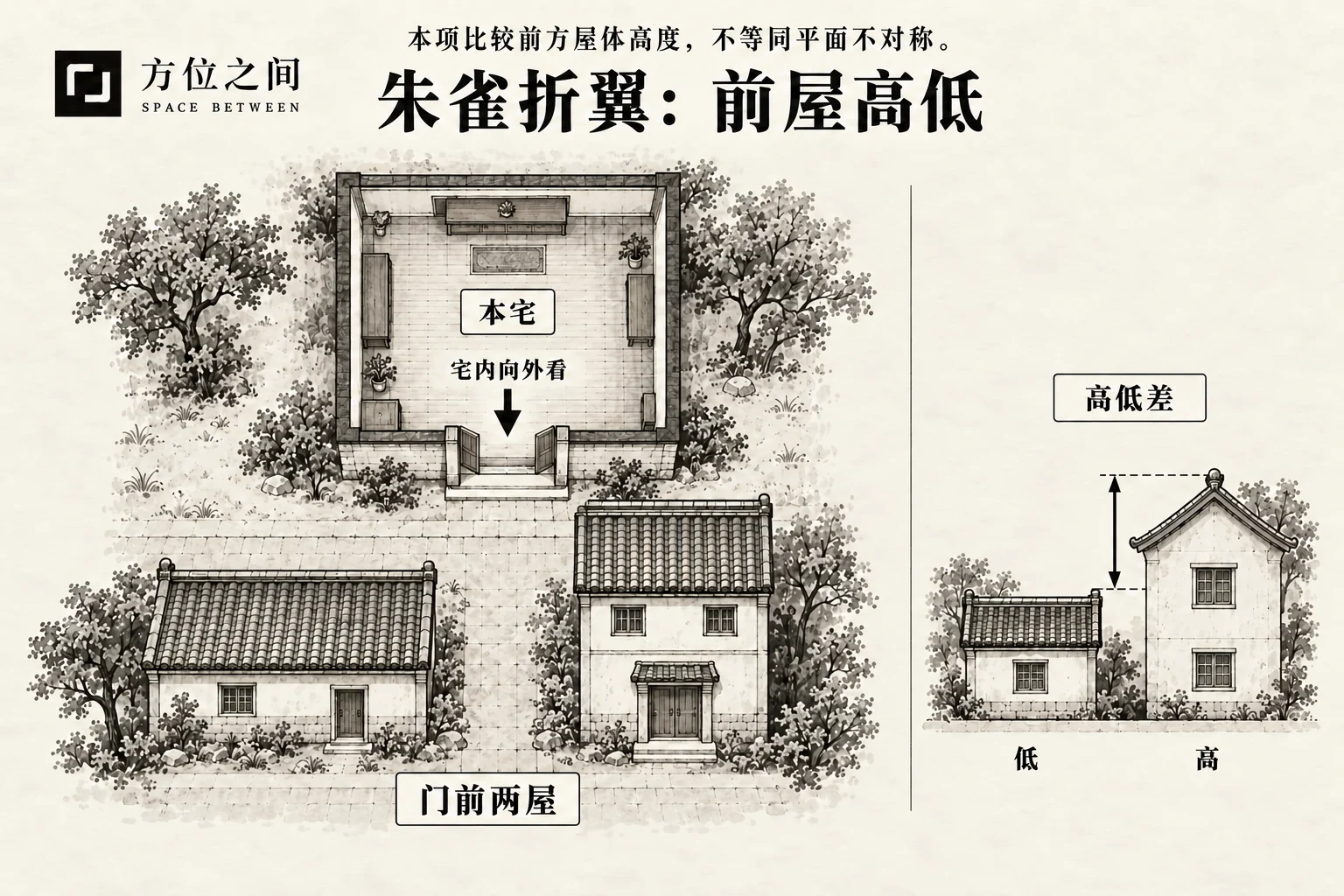
Item 45 of this list uses Vermilion Bird with a folded wing for unequal heights of two buildings or segments on the two sides of the home’s front. It compares building masses, not the total area of a plan or foundation settlement. First establish that both objects are in the forecourt, then record their heights.
How to identify and record it
Mark the home’s orientation and the two front buildings in plan, then compare eaves and ridges against a common datum. If the ground levels differ, record ground and building heights separately rather than drawing terrain variation as structural damage.
- State whether these are independent buildings or two segments of one structure.
- Record floor, eaves and ridge levels on both sides and their distance from the home.
- Check whether the higher part actually affects light or openings and whether the lower part serves a valid function.
Sources, versions and related names
This entry follows the supplied unequal-front-building-heights definition. The list’s other Vermilion Bird folded-wing wording describes broader left–right asymmetry, not height alone. Similar words for wings do not prove identical conditions or justify merging the observations.
Folk meanings and limits of interpretation
Folded wings and broken feet personify imbalance through an incomplete body. These names cannot predict actual limb injury, illness or interrupted careers, and should not condemn ordinary staggered building design as inherently harmful.
Practical observation: what determines the effect
Check light, sightlines, circulation and roof-water paths in the forecourt. Different heights may serve different uses or fit the site. A specific obstruction, drainage or usability problem defines the improvement target; simply aligning two roof ridges does not establish improvement.
Improvements and what they cannot replace
Prioritize activity locations, lighting and reversible layout changes. Repair actual roof leaks or junctions where needed. Adding storeys, lowering roofs or changing structure merely to achieve equal height may fail to solve the problem and harm existing conditions.
- Record height differences and functional differences in the same observation sheet.
- Keep maintenance access and necessary openings, avoiding additional obstruction.
- Do not merge foundation repairs and height changes into one supposed “restoring the feet” method.
Sources and further reading
These sources help clarify the concepts and their origins. Explaining a traditional term does not establish that it can predict outcomes.