
Read each entry
Open a name for its meaning, identification, diagram and practical responses. Different meanings of the same name are distinguished.
- Taller Side Wings (Qizhu)
- Small Side Wings (Hanjian)
- Absent Central Hall (Wuyi)
- Near Facing Buildings (Cixiong)
- Distant Facing Buildings (Cile)
- Natou: high-building wording variant
- Mingtang Sha
- Rear Ridge Alignment (Anjian)
- Oblique Frontal Ridge (Cimian)
- Ciji: rear oblique alignment
- Prison Sha
- Small Buildings at Both Ends (Dingtou)
- Gugua ShaFacing Front or Side Annexes
- Four-harms Sha
- T-Shaped House (Dingzi)
- High Middle Segment (Qubei)
- Low Middle Segment (Zheyao)
- Zhongtou: low-gate wording variantUndersized Doorway (Chuitou)
- Stepped Row of Houses (Lixiang)
- Rear Small Annex (Shiqi)
- Exposed-wind sha
- Rear Chain of Small Rooms (Dandan)
- Huanqi: rear-annex wording variantLateral Rear Annex Row (Tanqi)
- Small Front Building (Xuhao)
- Ting Jiu sha (vacant-house analogy)Dilapidated houses: appearance and safety
- Long Low Side Wings (Tuiche)
- Long Equal-Height Wings (Shenshou)
- Front Higher than Rear (Guotou)
- Hanxiong: frontal obstruction variantFrontal Obstruction (Saixiong)
- Guasu: isolated-height sceneIsolated-tower Sha
- Shared Hall and Sleeping Use (Mojian)
- Guzhang: front-bedroom wording variantFront Sleeping, Rear Reception (Guchen)
- Reception in the Center (Duozhu)
- Rear-Attached Side Wings (Fanshou)
- Front Left End Outward (Qinglong Fanshou)
- White Tiger outward turn (Luantou variant)Front Right End Outward (Baihu Wantou)
- Vermilion Bird protruding tongue
- Black Tortoise refusing the body
- Azure Dragon envying the host
- White Tiger holding a body
- Vermilion Bird open mouth
- Black Tortoise hidden head
- Azure Dragon without feet
- White Tiger without feet
- Vermilion Bird broken wing
- Black Tortoise broken footBlack Tortoise broken foot: unequal rear building heights
- Azure Dragon broken arm
- White Tiger broken arm
- Detached Single-Room House (Kongwang)
- Xupi: vacant-neighbor wording variantNeighboring Empty Rooms (Xulao)
- Exterior Side Stair (Liuyi)
- Dingdao Longchun ShaDingdao Longchun Sha: the building-row version
- Unresolved Boat or Boat-House Form (Zhangchun)
- Gugua ShaWaterside Pavilion in Front
- Chicken-beak corner (wording variant)Sharp-corner Sha
- Azure Dragon peeking
- White Tiger peeking
- Vermilion Bird falling into a well
- Black Tortoise falling into a well
- Azure Dragon open mouth
- White Tiger open mouth
- Vermilion Bird holding tears
- Black Tortoise holding tears
- Azure Dragon lowering its head
- White Tiger lowering its head
- Vermilion Bird scratching its head
- Black Tortoise scratching its head
- Azure Dragon broken waist
- White Tiger broken waist
- Vermilion Bird broken wings
- Black Tortoise broken wings
- Azure Dragon without a head
- White Tiger without a head
- Vermilion Bird without a head
- Black Tortoise without a head
- Azure Dragon broken foot
- White Tiger broken foot
- Vermilion Bird broken foot
- Black Tortoise broken footBlack Tortoise broken foot: rear foundation settlement
- Incomplete four-symbol shelter
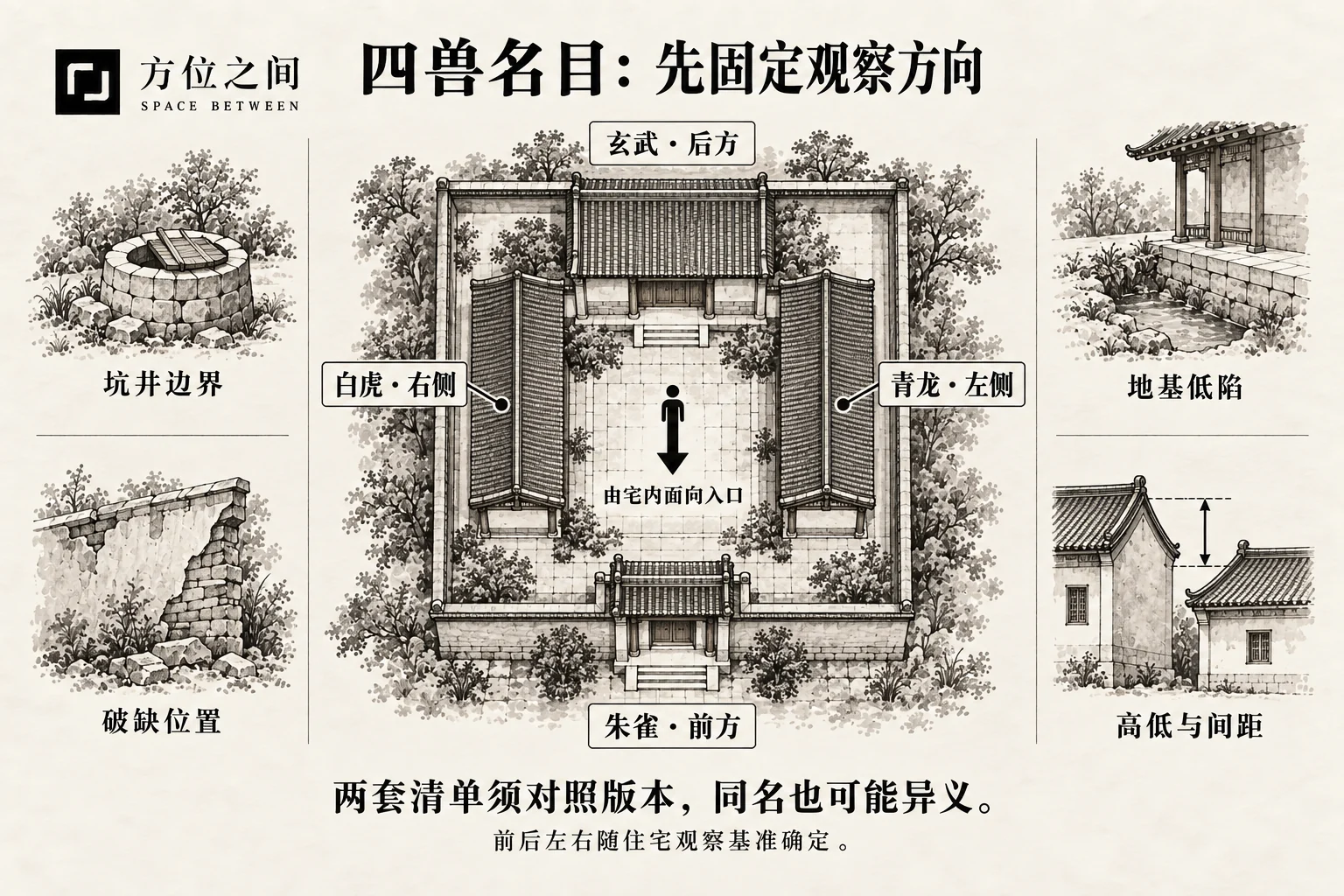
Fix front, back, left and right before using the four symbols
Here, left and right are established while looking outward from the dwelling along its main facing direction, marked on the plan. Front, rear, left and right correspond to Vermilion Bird, Black Tortoise, Azure Dragon and White Tiger. If a source uses a burial site or another axis, record that reference separately.
Dili Nangjin Jizhu treats the four symbols as metaphors of shelter, not literal animals. Yusui Zhenjing also notes that names need not have equal totals. Eighty is therefore not a naturally complete standard, and terms like broken arm, foot or head are not illustrated as bodily injuries.
Three important differences between old texts and this list
The historical passages concern burial-landform relationships, not a modern table of building heights. These three names have textual counterparts, but the submitted list simplifies them substantially.
- Black Tortoise refusing the body: this list says no rear support; the historical passage instead describes an elevated rear landform that does not descend toward the site. Absence and over-elevation are not the same scene.
- Azure Dragon envying the host: the submitted wording is left higher than right; the old text describes a resistant, crouching left landform. A pair of unequal buildings does not establish that complete historical shape.
- White Tiger holding a body: this list says right higher than left; the source describes a raised, crouching right landform facing the site. It does not designate every taller right-hand building or predict a death.
Height, enclosure and scale
Read these scenes as submitted descriptions. Compare heights from a common ground datum, with distances, openings and periods of obstruction; left-high/right-low alone is insufficient.
Respond to actual shading, constricted access or local wind conditions through room use, lighting and movable screening. Do not extend or alter buildings merely to make one side higher.
- Prison and Exposed-wind sha: the list compares a low home with high “beasts,” or the reverse. Whether beasts mean landforms, neighbors or wings must be established first; the names neither predict imprisonment nor measure wind.
- Four Harms: a low dwelling amid higher neighbors, comparable to the enclosure discussed under Guyin; daylight still depends on spacing and openings.
- Azure Dragon or White Tiger lowering its head: respectively a low left or right building; a single side is not identical to Hanshoulder, where both sides are low.
- Vermilion Bird broken wing and Black Tortoise broken foot (item 46): uneven building heights at the front or rear. These concern massing; item 79 uses the same Black Tortoise name for rear ground subsidence.
Gaps, asymmetry and interrupted connections
Distinguish intentional openness, unfinished construction, removal and actual damage. All may look like gaps from above, but their significance differs. A missing wing does not imply a missing family role.
Check clear boundaries, detours and drainage pockets. Improve paths, boundaries, drainage and functional zones first; construction for symmetry must not sacrifice daylight or safe access.
- Azure Dragon or White Tiger without feet: an absent building or gap on the left or right. Compare Louqi, while recognizing that an unbuilt space is not necessarily damaged.
- Azure Dragon or White Tiger broken waist: interruption in a side wing; establish whether these are separate buildings or a damaged formerly continuous structure.
- Vermilion Bird or Black Tortoise broken wings: general front or rear asymmetry, broader than the height inequality assigned to the similar broken-wing name; do not force them into one exact shape.
- Azure Dragon or White Tiger without a head: the list says no principal building on one side. Clarify whether principal means the main hall or a side-wing body; this is not automatically the unbuilt-main-hall Wuzhu scene.
Dilapidation, breaks and “open mouth”
Dilapidation is observable, but “open mouth” elsewhere may refer to an elevator doorway. State the damaged building’s position and affected components rather than relying on the shared word.
Record loose parts, surface loss, cracks and effects on access. Falling-material concerns or possible structural changes need assessment, protection and repair by the responsible party; screening cannot repair a building.
- Vermilion Bird open mouth: a dilapidated building in front, comparable to Tingjiu and the dilapidated-house entry, not elevator-facing Open-mouth sha.
- Azure Dragon or White Tiger open mouth: a damaged building to the left or right. Position differs, but maintenance assessment does not depend on symbolic side.
- Azure Dragon or White Tiger broken arm: breaks in the left or right building, comparable to the respective Posui scenes. The wording does not predict a resident’s bodily injury.
Facing buildings, projecting wings and rear annexes
Mark projection direction in plan: forward extension, inward turn, outward turn or a rooftop element. Peeking, extended-wing and rear-annex scenes involve different heights and connections.
Check encroachment on paths, obstruction of openings and close sight lines. Furniture, curtains and routes may help with use; alterations to the building require checking ownership, construction and actual effects.
- Mingtang and Vermilion Bird protruding tongue: facing linear buildings before a hall or door, comparable to frontal-building scenes. If only a ridge aligns, use the ridge entry instead of treating the whole building as the object.
- Azure Dragon or White Tiger peeking: in this list, a left or right wing projects. Compare extended-wing scenes, not a rear rooftop visible above a front building.
- Black Tortoise hidden head: a rear annex in this list, comparable to Shiqi. Historical landform uses differ; one annex diagram cannot establish every older meaning.
Incoming water, pits and physical boundaries
Determine flow from slope, direction and observed traces; still water is not an arrow aimed at a house. Distinguish excavation pits and well openings from light courts or gaps in a plan.
Check where water drains, whether rain reaches used paths, and whether pits or wells are visible and protected. Do not enter or fill an unknown opening; the responsible manager should establish its use and maintenance, with drainage or foundation issues assessed appropriately.
- Vermilion Bird or Black Tortoise holding tears: direct incoming water at front or rear in the submitted list. Compare direct-flow water, while preserving distinctions from historical weeping-water imagery.
- Vermilion Bird falling into a well and Black Tortoise falling into a well: a front or rear pit or well. Record its location, known depth, protection and routes; the terms do not predict a fall.
Loose stones, ground depression and conflicting names
Landscaping stone, temporary stockpiles, loose slopes and subsiding foundations are different objects. Establish stability and change over time before considering access, drainage and maintenance.
Remove movable clutter that blocks access. Rockfall, continuing depression or nearby structural change calls for professional assessment. Covering or filling solely for appearance may hide areas that need monitoring.
- Vermilion Bird or Black Tortoise scratching its head: irregular stone at front or rear. Identify landscaping, construction material or a natural slope rather than inferring fortune.
- Azure Dragon, White Tiger or Vermilion Bird broken foot: ground or foundation depression at left, right or front. These concern ground conditions rather than height rankings.
- Black Tortoise broken foot (item 79): rear ground depression, whereas item 46 uses the same name for unequal rear building heights. Search can preserve both, but text and images must identify the intended meaning.
Front and rear landforms and “incomplete four symbols”
Front and rear supporting landforms belong to traditional landscape language; they are not mandatory fixtures for every urban dwelling. Openness can provide views and daylight rather than automatically imply lost protection.
Observe exposure, wind, shading, privacy and neighboring uses. Choose appropriate curtains, landscaping or boundaries where needed, without constructing obstacles merely to complete four symbolic sides.
- Vermilion Bird without a head: no front landform; Black Tortoise without a head: no rear supporting landform. These differ from the principal-building wording assigned to Azure Dragon and White Tiger without a head.
- Incomplete four symbols: the list describes no surrounding shelter. Specify whether shelter means landforms, buildings or perceived enclosure; four open sides do not automatically establish physical danger.
Eleven wording variants and object differences
These items have existing counterparts, but similar wording is not proof of complete equivalence. New terms remain searchable while the observable object defines the limits of comparison.
- Natou / Motou: this list says a high main building and low hall, while the existing entry emphasizes the gatehouse. Main building and gatehouse are different objects.
- Ciji / Cibei: both involve a rear oblique alignment, but specify ridge, building or other object.
- Zhongtou / Chuitou: both lists describe a low gate relative to the house despite apparently opposite names. Preserve the wording rather than inventing another shape.
- Huanqi / Tanqi: both concern rear crosswise annexes; wording differs and does not determine a resident’s emotional outcome.
- Hanxiong / Saixiong: both concern frontal building obstruction; distinguish whole-building shading from a ridge or pillar alignment.
- Guzhang / Guchen: compare the front-bedroom/rear-hall sequence without equating it with astrological Guchen.
- White Tiger Luantou / Wantou: compare the outward-turning right-front cross-building while retaining the variant characters.
- Xupi / Xulao: this list describes empty buildings on both sides; older wording may specify one side. Record vacancy and maintenance, not a disease inferred from the word.
- Dingdao Longchun: a row of buildings and an ornamental gateway are materially different. Retain the submitted row-of-buildings wording as a variation; a gateway image does not prove it.
- Gugua: item 13 means facing small buildings, while item 54 means a waterside pavilion; consult the separate entries.
- Jijui / Jizui: both refer here to a building corner facing a window; compare the sharp-corner entry rather than inventing separate outcomes.
How to continue with entries already covered
Qizhu, Hanjian, Wuyi, Cixiong and Cilei concern main halls and neighboring buildings; T-shaped houses concern connected plans; Qubei, Zheyao, Lixiang and Guotou concern height sequences. Shiqi, Dingtou, Dandan and Xuhao concern annexes; Tuiche, Shenshou and Fanshou concern wings, while Azure Dragon Fanshou concerns a cross-building turn.
Read Guasu as isolated height; Mojian and Duozhu as room use; Kongwang as a single isolated room; Liuyi as exterior stairs; and Zhangchun as a boat-related frontal scene. Existing entries retain their identifiers, without duplicating images solely for a new list number.
From a sha remedy to an observable change
Record relative position, physical object, distance, change and actual difficulty before selecting a response: daylight for shading, maintenance for damage, drainage for water, protection for openings and functional access for gaps. Multiple names should not create duplicated or contradictory work.
Traditional predictions can be discussed as historical ideas, not judgments about character, marriage or illness. Objects, mirrors or symbolic support cannot be promised to solve physical problems; structural and ground concerns require appropriate assessment.
Sources and further reading
These sources help clarify the concepts and their origins. Explaining a traditional term does not establish that it can predict outcomes.