
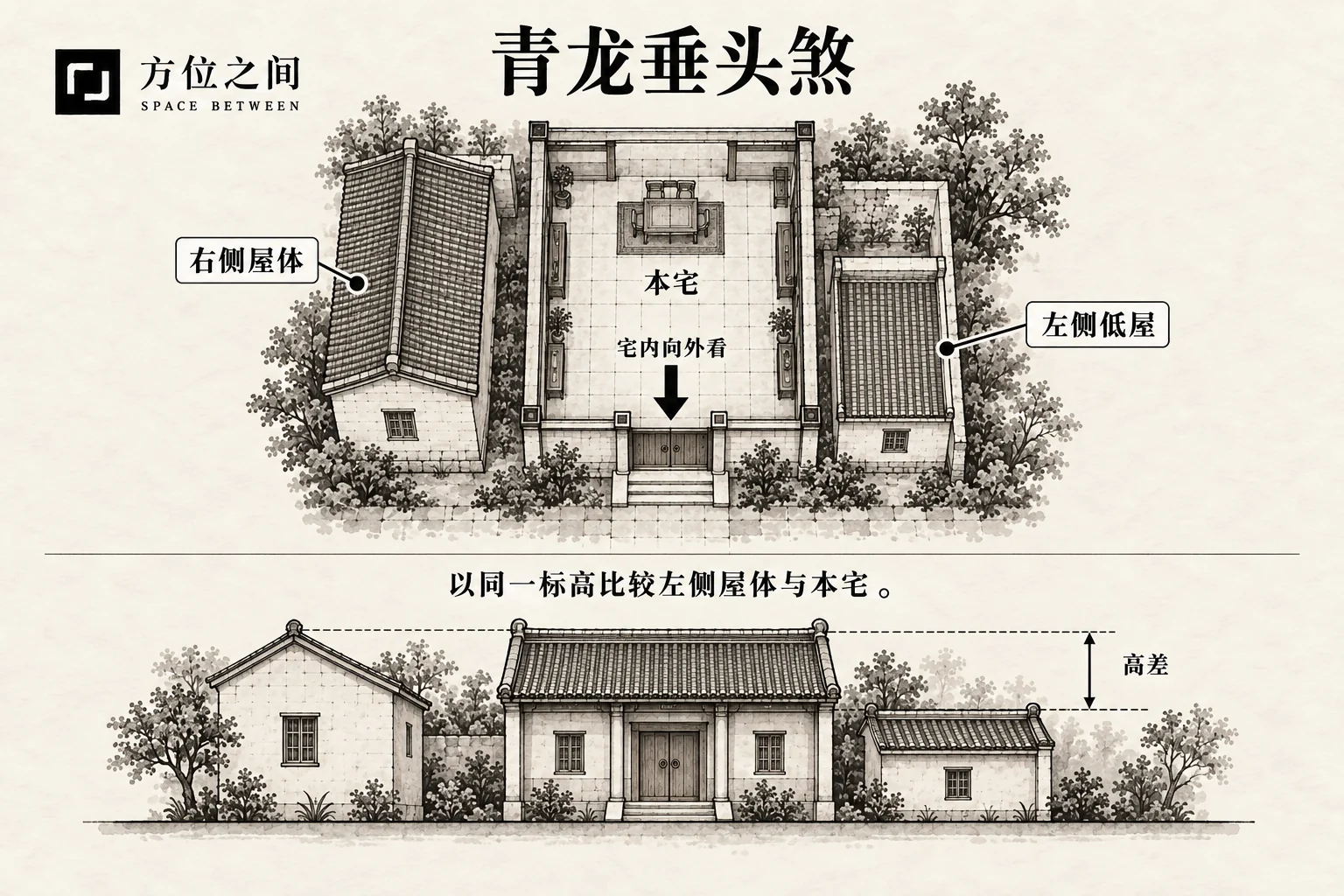
Name and specific form
In this list, Azure Dragon lowering its head describes a low building on the left. Lowering the head is a posture metaphor, not evidence that a roof is sagging or a component has deformed. Specify whether low means relative to the main house, the opposite building or surrounding terrain so the comparison can be checked.
How to identify and record it
Define left while looking outward from the home, and record heights against a common ground datum. A gatehouse, store or canopy may reasonably be lower because of its use. Different functions need not satisfy one imagined ideal height.
- Record ground-level differences, eaves height and ridge height separately.
- Document the lower part’s use, openings and actual access conditions.
- If settlement or deformation is suspected, separately record cracks, timing and change instead of only writing “lowered head.”
Sources, versions and related names
This list records the low left building separately as Azure Dragon lowering its head, without a universal size threshold. The older cold-shoulders entry describes a higher center and lower buildings on both sides. A low right can be recorded too, but one-sided and two-sided conditions should remain distinguishable.
Folk meanings and limits of interpretation
The lowered-head image can suggest submission or weakness in folklore, but remains symbolism about appearance. It does not establish a relative’s low status, poor spirits or blocked future, nor turn maintenance problems into proof of fate.
Practical observation: what determines the effect
A lower side building may give the main house more visible sky or maintain a comfortable courtyard scale; low clearance and poor light may also affect the side building itself. Separate benefits to the main home, annex usability and maintenance rather than pursuing a symmetrical silhouette alone.
Improvements and what they cannot replace
For real inconvenience, first improve lighting, storage and routes, then decide whether the use requires professional alteration. Do not add a storey or roof load simply to raise a metaphorical head. Actual deformation belongs in a building inspection.
- Preserve sensible functional differences instead of rebuilding for appearance alone.
- Check roof drainage and maintenance access and record genuine defects.
- Do not promise that raising one side will improve family fortune.
Sources and further reading
These sources help clarify the concepts and their origins. Explaining a traditional term does not establish that it can predict outcomes.