
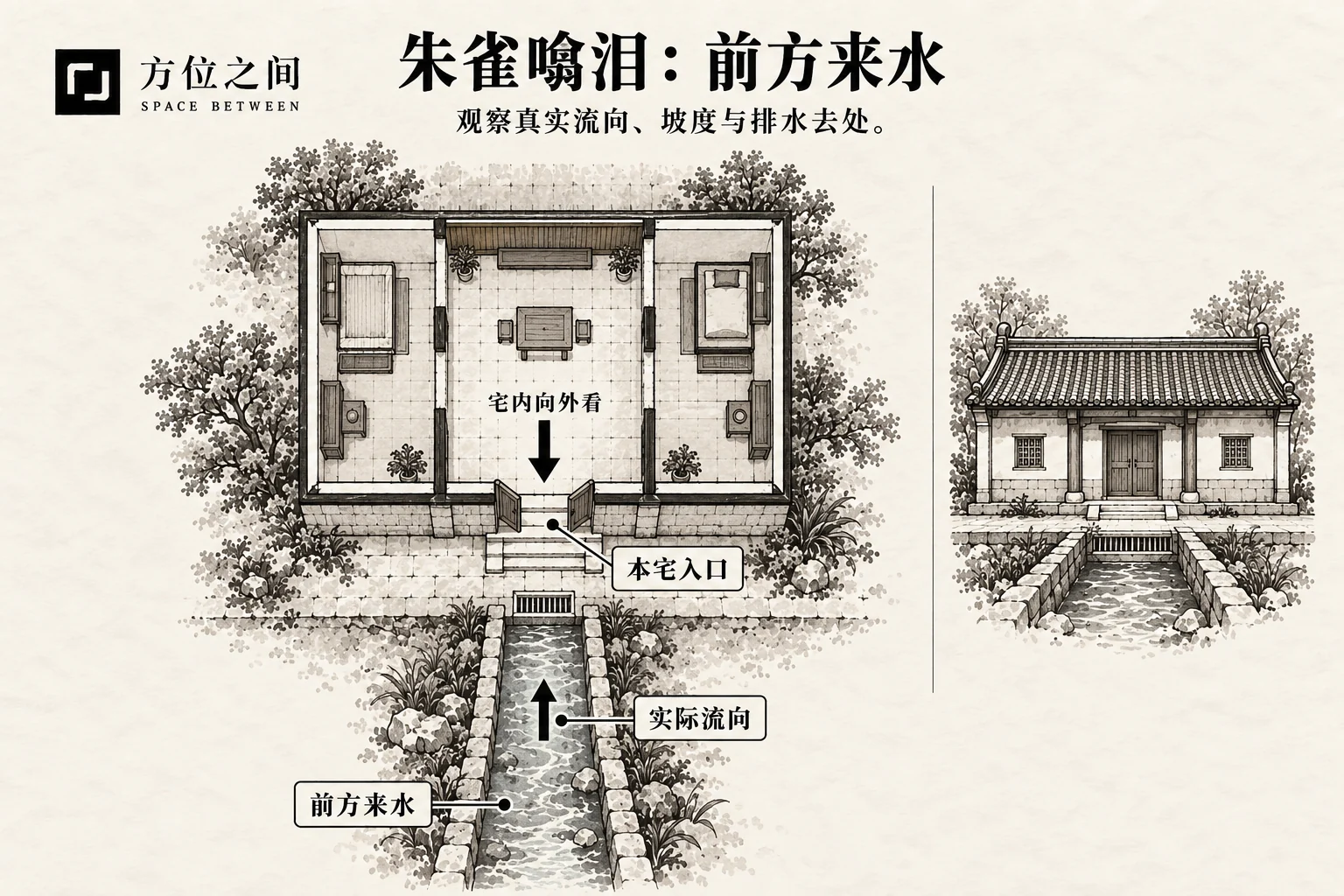
Name and specific form
This list uses Vermilion Bird holding tears for water coming directly toward the home from the front. There must be an observable flow direction. A pond, fountain or reflection on that side alone is insufficient. Identify the water source, path, collection point and time of occurrence.
How to identify and record it
Mark ground slopes, channels, outlets and openings on the front, then safely inspect traces left by rain or normal operation. Still water must not be drawn as an arrow shooting at the house. A drainage channel in a photograph does not itself establish flow toward the building.
- Distinguish a river, rain runoff, equipment discharge and eaves runoff.
- Record where water actually goes and whether it collects at the entrance, wall base or path.
- State whether it occurs only in heavy rain or continuously, retaining observation dates.
Sources, versions and related names
This page follows the supplied modern definition of Vermilion Bird holding tears; related checks can be compared with the water-facing entry. Older Vermilion Bird weeping language may concern water shape or sound. Shared tear imagery does not establish synonymy, and no universal speed or distance threshold has been verified for this name.
Folk meanings and limits of interpretation
The tear metaphor links water to crying through personification. It does not establish future grief, bereavement or financial loss, or make water from one direction inherently harmful. Cultural explanation can describe the imagery without turning it into a certain future event.
Practical observation: what determines the effect
Observe whether water enters used space, makes paving slippery, repeatedly collects at walls or affects nearby facilities. A small managed drain and fast eroding flow are different situations. Flow path, terrain and facility condition should determine the assessment.
Improvements and what they cannot replace
Identify the source, responsibility and proper drainage path first. Safely maintain accessible outlets and check existing systems. Persistent erosion, leakage or unusual conditions near foundations require relevant expertise. Placing a stone that redirects water toward a neighbor is not a solution.
- Revisit the same position before and after rain and record whether changes work.
- Keep routes legible and avoid blocking drains with screening.
- Ornaments, mirrors and arrows on a diagram cannot replace management of water flow.
Sources and further reading
These sources help clarify the concepts and their origins. Explaining a traditional term does not establish that it can predict outcomes.