
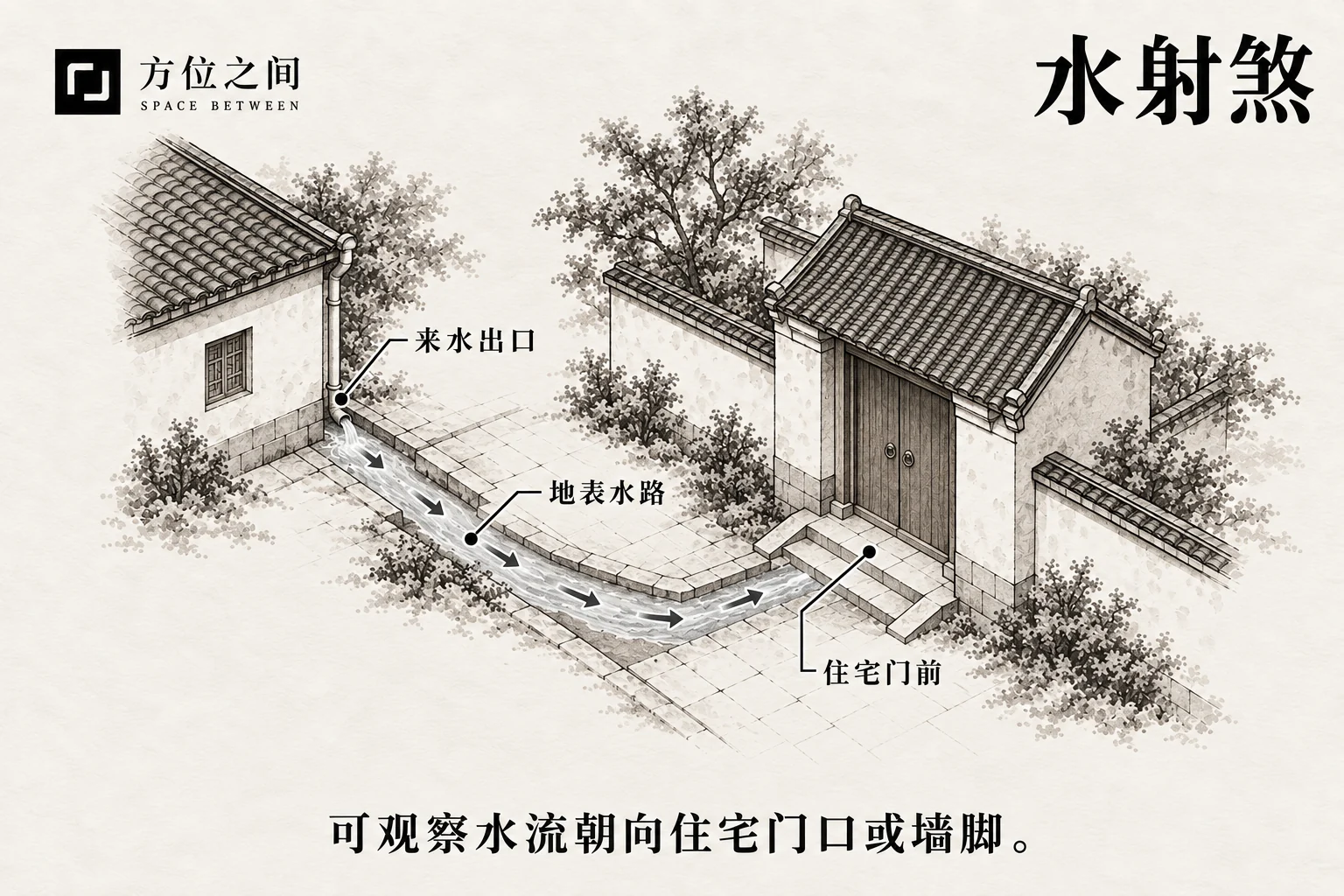
Name and background
These names emphasize flow directed toward occupied space. Old accounts include water at doors and between eaves; local usage may call a channel toward a house corner a water-arrow. Objects differ, but direction is the common feature, not that all water is inauspicious. Specify the flow and affected entrance.
Typical form and comparisons
Typical forms include downpipes discharging toward an opposite door, slope runoff gathering at a gate, or channel outflow continuing toward a wall base. Show levels, entry points, and downstream outlets; an arrow through a house alone cannot explain the water path.
A channel may run parallel along the street, or water may enter a functioning drain before reaching the doorway. Direction, volume, and drainage capacity all matter: a drip, brief splash, and sustained storm runoff need different responses.
Traditional reasoning and modern observations
Traditional imagery compares direct rushing water to an arrow and favors a turning or collecting flow rather than one pressing at the door, linking it with household unease. Water’s favorable wealth symbolism does not mean every flow should be brought to the entrance, nor that drains should be blocked to avoid water-arrows.
Modern checks ask whether water crosses a threshold, erodes ground, creates slipping surfaces, or enters joints. Hong Kong seepage guidance lists supply and drainage pipes, waterproofing, roofs, and windows, so wall stains need not originate in an outside channel. Trace flow and building defects separately.
How to identify it
Identify drainage in dry weather and verify paths during rain from indoors or safe shelter. Do not enter water of unknown depth or speed or open drain covers during a storm.
- Draw the route downstream from roofs, downpipes, channels, and ground slopes, noting turns and drains intercepting flow before the entrance.
- Record onset, heavier rain, and after rain, comparing threshold, wall-base, and yard marks rather than treating one maximum flow as year-round conditions.
- If stains do not track rain, or change despite shutting a water supply, seek professional pipe and waterproofing investigation rather than assuming the outside channel is the source.
Common points of confusion
Foot-cut concerns proximity to a water edge, reverse-bow the outer curve, and water-directed sha the flow direction. Record these separately without adding harms. A fountain may be a recirculating feature and a pipe leak hidden inside a wall. An eave pointing toward a window without water flowing there remains a visual relationship.
Effects described in traditional beliefs
Volume Five of Duoneng Bishi lists water directed at doors and between eaves as taboos. A Taiwanese local record describes a resident placing a Shigandang marker because a channel faced a house corner, showing continued water-arrow belief. These document protective belief, not causal effects on family fortune or personal outcomes.
- Household dispersal and harm: the old doorway-water belief links family separation and bodily harm, expressing apprehension about direct water pressing at the entrance.
- Harm from eave water: the text distinguishes outward and inward flow to identify the imagined affected side; merely seeing a neighboring eave does not fit this account.
Traditional remedies and practical improvements
The practical aim is to collect and drain water properly and repair weak points. Traditional turns, boundaries, and Shigandang markers provide cultural context, but should not compromise public drainage or divert water onto neighbors.
- For downpipes discharging toward an entrance, have the responsible party check connections and discharge points and connect to appropriate drainage for the site.
- Have maintenance staff clear blocked channel inlets and check downstream blockages; clearing one segment while water pools elsewhere is incomplete.
- For seepage at thresholds or window-wall joints, distinguish external rain from pipe or waterproofing defects before repairing the relevant point, rather than repeatedly coating the stain.
- When pooling affects customers, adjust waiting and delivery routes and deal with slippery areas while arranging grading and drainage repairs. Mats must not cover inlets or jam doors.
- If retaining a Shigandang marker or other protective ornament, keep it secure and clear of water and access as local culture. Drainage remains the job of the infrastructure, not a newly purchased ritual substitute for repair.
Illustrative example
Hypothetical example: at a hillside home and small shop, a neighboring downpipe feeds a shallow channel past the door. It drains normally but pools at the threshold in heavy rain. Investigation finds packaging blocking the downstream inlet and a sunken paver. The responsible party clears and repairs these and checks the pipe connection; waiting moves to a dry area. The next rain is used to recheck the same path, rather than judging success by a ritual object beside the door.
Sources and further reading
These sources help clarify the concepts and their origins. Explaining a traditional term does not establish that it can predict outcomes.