
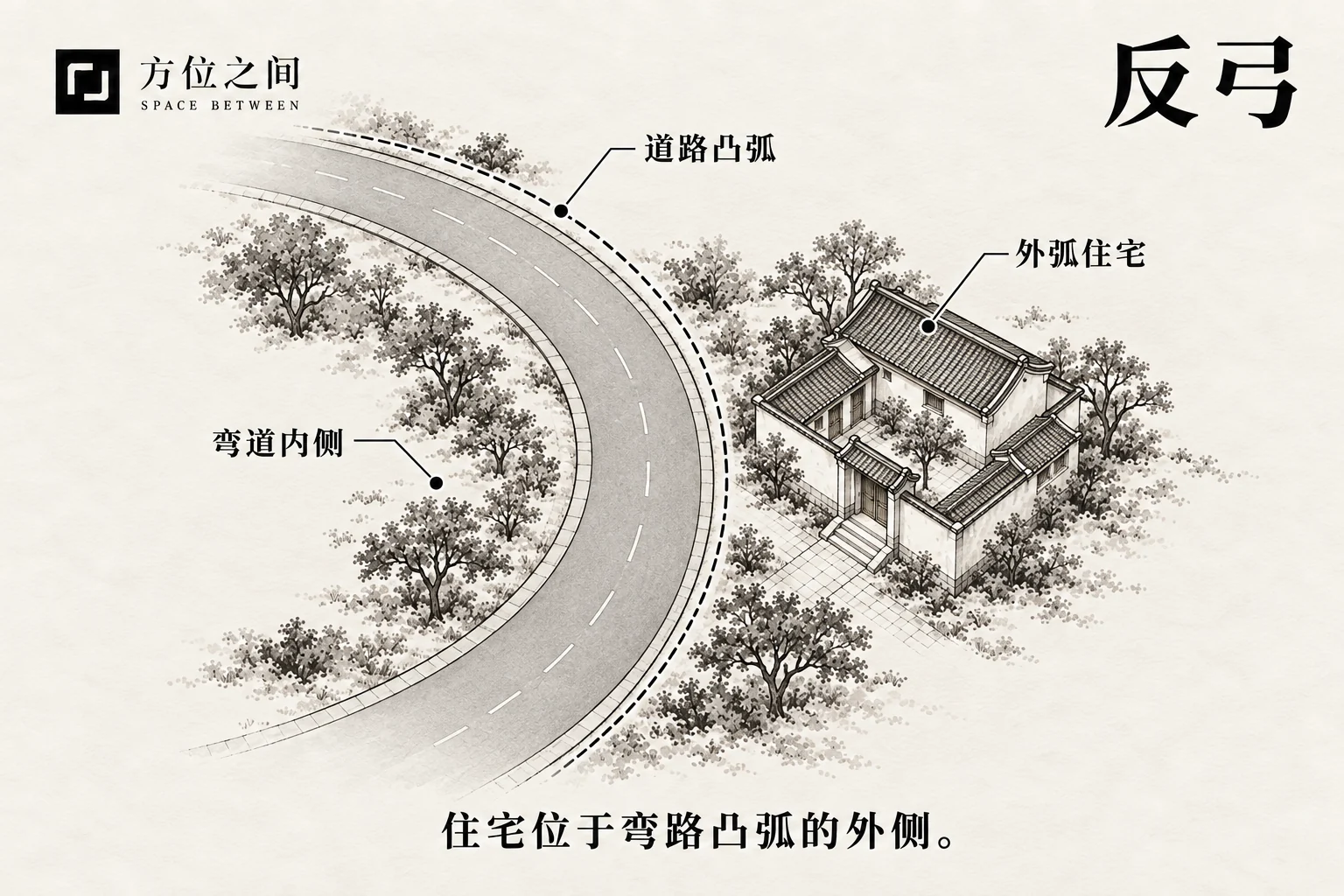
Name and background
The key is the bow’s back facing you, not traffic moving in reverse. Imagine a bow: on the string side, its curve seems to enclose you; on the back side, it bulges toward you. The latter is the form discussed here. Roads and water share this shape metaphor, but traffic and river levels need different responses.
Typical form and comparisons
Typically, the home is outside a bend, with the nearby road bulging toward it and the centre of curvature on the opposite side of the road. A home on the centre-of-curvature side instead sees a concave, enclosing form. Use a continuous curve as the reference, not a short kerb or isolated roundabout fragment. On an S-bend, the same home may lie on different sides of different curve segments.
Traditional reasoning and modern observations
Traditional reasoning contrasts caring enclosure with an indifferent outward turn. The inner curve seems to look back toward the home; the outer curve seems to pass and leave. These images underpin ideas of retention versus dispersal, including the financial and interpersonal readings below. The concern is a lack of gathering and support in front of the home, not a new sha for every curved line.
Spatially, a bend changes the angle between vehicles and windows, so headlights may sweep indoors at particular times. Traffic sound also depends on traffic volume, setback, terrain and barriers. Being outside a bend does not automatically mean high speeds, noise or danger. Beside water, examine local levels, drainage and banks rather than transferring traffic judgments.
How to identify it
First distinguish the inside and outside of the curve, then check the home’s distance and elevation. Do not decide from a single window-view photograph.
- Trace the whole bend and use short radius lines to indicate the centre-of-curvature side. Mark whether the home is outside the convex edge or inside the concave edge; traffic direction does not define this.
- Mark the nearest road edge, doors, windows, garden and levels; verify barriers, acoustic structures and vegetation on site. Record a distant outer curve differently from one beside a window.
- From a safe location, observe the regular entrance and crossing route, and record lights, noise and open-window conditions at different times. For a watercourse, record the bank and authority information separately rather than borrowing road conclusions.
Common points of confusion
Sickle sometimes names the same form and sometimes a curved flyover close to windows. This guide uses reverse bow for inside–outside geometry and sickle for distance and floor height. Both descriptions can apply to one place from different viewpoints. Inner bends, circular flowerbeds and traffic-free plazas require their own context.
Effects described in traditional beliefs
Traditional effects centre on failure to gather and turning away. These are folk interpretations, not causal evidence. The Illustrated Account of Reversing Water Forms in Gujin Tushu Jicheng describes water “like a reversed bow” and failing to gather qi, linking it to decline and separation. Its original setting is water around geomantic burial sites; present-day road readings extend the imagery.
- Finances and business: money is said to be difficult to retain, with income quickly going out and temporary bustle failing to become lasting accumulation. The emphasis is on keeping gains, not merely receiving them.
- Relationships and family: turning away is associated with outward-looking loyalties, distance and weak support. Exaggerated older language about flight and separation reflects anxiety about family cohesion, not grounds for accusing a person of betrayal.
- Household continuity: older readings particularly fear initial prosperity followed by decline. In everyday terms, they express concern that favourable conditions may not last, rather than predicting an event a set number of years after moving in.
Traditional remedies and practical improvements
Choose the actual issue first, then decide whether to screen, redirect or add a buffer. These options need not all be used.
- Homes with a front garden: retain separation between the road and living areas. Low hedges, open fencing or an internal screen can organise views and create a pause before the door. Keep bends and access points visible; the aim is relief from proximity and a better transition.
- For a home or shop entrance beside the bend: a suitable side entrance can allow a turning route within the plot. Keep the shopfront visible; put the till and waiting seats on a quieter indoor side clear of circulation, leaving turning space at the door. Address direct views and entry crowding without sending customers on a detour.
- For actual headlights or overlooking at a window: adjust blinds, translucent curtains and seating to screen the source while keeping daylight. A distant visible curve without disturbance may need only a more comfortable view, not sealed windows or high walls.
- For traffic noise affecting rest: assess acoustic windows, sealing and ventilation for that room, and consider a quieter bedroom position. Hedges primarily organise boundaries and views; they are not engineered noise barriers or vehicle protection.
- For a traditional protective custom: a securely placed Shigandang or similar symbol in private space can express that wish as a general junction custom. No special reverse-bow object is required. Avoid reflecting strong light onto roads or neighbouring windows; waterside homes still need drainage and bank maintenance.
Illustrative example
Illustration, not a measured case: two houses flank one bend. House A is outside the curve with a garden setback; house B is inside but directly beside the carriageway. A can be classified as a reverse-bow relationship without concluding it is noisier or more dangerous than B. Check each home’s windows, barriers and entrance and compare conditions at similar times; a plan label is not an environmental measurement.
Sources and further reading
These sources help clarify the concepts and their origins. Explaining a traditional term does not establish that it can predict outcomes.