
Name and background
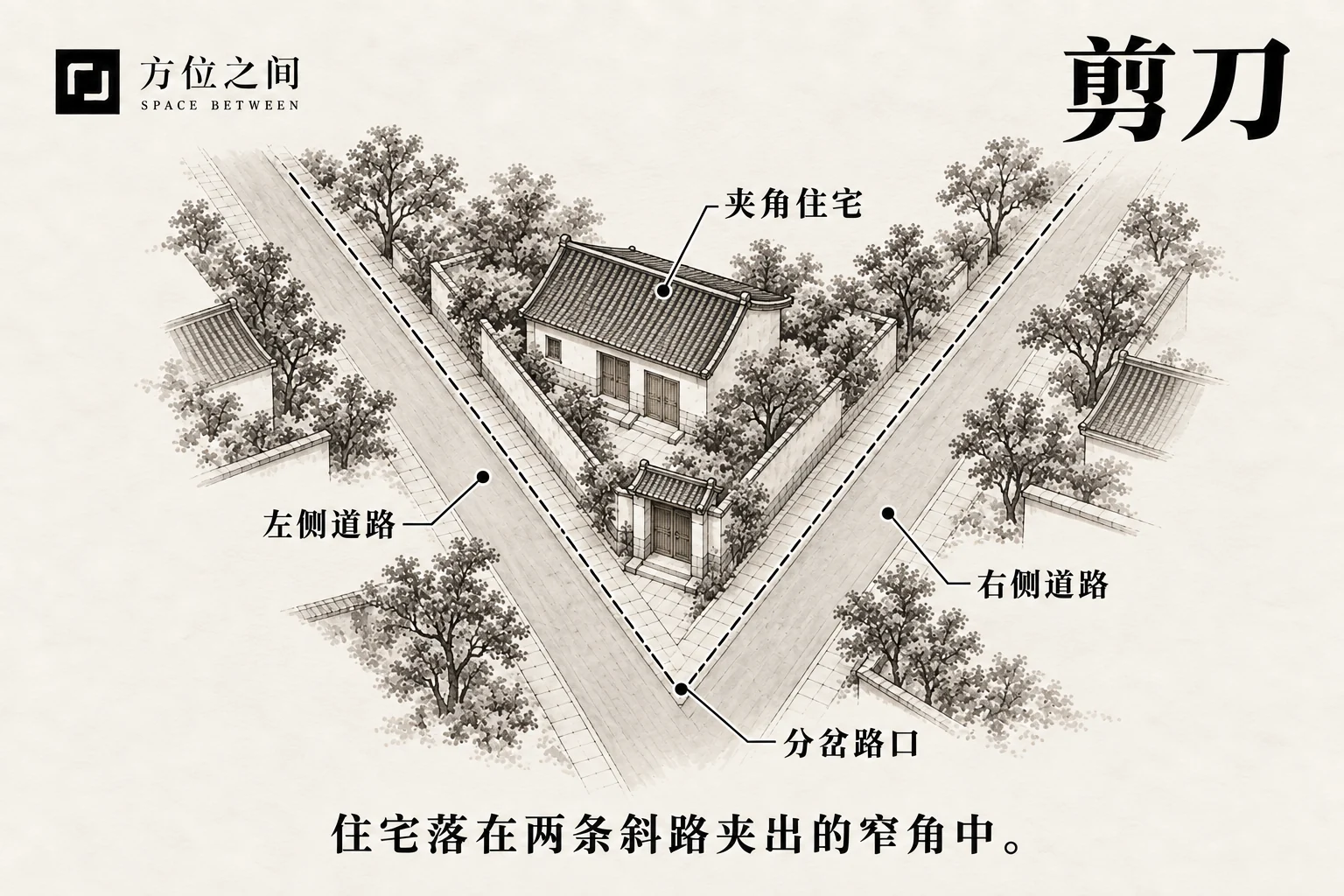
Scissors roads and a dwelling between two roads name this geometry. The older phrase “crossing roads flanking a gate” concerns an entrance; modern scissors sha often includes the entire wedge-shaped plot. Shops may have display windows on two streets, but prominence, two street frontages and a constrained entrance are different conditions.
Typical form and comparisons
Locate the home relative to the fork. The narrow sector between the Y’s branches differs from the broad area outside them. The road intersection may be separated from the plot tip by a footpath, planting or verge. A building set back in the broad area, with only its garden extending toward the tip, has different entrance space from one built at the point.
A tip entrance often requires attention to both sides; a broad-side entrance may meet a continuous pavement. Shops also need to record customer approaches and delivery or unloading locations, not just sign orientation.
Traditional reasoning and modern observations
Traditional interpretation compares the two roads enclosing the site to two blades pressing inward, with particular attention to room for movement in front of the entrance.
The practical issue is how traffic on two roads meets a single entrance: turning, brief stops, crossing, and queuing may converge here. A junction may also have low speed controls, signals, and continuous footpaths. An acute angle therefore does not itself imply disorder, and its size cannot predict accidents.
How to identify it
Check the sector, entrance and circulation, then sound and light.
- Draw the complete network: both roads should flank the building; mark boundaries and setback to confirm it is inside the sector rather than simply facing a fork.
- Mark the main entrance: compare tip and side doors, recording door swing, pavement width and a place to pause, including existing planting and barriers.
- Follow real routes: household access or shop customers, deliveries and queues; record busy periods, headlights and sound separately for each side.
Common points of confusion
One road aimed at an entrance is direct-road alignment; two crossing roads need not form scissors unless they enclose the home. Triangular roofs, sloping walls and island tips are different objects. If one boundary is a garden path or green space, record it accurately rather than treating every line as a carriageway.
Effects described in traditional beliefs
Volume five of Duoneng Bishi mentions crossing roads flanking a gate. A modern authorised account by Yang Dengke specifically lists the following effects for homes within a Y-fork. These are folk predictions, not factual grounds for inferring injury, interpersonal conflict or business outcomes from road geometry.
- Accidental injury: the meeting blades are interpreted as vulnerability to injury or mishap, following the cutting metaphor.
- Discord and disputes: the account groups household disharmony, arguments and litigation, extending spatial pressure into interpersonal conflict.
- Unsettled occupancy and staffing: frequent moves and staff turnover are also named, linking the concern to stable homes and day-to-day shop management.
Traditional remedies and practical improvements
Traditional responses avoid the narrow opening and create a buffer; practical work addresses the entrance, waiting space and both street-facing boundaries.
- Choose access: where an existing side door reaches a continuous pavement, use that route to reduce direct entry at the tip; structural entrance changes require ownership and escape-route checks.
- Provide a pause area: create a short transition inside a home; place shop waiting, pickup and unloading where space and permission allow, away from the junction tip.
- Moderate screening: low planting or a screen within private space can soften the enclosed view while keeping access clear; preserve corner sightlines instead of blocking the opening with tall trees.
- Treat each side separately: blinds for lights on one side, seals and acoustic ventilation for persistent sound on the other; move bedrooms or shop consultation seats toward the quieter side.
- Reassurance customs: Shigandang is one junction object; an existing securely placed display can express protection and stability where permitted. It provides no collision, medical or business guarantee and does not require buying ritual goods.
Illustrative example
Illustrative case: a bakery occupies a triangular plot with planting at the tip and customer access on the broad right side, while delivery vehicles stop at the left corner. The scissors-shaped plot’s practical issues are unloading and queues. Moving pickup indoors, scheduling deliveries and preserving corner views help the shop; residents upstairs separately examine early noise at left-side bedrooms.
Sources and further reading
These sources help clarify the concepts and their origins. Explaining a traditional term does not establish that it can predict outcomes.