
Name and background
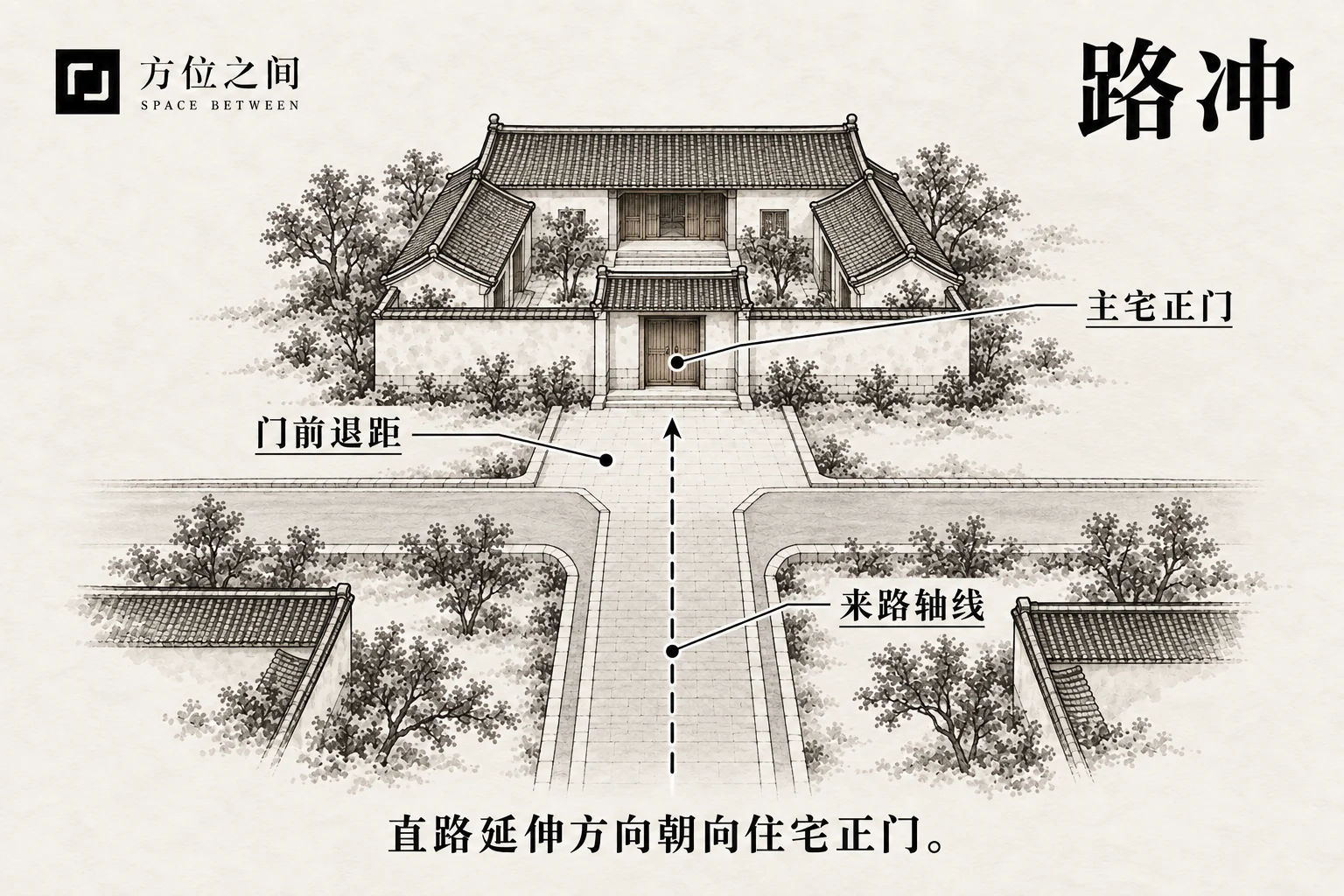
Direct-road sha is also called spear sha or visible-spear sha, an external road-to-home form. It usually means a road extending toward the front, especially the main entrance. A garden gate, front door and window need not align, so identifying the actual facing point is more useful than the name alone.
Typical form and comparisons
A typical arrangement is a house beyond the head of a T-junction: extending the approaching road’s centreline reaches the front facade, with a door or window on that line. The road need not physically end at the wall; a cross street, pavement or front garden may intervene. Road width, setback, changes in level and openings in boundary walls all affect the view from the doorway. A line on a satellite image alone is insufficient.
Traditional reasoning and modern observations
Tradition sees the entrance as the meeting point of inside and outside, favouring a pause, turn and receiving space before it. A long road aimed at the door is described as too direct to gather comfortably. The spear metaphor stresses length, straightness and alignment, so responses focus on slowing the approach, offsetting the line and adding a transition indoors.
A straight approach can also create a continuous sightline: passers-by may see indoors, headlights may reach lower windows, and the entrance may meet turning traffic. Traffic arrangements, floor height and timing determine which effects occur. A solid wall beyond a broad garden and an open shop door beside the pavement may share an axis but need different responses.
How to identify it
Record geometric alignment separately from effects experienced in daily use, in the following order.
- Draw the road centreline and front facade, extend the centreline and mark whether it reaches a door, window, solid wall or open yard. Do not substitute the kerb line.
- Take level photographs from inside the entrance and a safe place at the junction. Note distance to the entrance, steps, height differences, walls and any cross street, with camera positions.
- Check pedestrian and vehicle movements by day and actual headlight locations at night. Record which doors stay open, which windows receive light and any noise. Do not measure from within the carriageway.
Common points of confusion
If the road faces a boundary wall but the gate is at the side, it faces the plot without directly aligning with the entrance. Alignment in plan also does not mean headlights reach a high-floor apartment. A rear approach belongs under rear-road sha and an oblique approach under oblique-spear sha. A street parallel to the front is simply alongside it; a curved road requires checking its inner and outer sides.
Effects described in traditional beliefs
Duoneng Bishi, volume five, lists direct approaches among dwelling taboos; Taiwan Historica records protective Shigandang at junctions. The following distinguishes older taboos from later explanatory readings. These are folk beliefs, not causal proof of residents’ experiences.
- Household and elders: severe old wording connects direct approaches with concern for elders and household members. Folk practice therefore pays particular attention to the main entrance and occupied rooms, seeking family peace.
- Disturbance and disputes: the spear image is also used to express worries about alarm, restlessness and arguments. This extends the imagery of proximity and directness, rather than defining any family member’s character.
- Money and trade: the reading that things arrive quickly but do not stay links direct roads to fleeting gains and unstable trade. For shops, the concern is whether visitors can pause and gather after entering, not a claim that an aligned road prevents business.
Traditional remedies and practical improvements
Prioritise the regular entrance and affected rooms; homes and shops can use different buffers.
- With a courtyard: use a turning path, low hedge or screen wall to create a transition, so the approach does not look straight into the living room. Leave circulation and daylight around the screen and preserve junction sightlines. It screens views and provides a pause, not vehicle protection.
- Homes without a front garden: use an open entrance screen or rearrange furniture to offset views of seating and beds. A suitable side door may help if access remains convenient. Avoid forcing a large screen into a narrow hall; doors and escape routes must remain usable.
- Open-front shops: keep a welcoming pause area at the entrance and move tills, waiting seats and long-stay workstations slightly off the road axis. A display can screen part of the view while leaving the entrance and route legible. Do not force arriving customers against a counter or back toward traffic.
- For headlights or noise: use blind angles, blackout curtains and seating changes for light; assess window sealing, acoustics and ventilation for ongoing traffic sound. Treat the affected room rather than sealing the whole home. Ordinary curtains and plants do not replace acoustic or collision protection.
- For a traditional response: Shigandang has documented junction-protection associations and can be securely placed in suitable private space as a reassuring symbol. Bagua mirrors and Shanhai Zhen are other general symbolic choices, not requirements for this form. Avoid strong reflections toward neighbours and costly purchases presented as necessary.
Illustrative example
Illustration, not a measured case: a cottage stands beyond a T-junction. The approaching centreline passes through its garden gate but reaches a storeroom wall; the everyday entrance is on the right. Distinguish the gate from the front door, then check whether light affects the storeroom. Adding a side path or entrance lighting changes circulation and use; it does not demonstrate a change in fortune.
Sources and further reading
These sources help clarify the concepts and their origins. Explaining a traditional term does not establish that it can predict outcomes.