
Name and background
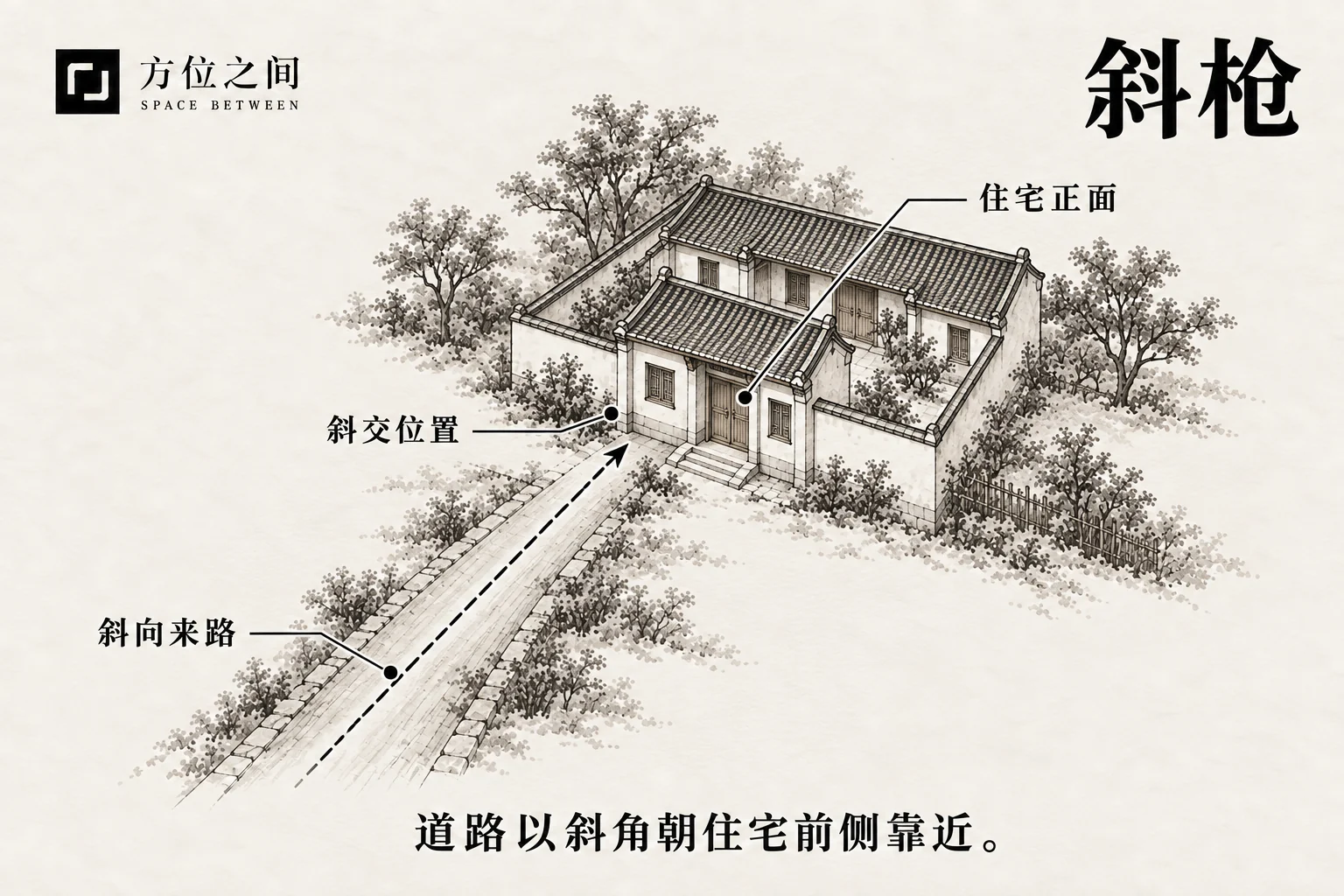
Oblique-spear sha is a straight road obliquely aligned with a home. The road itself can be straight; its relationship to openings or a facade is oblique, without a universal angle boundary. If its extended axis misses the house, it is adjacent rather than the direct alignment described here.
Typical form and comparisons
A typical form is a straight lane oblique to the front facade, its extended centreline reaching a front-side corner, side door or edge window. The road itself may be straight: “oblique” describes its angle to the home, not a slope. If it turns before the entrance, draw the entire turn. Cropping the bend out of a photograph can falsely suggest a continuous straight approach.
Traditional reasoning and modern observations
Tradition likens a long road to a spear and an oblique approach to pressure from the side. Compared with a frontal approach, it stresses the off-centre contact and a sense that openings lack a comfortable transition. Responses therefore offset the relevant point or introduce a buffer, focusing on that facade or window rather than treating every corner alike.
Distinguish the road axis from vehicle turning paths. A lane may point at a corner while turning headlights reach another window, and side windows may expose dining or work areas. Local shading, privacy and entrance visibility often matter more than rotating a door by a prescribed angle. A solid wall with no light or noise issue does not need the same response as a window.
How to identify it
First check the approach in plan, then how the facing doorway or window is used.
- Draw the actual continuous straight segment and extend its centreline against the front facade, marking where it reaches. Show changes in direction rather than extending a straight line through a bend.
- Photograph from the window, doorway and a safe junction position. Check setback, side walls, neighbouring obstructions and floor height; wide-angle perspective can make an adjacent road seem aimed at the home.
- Observe actual turning paths and how long light falls on the building, and check views into regularly used spaces. Mark unmeasured distances and angles as unverified rather than inventing precise numbers.
Common points of confusion
The object is a road; a neighbouring building corner belongs to sharp-corner forms, while two enclosing roads suggest scissors. Alignment with a wall corner differs from alignment with an offset window. Turning headlights can still reach that window, so the road may miss it geometrically while light enters.
Effects described in traditional beliefs
Oblique spear belongs to road imagery based on weapons. The approach taboos in Duoneng Bishi provide an older background, while contemporary readings commonly associate this form with injury and financial loss. The categories below describe folk readings, not accident probabilities, health findings or a list of classical predictions.
- Unexpected harm: a spear arriving from the side evokes sudden alarm and injury, a common theme in this reading. The weapon image expresses vigilance, not a measured risk category for the occupants.
- Finances and trade: readings mention unexpected expenses and losses, stressing disruptions from the side. For a shop, this can prompt orderly placement of entrances, counters and permanent workstations, without promising income from rotating a till.
- Household associations: some readings map left and right approaches onto Green Dragon and White Tiger symbolism, associating them with different family members. This is a further symbolic subdivision. In practical use, identify who uses the facing room rather than judging people by gender or family rank.
Traditional remedies and practical improvements
Local measures suit an oblique approach: identify the facing point, then redirect, screen or move the activity.
- For an oblique approach to a side door: turn the final garden path or add an open boundary that preserves visibility. Without a garden, create an indoor entrance zone. This moves activity away from the direct sightline without rebuilding the facade.
- For headlights entering a side window: try angled blinds or translucent and blackout curtain layers at the affected times. A suitable external side screen may help where feasible. Preserve daylight and ventilation instead of permanently blocking the window.
- For seating or a bed facing the road: move dining, work or resting positions slightly off the sightline and use a low cabinet as a partial transition if needed. Assess windows and ventilation separately for noise. Seating changes improve views and use; a cabinet is not an acoustic wall.
- For a corner shop: keep a clear welcome area and offset the till, waiting seats and permanent desk from direct views. Arrange displays along interior edges, not diagonally across the entry route. The entrance should remain obvious and easy to turn through; avoiding a sightline must not hide access.
- For symbolic customs: screens or bead curtains can form an interior boundary, while Shigandang remains a general protective custom. Choose stable, convenient sizes rather than special oblique-spear objects. Bead curtains give a light visual transition, not blackout, sound insulation or impact protection. Do not reflect strong light toward traffic.
Illustrative example
Illustration, not a measured case: a lane points obliquely at a corner house. Its dining-room side window is off-axis, but headlights sweep the table during right turns. Record both “axis reaches the corner” and “turning headlights affect the side window.” Adjust the table and blinds first, then compare experience at similar times; the building need not be rebuilt to erase a diagonal line on a plan.
Sources and further reading
These sources help clarify the concepts and their origins. Explaining a traditional term does not establish that it can predict outcomes.