
Read each entry
Open a name for its meaning, identification, diagram and practical responses. Different meanings of the same name are distinguished.
- Door AlignmentDoor-facing-door Sha
- Road AlignmentDirect road alignment
- Corner AlignmentSharp-corner Sha
- Distant alignmentDistant alignment: towers and chimneys in the sightline
- Offset Corner AlignmentSharp-corner Sha
- Rear AlignmentRear road alignment
- Opposing DoorwaysDoor-facing-door Sha
- Flying-blade sha (a term with varying meanings)
- Time-period clash sha
- Directional clash sha
- Zodiac Clash ShaZodiac clashes: Six Clashes do not establish incompatibility
Find the subject through four main groups
Main groups identify what an article discusses; subgroups narrow this to roads, openings, water or a particular rule system. They are reading aids, not rankings of supposed harmful power.
- Common forms: identifiable spatial relationships involving roads, buildings, interiors, terrain, water and trees.
- Historic house forms: retain the context of halls, wings, courtyards and eaves rather than mapping every old house shape directly onto an apartment.
- Environment and senses: organise observations of odour, light, sound, moisture and colour, distinguishing traditional labels from modern measurements.
- Directional and personal-gua systems: discuss traditional rules involving years, directions and personal categories. State the system used; a photograph alone cannot supply these inputs.
Form, clash and projection emphasise different aspects
A straight road facing an entrance belongs under roads and traffic, may be called spear sha by analogy, and may be described as road clash for its alignment. Two facing doors can also use the word “clash” without any road. Sharing that word does not imply equal traffic speed, wind or impact; the objects and their use still matter.
An alias does not replace a definition
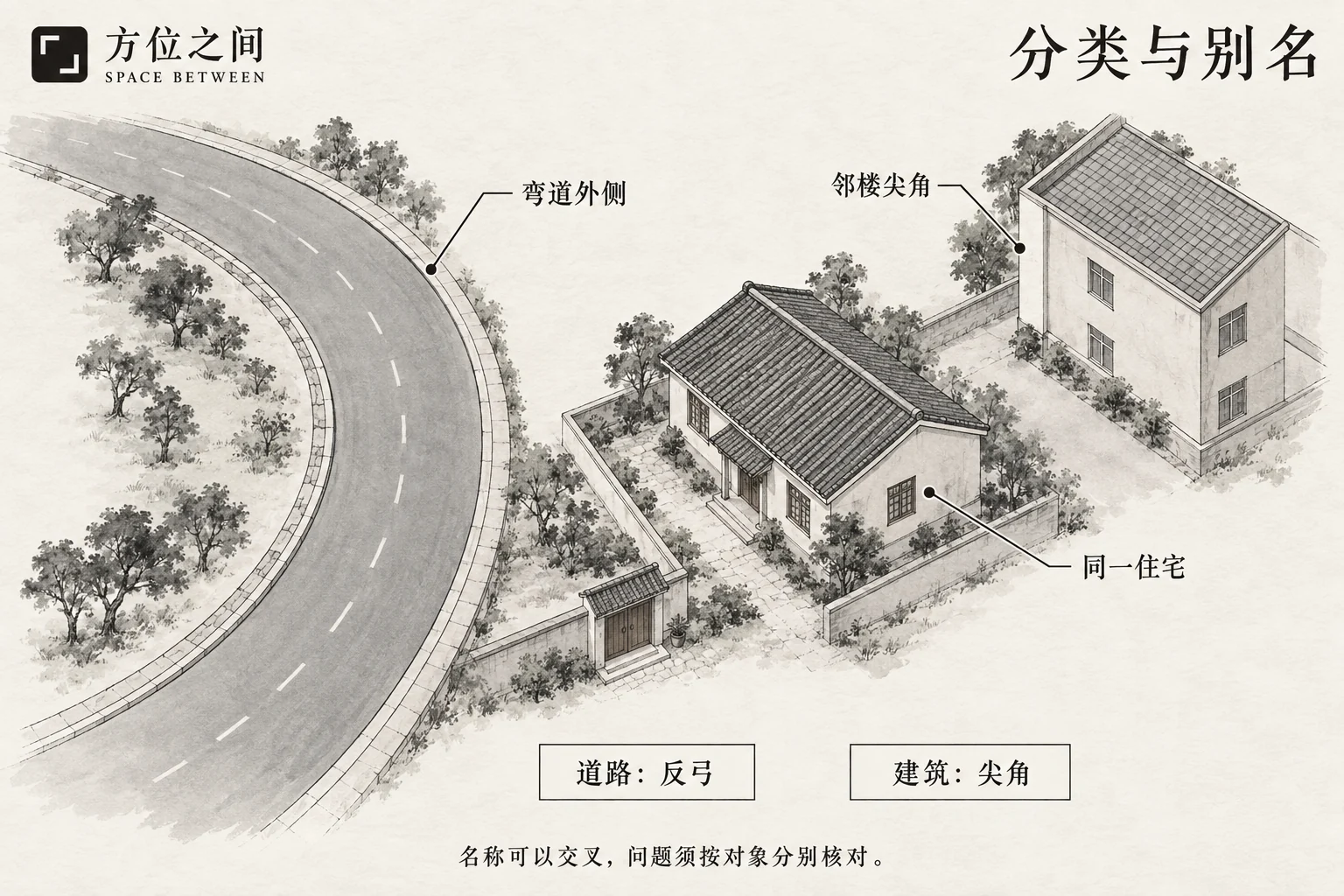
Reverse-bow roads and waters share the geometry of being outside a curve, but roads call for attention to vehicles and access, while rivers involve water levels, flow and banks. Sickle sha often draws attention to a curved elevated or ordinary road close to a dwelling. Preserve both the shared analogy and the different objects; related names do not make road-noise measures suitable riverbank works.
The same name may describe different things
In modern usage, “piercing the heart” may describe underground transport below a building, or sometimes an aligned route through rooms. This library separates underground passage, through-draft layouts and three aligned doors. With a shared name, first locate the object above, below, around or inside the home, rather than combining every search result into a cumulative list of harms.
Read a source in its historical and architectural context
Volume five of Duoneng Bishi places roads, doors, trees and eaves alongside traditional fortune statements; Yangzhai Zhinan discusses entrances, routes, courtyards, movement and height relationships. These texts show how observations and symbolism were organised, but do not establish that every popular modern name comes from one ancient book. Records of Shigandang stones document protective beliefs at roads and entrances, not a substitute for collision, drainage or structural measures.
The six faculties are observation lenses, not six new forms
The Buddhist six faculties are eye, ear, nose, tongue, body and mind. Master Hui Chao’s retreat teaching discusses them in a religious practice context. When housing literature borrows “six-faculty sha” to organise experiences, this library uses it as a cross-topic index, without counting six extra hazards or treating religious practice as environmental measurement.
- Eye-faculty sha: route visible objects to form, glare, nighttime light, changing light or colour. Seeing a sharp corner differs from actually receiving glare.
- Ear-faculty sha: identify external or internal sources, when and where they are heard, and whether sound and vibration occur together. A sound label does not predict fate.
- Nose-faculty sha: consult outdoor odours or indoor pollution, starting with the source and route. Smell does not replace assessment of substances and exposure.
- Tongue-faculty sha: references to food or drinking water belong to their specific hygiene questions. This cultural analogy does not make tasting a method for testing water or identifying poison.
- Body-faculty sha: record sensations of wind, heat, dampness, vibration or contact with edges, then consult airflow, light, moisture or interior layouts. Different sensations require different responses.
- Mind-faculty sha: separately record associations, unease and preferences; see place-related folklore and the viewing checklist. Respect experience without turning unease into a measured external danger.
How to read variant spellings and broad labels
Keep the original spelling and the object described when names resemble one another. The following terms can guide a search, but a shared destination does not establish identical classical origins, forms or judgments.
- A road aimed at an entrance may be called an arrow through the heart: see road alignment. For consecutive door openings, see three aligned doors; for underground transport lines, see underground passage; for a ground-level passage beneath an upper hall, see the historic through-hall entry. Dingxin also needs to distinguish a pillar facing the door from a roof ridge in front. Shared characters do not make these objects one configuration.
- “Pressing the centre” must specify stairs, a beam or another element. Stairs occupying the middle belong under central stairs; not every use of the centre is the same form. “Wealth-loss sha” often names an alleged outcome, with compression between buildings only one example in some accounts, not a universal geometry.
- Look up chicken-beak spellings by the sharp corner described. The uneven connected buildings called Laoshe resemble the form catalogued here as Laodu; the neighboring empty rooms called Xupi resemble Xulao. The original characters of the latter two pairs remain unresolved: similar descriptions do not establish verified aliases.
- Do not infer the meanings of yang-fire and yin-fire light sha from yin and yang alone. If a source explicitly means direct sunlight, consult sun at the bedhead; if it means a mirror-like reflection, consult glare. Without a definition, leave the name unresolved. Yin-fire does not automatically mean nighttime lighting, and these folk labels are not optical classifications.
- For beam sha, read beam overhead; for separated-corner clash, read neighboring building corners; for facing-door clash, read opposing doors. Through-draft and sky-cut wind labels borrow aligned openings and building gaps to discuss wind, but actual airflow needs separate checking: a form name is not a wind-speed result.
- Tree-shade and damp-mould sha labels lead respectively to daylight under trees and moisture sources. White-glare pollution, artificial-daylight sha and coloured-light pollution lead to reflection, nighttime light intrusion and changing coloured light. Sunlight at the bedhead also needs season and time records; afternoon western sun is only one common case.
- Construction in a three-sha direction combines a time-and-direction rule with actual work: consult three sha for traditional inputs and nearby construction for noise, dust and structural maintenance. It is not an extra sha, and an annual table cannot replace checking engineering conditions.
Find environmental entries by their source
Pollution sources, equipment and sound sources are things to observe, not reasons to invent a separate sha for each. Labels such as electrical, sound or light “shooting” are routed by the actual source. Equipment function is more useful than appearance in deciding what to check.
- Outdoor odour inquiries may involve wastewater channels, foul ditches, public toilets, waste sites, septic tanks or cooking fumes. Incinerators, heavy industry and chemical plants require checking actual emissions and pathways; seeing a plant does not establish indoor pollution. Indoor inquiries include paint, renovation materials, furniture panels, drain odours, pesticide use, secondhand smoke and pet waste. Smell or its absence alone establishes neither composition nor safety.
- External sound records may concern shop audio, school broadcasts, factory machinery, blasting, loading, construction or cars, trains and aircraft. Thunder is a natural weather sound. Internal records may concern creaking cabinets or floors, dripping pipes, ticking clocks or equipment cycles. Lifts, renovation vibration and neighbors’ activities can transmit across rooms or through structure. Suspected rodent activity needs confirmation rather than a label based on a noise alone.
- Distinguish power lines, substations, transformers, distribution boxes, meters and transmitting towers by function and frequency. Air conditioners can also involve noise, vibration and return air. A lightning rod is part of a protection system that conducts lightning current to ground; this differs from wireless transmission. A rod’s appearance is not evidence of continuous “electrical shooting.”
Example: one street corner, several observations
Suppose a home is outside a road curve and a neighbouring building corner is visible through its window. Record the curve and corner separately, then check headlights, noise, daylight and views. Road and corner are objects, glare and noise are observations, and reverse bow and sharp corner are traditional labels. Evidence must connect them; adding labels does not establish doubled harmful power. Choose shading, acoustic assessment or layout changes according to the actual issue.
Sources and further reading
These sources help clarify the concepts and their origins. Explaining a traditional term does not establish that it can predict outcomes.
- Duoneng Bishi, volume five: household siting passages (primary text)
- Yangzhai Zhinan: entrances, courtyards and height relationships (primary text)
- Taiwan Historica: records of Shigandang folk beliefs
- Fo Guang Shan, Master Hui Chao: July 2017 retreat teaching on the six faculties
- US National Weather Service: lightning rods and protection systems