
Name and background
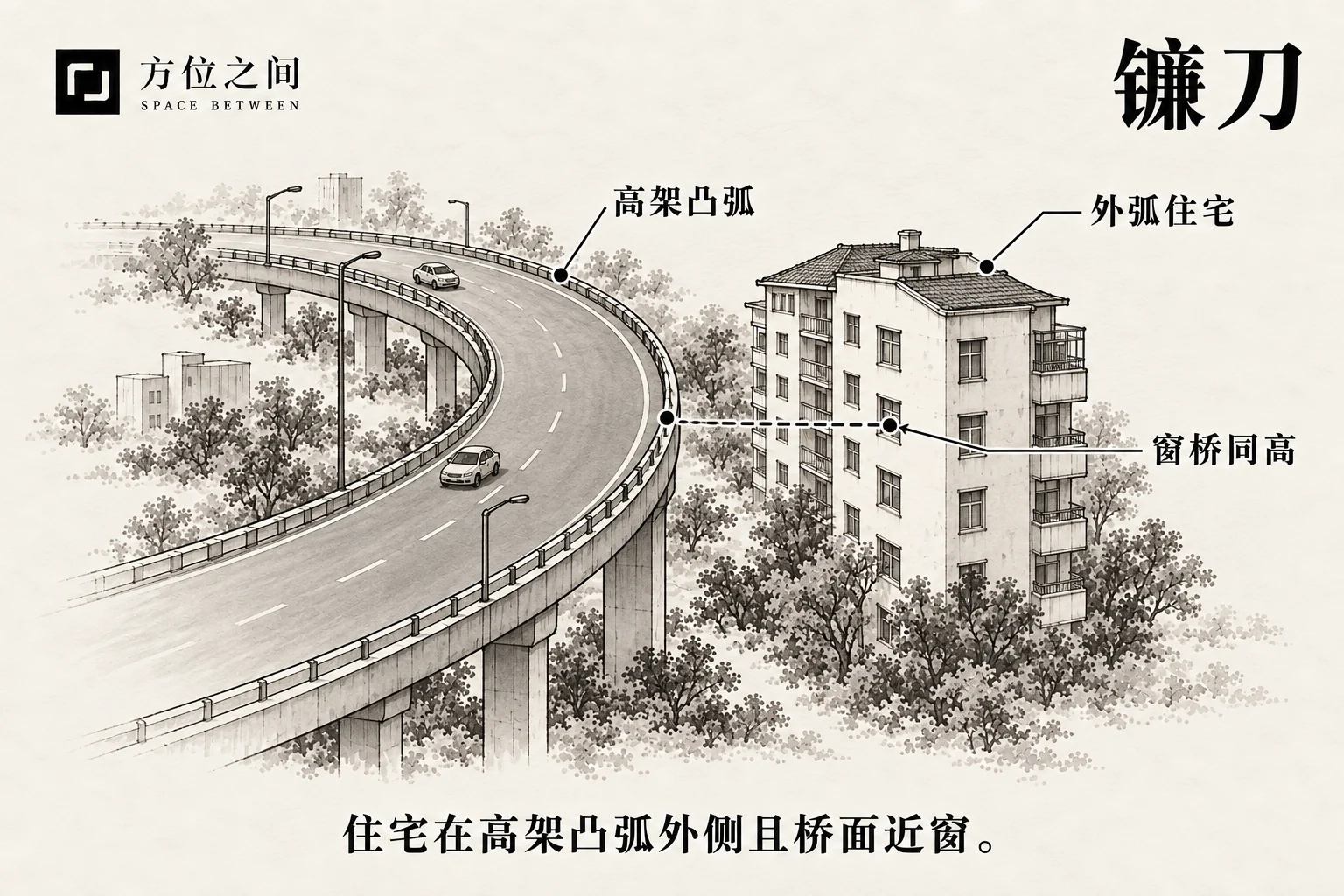
Curved-bridge and curved-road sickle are common variants of the name. Some accounts include any reverse-bow road; others restrict it to a curved bridge close to a floor. Here the subject is the curved transport structure as seen from a home’s openings, balcony or a shop’s customer area.
Typical form and comparisons
In plan, the building lies beyond the convex edge, opposite the centre of curvature. In elevation, the deck or edge lies near a particular window level. Together these create the sweeping relationship. A distant bridge, a home well above it or an intervening building requires its distance and obstruction to be recorded separately.
At home, inspect the view from the bed or sofa; in a shop, use the display window, till and entrance. One flyover may hide a ground-floor sign while aligning with an upstairs living room. A distant photograph of the whole building cannot replace floor-by-floor assessment.
Traditional reasoning and modern observations
Traditional imagery likens the outer curve to a curved blade and the vehicles passing along the bridge to a blade being drawn past the home. It emphasizes closeness, a line across the frontage, and movement.
Practical observation concerns an obstructed view, passing lights, and traffic sound. Vehicles may slow down, stop, or queue on a bend; the curve alone does not reveal their speed. Whether headlights enter a room also depends on barriers, lamp height, and window position.
How to identify it
Start with a plan, add heights, then check conditions at the times the space is used.
- Confirm the outside: locate the centre of the full bend, the building’s side and nearest edge; identify a main bridge, ramp or footbridge.
- Check floors: take a level photograph from the used window, noting deck, barrier and sill heights and the position of beds, seats or counters.
- Record timing: compare bedtime and early morning at home, and peak trading with after closing in shops; note lights, sound, daylight obstruction and open-window conditions.
Common points of confusion
Reverse bow concerns the side of a curve; the curved-bridge sickle adds proximity and floor height. A straight bridge belongs with transverse or overpass forms. Some folk articles call an exterior front stair “sickle” too; that is a different shape sharing a name, and its claims are not transferred here.
Effects described in traditional beliefs
Yangzhai Zhinan discusses bridges and markets as background to siting, not a dedicated sickle entry. A modern article signed by Li Liqian explicitly defines curved bridges or roads close to openings and lists the following three types of effects. These are folk predictions, not evidence that shapes cause illness, disaster or business outcomes.
- Injury and mishap: a blade-like edge and repeated passing traffic evoke cutting or collision—the name’s most direct symbolism.
- Financial loss: the same account treats the outside bend as an image of depleted wealth, extending the concern to difficulty retaining money and business setbacks.
- Illness concerns: some modern predictions add serious or persistent illness, extending blade imagery to bodily insecurity through symbolic inference.
Traditional remedies and practical improvements
Match changes to the room and time: start with adjustable shading, layout and ventilation, then assess works needing professional design.
- Lights near windows: adjustable blinds or curtains suit bedrooms; shops can screen occupied seats without obscuring displays.
- Dominant bridge views: move beds, desks or tills away from the strongest sightline while keeping window access; relocating long stays is more flexible than sealing the facade.
- Persistent traffic sound: locate paths through windows, doors and vents, then have acoustic windows and ventilation designed for sleeping or shop conversation as appropriate.
- Bridge facilities: report damaged barriers or recurring traffic disturbance with time records so managers can arrange repairs or acoustic review; do not attach objects to the bridge.
- Folk objects: Shigandang stones at bridgeheads are documented locally. An existing custom can be expressed with secure placement on permitted private ground; this is cultural reassurance, not acoustic or protective equipment, and requires no purchase.
Illustrative example
Illustrative case: a curved ramp passes a fourth-floor home, with a small studio on the eighth floor. Both are outside the bend, but turning headlights affect the fourth floor while sound dominates upstairs. The home adjusts sofa and blinds and checks the lights again; the studio examines window seals and ventilation. One form can therefore call for different measures rather than one object for the whole building.
Sources and further reading
These sources help clarify the concepts and their origins. Explaining a traditional term does not establish that it can predict outcomes.