
Name and background
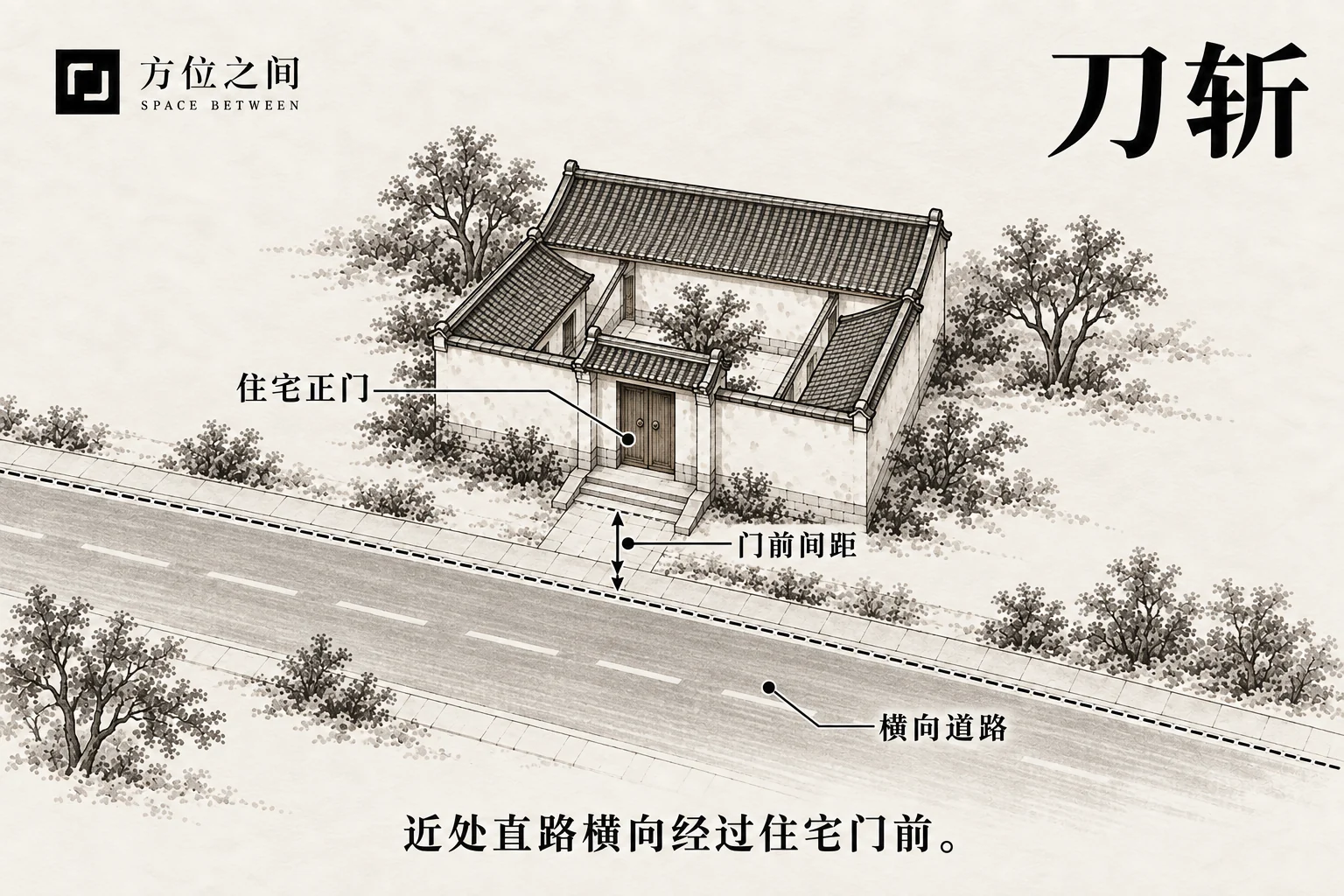
Knife-cut, transverse-blade road, and a road cutting across the frontage all use blade imagery, but the names do not guarantee the same geometry. Modern accounts may mean roads broadly imagined as striking blades, sometimes also confusing them with wall edges. This entry uses a close transverse road to illustrate the metaphor and compare it with direct approaches and bends. Its transverse orientation belongs to this illustration, not to every use of the name.
Typical form and comparisons
In this transverse-road illustration, the building stands on one side of the road, the door faces it, and the road continues left and right. Traffic runs along the front wall while the entrance faces across the roadside; draw these directions separately. The sense of closeness concerns limited room to pause or turn between the entrance and moving traffic, rather than road width implying greater misfortune.
For a home, examine the threshold, fence, and forecourt. For a shop, also consider display windows, the door swing, and waiting areas. A continuous footpath, planting strip, or broad forecourt changes the relationship even though the transverse road remains.
Traditional reasoning and modern observations
Traditional imagery compares the close line across the frontage to a cutting edge, using chopping and slicing to express a feeling of interruption before the entrance. It values space to turn and settle, so a road beside the door and the same road beyond a courtyard carry different weight in this interpretation.
Practical observation begins with the first step outside: can people pause and see both ways, where do pedestrians and vehicles cross paths, and do stopped vehicles occupy the footpath? Passing parallel traffic does not necessarily shine into a room. Lane direction, gradient, parking positions, and window height determine the actual light paths. Record sound by time of day and room use as well.
How to identify it
To identify the form illustrated here, confirm the transverse relationship on a complete plan, then check the actual entrance. Do not crop out the existing footpath and setback when showing a road segment.
- Mark the front wall, door orientation, and road centreline. The road should extend left and right along the wall; an approach aimed directly at the entrance belongs under direct-road sha.
- Record the spaces between the threshold and kerb, including steps, footpath, boundary wall, and door swing, and locate a place to pause safely after leaving.
- Observe during commuting hours, deliveries, and the evening. At homes, consider pushchairs and older residents; at shops, customer queues and couriers. Record where their paths actually overlap.
Common points of confusion
A straight road approaching a home is direct-road sha; a close outer curve belongs to reverse-bow or sickle terminology; a wall edge directed at a window or door is usually wall-blade sha. A transverse road close to the foot of a low window may also resemble foot-cut sha, but height and direction should be described separately. An ordinary frontage behind a wide footpath is not automatically knife-cut, and a distant transverse road does not show the closeness illustrated here.
Effects described in traditional beliefs
Volume Five of Duoneng Bishi shows traditional attention to roads outside a home, but the checked passage has no dedicated rule for a transverse knife-cut road. A signed 2017 article by Yixuan Fengshui describes a road like a blade striking a home and lists injury and frequent mishaps without specifying a parallel road. The two modern folk claims below are retained as cultural statements, not conclusions that transverse roads cause harm or predictions of personal events.
- Injury: the blade image is associated with bodily harm and concern for residents’ safety, rather than one particular disease.
- Frequent mishaps: this claim concerns sudden disruptions in daily life and is often paired with injury. The source gives no accident category, frequency, or predicted date.
Traditional remedies and practical improvements
The aim is to provide room to pause, turn, and see clearly before the entrance, arranged around how a home or shop is used. There is no universal set of ritual objects specific to knife-cut sha. Address access, waiting, light, and sound individually rather than copying an arrangement solely because of the name.
- Where a home opens close to traffic, move shoe storage and pushchair parking inside so people can prepare and pause before leaving. Any small screen or furniture inside must preserve a clear passage.
- For a shop with a narrow frontage, move collection, waiting, and QR scanning inside and coordinate delivery times so customers do not form an obstruction outside. Keep display racks off the footpath.
- With a private forecourt, a low hedge or open railing can mark walking routes while seating or waiting areas move farther back. Keep approaching traffic visible at the entrance; do not block both side views with a high wall.
- If turning headlights actually disturb a bedroom, adjust the bed position, blind angle, or blackout curtains. If traffic sound is the main issue, assess window gaps, acoustic windows, and ventilation separately from light control.
- If the issue is roadside parking obstruction, missing footpaths, or public facilities outside, give the property or road manager a record of times and locations. Before changing a door or adding a wall, check ownership, approvals, and escape requirements.
Illustrative example
Example: on the north side of an east–west road, a ground-floor breakfast shop has only a narrow footpath outside, while the adjacent home has a forecourt. Both doors face south and traffic travels east and west. Moving collection inside the shop prevents customers from blocking its entrance; the home can retain its waiting space within the yard. If only headlights turning at the junction reach the shop’s rear room at night, address that window rather than placing the same ritual object throughout the row.
Sources and further reading
These sources help clarify the concepts and their origins. Explaining a traditional term does not establish that it can predict outcomes.