
Name and background
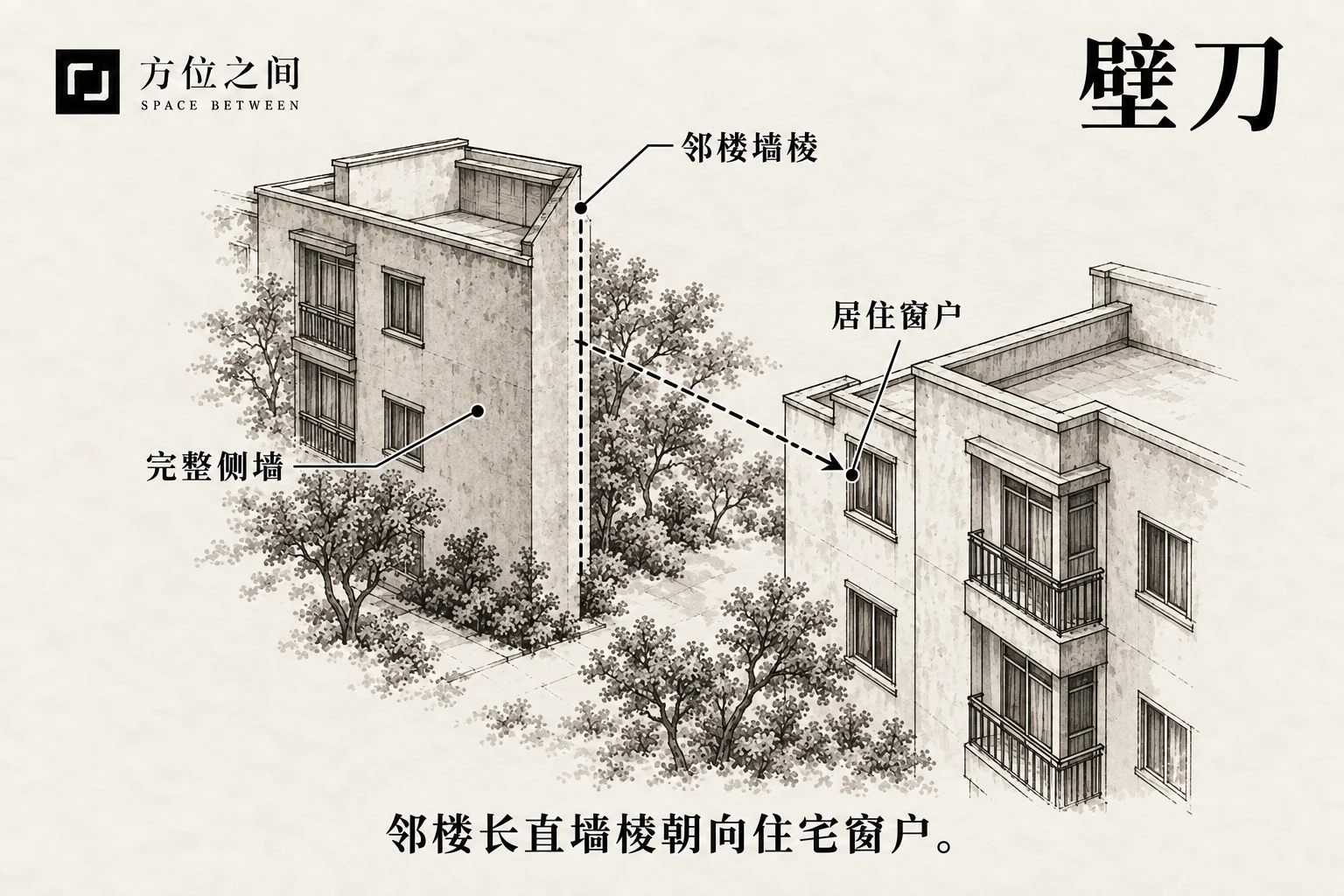
The defining object is a wall end or edge, commonly exposed when one block projects beyond another and faces residents opposite. A corner can show both point-like and blade-like features; here wall-edge sha means the linear outline, distinct from a small eave point. Names involving cutting or blades are also used for roads, so the shared metaphor does not make the objects identical.
Typical form and comparisons
A typical view includes much of a vertical edge, with two faces extending in different directions and one seen as a narrow strip. An edge that is only a tiny part of the distant skyline, or below the sill and invisible, has much less presence in daily views. A nearby wall end occupies more of the scene; distinguish concern about its outline from loss of sky caused by the building as a whole.
Traditional reasoning and modern observations
Traditionally, the long edge is likened to a blade: a door or habitual seat facing its edge is seen as lacking turns, screening and buffering. The blade is a visual metaphor, not a moving weapon. The reading depends on a head-on, continuously visible edge and intervening shelter; an infinitely extended line on a photograph cannot establish the relationship for an entire building.
Distance, orientation and window position determine the view, overlooking and daylight. A long edge alone is no evidence of illness or accidents. A nearby outlet may produce dripping, while cracked or loose finishes call for a maintenance review. Such issues require observed conditions, not an engineering conclusion drawn from a blade-like appearance.
How to identify it
Record the whole wall rather than only a blade-like sliver. The same edge can relate differently to different floors and rooms.
- Take a wide view from the usual seat including the edge’s height and both facades; compare it with the window view without using a telephoto crop to exaggerate it.
- Sketch the staggered blocks, side-wall length and your window to distinguish an approaching wall end from a broad parallel face; note the intervening distance.
- Compare day and night: check sky obstruction and daylight by day, and whether opposite windows overlook the interior at night. Record dripping or cracks separately.
Common points of confusion
A bright slit between two buildings is a gap, considered under sky-cleft sha; a projecting point is a sharp-corner form. A fully visible wall face is primarily an obstruction. Gable or canopy edges can also look linear, but identify the actual object rather than drawing walls, eaves and roads as one blade and adding their names as separate impacts.
Effects described in traditional beliefs
The name comes from the resemblance of a long wall edge to a blade. A related historical context is Duoneng Bishi, volume 5, on wall ends facing people: it concerns the relationship between a wall end and habitation, not a dimensional standard for modern towers. The following is its folk account of interpersonal effects, not a causal claim about a neighbor’s wall.
- Gossip and criticism: the old passage links an approaching wall end with being discussed or criticized by others. It illustrates a folk symbolism of interpersonal friction, not an inevitable lawsuit, operation or financial loss, and gives no grounds to accuse a neighbor of deliberate harm.
Traditional remedies and practical improvements
First reduce prolonged head-on views of the edge, then select measures according to daylight, privacy and maintenance needs.
- For a desk or bedside seat facing the edge: move it sideways behind the solid wall beside the window or turn it inward. Try the view before fixing the layout and keep passageways clear.
- For a visually intrusive line in part of the window: use vertical blinds or a translucent curtain panel at that angle, leaving the open view beside it. If the whole building already blocks daylight, avoid heavy additional screening and provide task lighting.
- For a shop counter or waiting area facing the wall end: move prolonged stays inward along a side wall and add a low partition. Keep display and reception visible from the entrance so screening does not hide the doorway from customers.
- For a traditional response: a screen can symbolize blocking the form, and an existing small blessing ornament may be retained. Coins, mirrors or swords are not a mandatory wall-edge kit; reflective objects aimed at neighbors may create another source of friction.
- If the wall end has cracks, bulges or runoff near the window: keep photographs and times and ask management to coordinate owners and professionals. Check feasibility before fixed exterior screens or window alterations. Curtains screen a view, not a loose facade.
Illustrative example
Example: two staggered apartment blocks leave the front block’s vertical side-wall edge facing a bedroom in the rear block. The full edge is visible from the foot of the bed, but only a flat wall is seen from a desk beside the window. The resident moves the reading seat and uses a light curtain for evening privacy. A desk lamp addresses remaining dimness: hiding the edge does not remove the building’s daylight obstruction.
Sources and further reading
These sources help clarify the concepts and their origins. Explaining a traditional term does not establish that it can predict outcomes.