
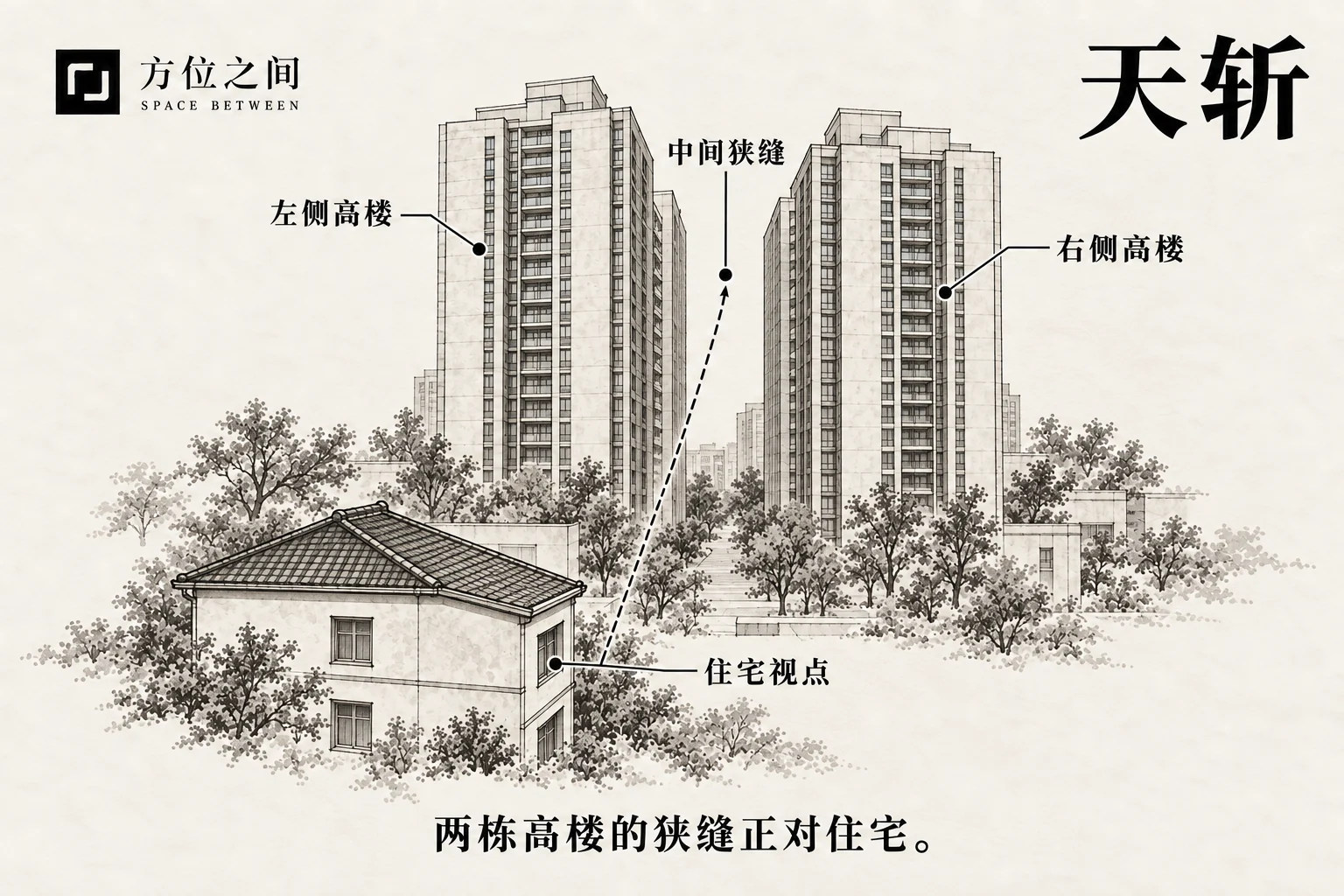
Name and background
The name comes from the distant image of a tall, narrow cut between buildings. The gap may reach the ground or be blocked below by a podium, bridge or trees. An upper slit may remain visible in the latter case, but movement and airflow conditions differ. Merely seeing two buildings from a window does not establish this form.
Typical form and comparisons
A typical case is a low-rise front window aligned with the narrow gap between two towers: high walls flank a slim strip of sky. An offset gap, a distant gap or a building blocking the foreground changes that directness. The towers need not be identical in height, but record height, gap width, distance and any lower closure together rather than relying on a cropped image.
Traditional reasoning and modern observations
Traditional imagery likens the cleft to a falling blade or axe, with the home in its path. Another account invokes sheltering wind and gathering qi, treating overly rapid flow as unable to settle. These emphasize form and qi respectively, and some schools add directional readings; no single severity scale or list of misfortunes applies to every gap.
Modern wind conditions depend on approaching wind, building layout and heights, podiums and openings; narrower is not automatically more dangerous. Hong Kong planning guidance uses adequate building gaps and layouts responding to prevailing winds to improve ventilation. Uncomfortable drafts, rattling windows or wind noise at a particular home require observations over time; a visible gap cannot establish a wind-speed multiplier or health outcome.
How to identify it
Record the visible cleft separately from actual wind disturbance to decide whether the response concerns the view, windows or ventilation.
- Photograph both full buildings from a usual opening, not just the bright slit. Check a map to distinguish truly adjacent blocks from buildings overlapping in perspective.
- Note width, height and distance; check podiums, bridges and trees below, and identify which room actually faces the gap rather than treating the entire home alike.
- In normal weather record opening direction, time and perceived wind, including moving sashes or loose objects. Follow safety guidance in strong winds rather than leaning out to test a folk label.
Common points of confusion
Sky-cleft sha concerns empty space, wall-edge sha a solid edge. A home squeezed between towers occupies the intervening space itself. A road beneath a gap may also align with an entrance, but road traffic and the upper cleft are separate. Normal distant spacing, gaps filled by low buildings and narrow-looking perspective lines are not all open vertical clefts.
Effects described in traditional beliefs
Chen Yujiu’s notes explain the blade-like image, while an article by Cui Zhengguo of Feng Chia University’s School of Architecture separates folk claims from environmental effects. The two groups below summarize reported folk fears, not probabilities, diagnoses or predictions of family outcomes from a photograph.
- Injury and accidents: blade imagery is associated in folklore with bleeding, traffic accidents or surgery, expressing fear of bodily harm. The article does not treat these predictions as empirical wind-environment findings.
- Family and disputes: related accounts mention divorce and litigation, extending the image of division to broken relationships. This symbolism does not justify blaming a neighboring building for conflict or judging someone’s marriage.
Traditional remedies and practical improvements
Address the view, wind at openings and shared space separately. A blessing custom can remain optional without sealing windows or blocking routes in response to a name.
- For visual unease: shift habitual seating away from direct alignment and filter the view with a translucent curtain or adjustable blinds, retaining useful sky and light rather than darkening the room all day.
- For strong drafts during ordinary window use: compare different sashes and opening widths, move seats out of the direct flow, and ask management to review hardware and ventilation options. Do not improvise with hanging pots or unsecured boards.
- For entrances or shop waiting areas in an airflow path: move seating and lightweight signs inward beside a private side wall, preserving entry visibility and clear access. Do not wall off a shared breezeway; persistent problems require a whole-site assessment by management.
- For a documented folk response: Kuang Zheng’s Q&A mentions Shigandang or Five Emperors coins, while Xuankongguan mentions bamboo or bronze turtles, illustrating differences between schools. A small secure symbol may express a wish for peace; costly sets are unnecessary and such objects are not wind-control devices.
- If wind is comfortable and the concern is inevitable misfortune: review observations together and identify whether the actual issue is the view or a habit. Address existing sleep, health or relationship difficulties on their own terms rather than replacing needed help with new ornaments.
Illustrative example
Example: a second-floor home faces a narrow gap between towers, with a bridge blocking the ground-level passage. Ordinary winds are mild, but a reading chair at one window draws attention to the slit, so the resident moves it and adjusts the blinds. When a sash later rattles in windy weather, management checks the hardware. The view and the window defect are addressed separately, without inferring year-round strong wind from one photograph.
Sources and further reading
These sources help clarify the concepts and their origins. Explaining a traditional term does not establish that it can predict outcomes.
- Changhua County Government: form-related beliefs in a property folklore course
- Hong Kong Buildings Department: alterations and additions
- Chen Yujiu: Home Feng Shui notes (2021, sky-cleft form)
- Cui Zhengguo / Feng Chia University Library: A Rational View of Feng Shui, Part 4
- Hong Kong Planning Department: breezeways and view corridors
- Kuang Zheng: reader Q&A on sky-cleft sha (folk practices)
- Chen Guilong, Xuankongguan: sky-cleft sha (folk practices)