
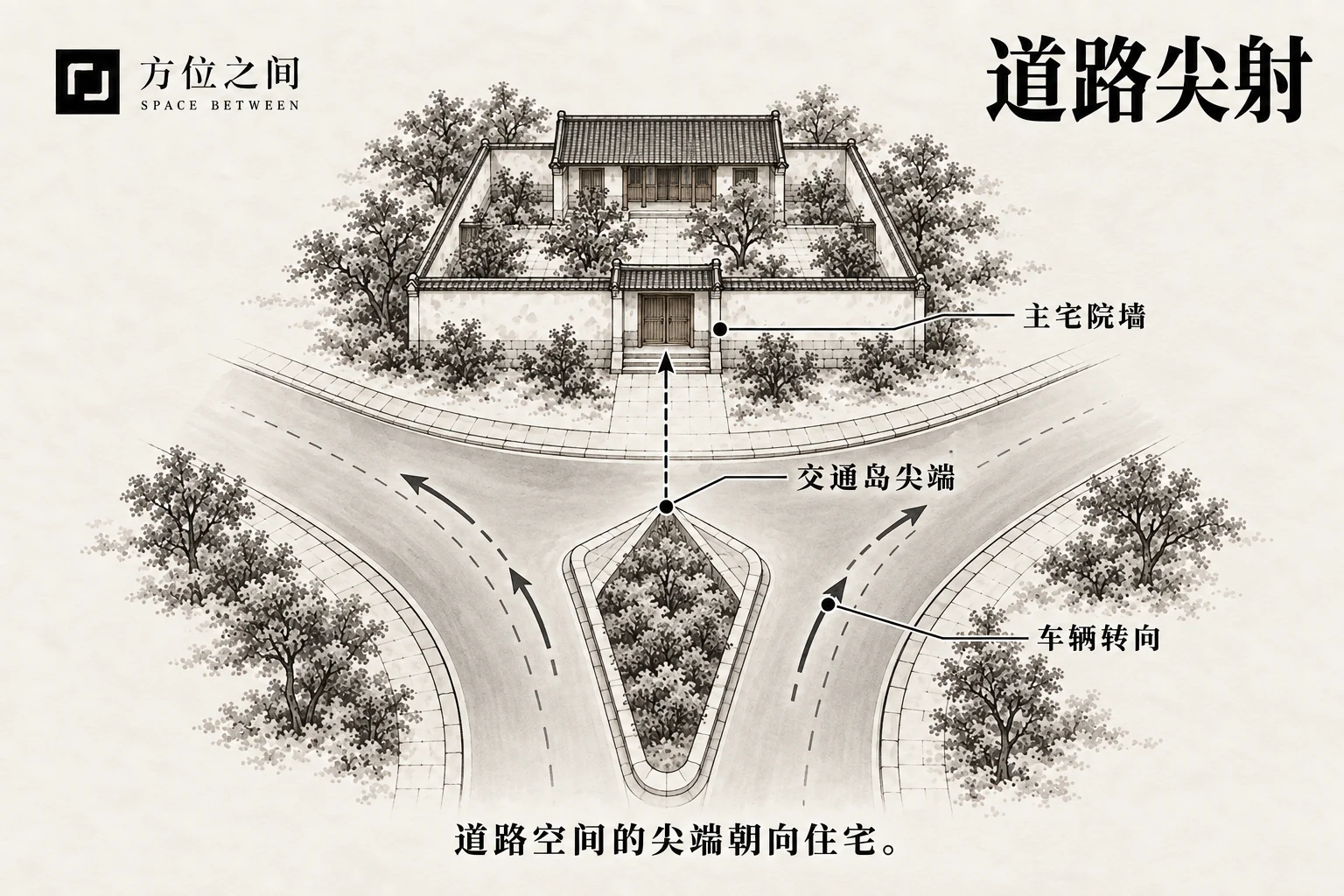
Name and background
“Projection” refers to a pointed shape resembling an arrow; the road need not run into an entrance. Folk usage of pointed approach and pointed projection varies, and can describe two roads meeting in a triangular form with its tip facing a building. A triangular planted island at a T-junction facing a courtyard wall, or a splitter-island nose facing a lower-floor window, makes the relationship of an external tip pointing at a home easy to see. This guide uses that illustration without treating traffic islands as the only possible form.
Typical form and comparisons
The typical form has three elements: a recognizable acute angle, a clearly directed tip, and a door, window or courtyard in front of it. A nearby, fully visible tip feels different from one across a wide road, tree belt or boundary wall. A raised island nose, triangular vacant plot and painted channelization area are also different. A triangle visible only in an aerial photograph should not be treated like a sharp corner routinely seen directly outside a window.
Traditional reasoning and modern observations
Traditional form-based feng shui favors gentle curves and enclosing forms, and uses sharp, direct pointing as a metaphor for a less harmonious setting. Road-tip imagery likens an inward-pointing arrow to a disturbance of qi gathering at the entrance. Its symbolic reading depends on whether tip and entrance face each other and whether an intervening turn or screen offers shelter; a triangle pointing toward a door is therefore read differently from one pointing away.
In a modern setting, the noticeable effects may be visual unease from a sharp outline, headlights from turning vehicles, or reduced privacy near a busy junction. Noise and movement conflicts depend on vehicle speeds, lanes, turning paths and the entrance setback. An island may channel traffic or incorporate crossing facilities. Its geometric tip direction, the road centerline and vehicle trajectories are distinct; a triangular shape alone does not show that vehicles will approach the home.
How to identify it
Use the doors, windows and places people actually occupy as your viewpoints. Identify the shape first, then observe how the road is used.
- Locate the tip: establish whether it belongs to a raised road edge, planted island or painted marking, then follow both edges to see where it actually points.
- Check from indoors: look from the sofa, bedside or counter to see whether the tip faces you directly. Note distance, height differences and boundary-wall screening instead of relying only on aerial views.
- Observe at different times: by day, watch turning paths around the island; at night, note where headlights fall. From a safe location, watch crossings and whether vehicles pass unusually close to the entrance.
Common points of confusion
When a tip points at a home, the building lies beyond the triangular point. In a scissors pattern, the home lies within the angle between two roads; these are different positions. A straight road aligned with the door adds a direct-road relationship, while a neighboring building’s corner is a building-corner form. The outside of a road curve is a reverse-bow form, not road-tip sha merely because it narrows locally. Triangular road markings are not automatically pedestrian refuges.
Effects described in traditional beliefs
In his 2021 lecture notes, Chen Yujiu describes two roads meeting in a triangular form directed at a building as a pointed approach, with the following two associations. This helps explain the folk imagery related to road-tip sha, but the passage does not specifically cover every type of traffic island. These are folk attributions, not evidence that road geometry causes financial losses or illness.
- Finances: the folk phrase “loss of wealth” conveys monetary loss or difficulty retaining savings. Applied to shops, it may express a concern that earnings will not stay in hand; it provides no basis for predicting amounts or dates of losses.
- Health: the notes include an association with frequent illness, reflecting a folk link between sharp, directed forms and unease at home. They do not specify a disease or family member corresponding to a particular tip.
Traditional remedies and practical improvements
Begin by screening the shape or shifting away from a direct view, then address light, access or traffic issues individually. Choose the measures that fit the property; they need not all be combined.
- For lower-floor doors or windows facing the tip: if you have a private yard or setback, use a short screen wall, slats or modest planting within your property to hide the sharp outline. Keep sightlines open on both sides of the entrance. This changes the view; plant pots are not vehicle barriers.
- For an upper-floor tip visible through one window: move the desk or bedside chair to a side that does not face it directly, and use adjustable blinds or curtains for the view and headlights if needed. If noise is the main concern, assess window gaps, glazing and ventilation separately; visual screening is not sound insulation.
- For a shop entrance directly facing the tip: where lease and fire-safety conditions permit, use an existing side entrance or a short interior vestibule to introduce a slight turn on entry. Put the cashier and waiting seats inside along a side wall, away from the tip’s alignment, while preserving the view of arriving customers and clear passage width.
- For those wishing to retain a traditional blessing custom: the roadside Shigandang tradition may be expressed with a simple small stone plaque, securely placed within lawful private space. The museum documents a protective folk custom, not a ritual specific to traffic-island tips. Expensive materials are unnecessary, and a plaque cannot alter traffic or guarantee prosperity.
- For vehicles turning too close or difficult pedestrian crossings: give the road authority the times, vehicle paths and entrance location so it can assess markings, crossing arrangements or protective facilities. Do not cut back an island, move signs or place stones in channelization areas yourself. Changes must preserve traffic-channeling and pedestrian-safety functions.
Illustrative example
Example: the pointed end of a planted island at a T-junction faces a home’s courtyard wall, while vehicles pass around both sides. A second-floor desk has a direct view of the point. The resident moves the desk to the side of the window and uses blinds at night to reduce light from turning vehicles, keeping both sides of the courtyard gate clear for checking traffic. The issues here are the desk’s view and incoming light; the tip alone is no reason to rebuild the entrance or remove the public island.
Sources and further reading
These sources help clarify the concepts and their origins. Explaining a traditional term does not establish that it can predict outcomes.
- Duoneng Bishi, volume 5: house forms and approaches (primary text)
- Taiwan Historica: Shigandang customs and legends
- Hong Kong Housing Authority: road-noise control
- Hong Kong Transport Department: Transport Planning and Design Manual, Volume 6, islands and crossings
- Hong Kong Transport Department: Road Crossing Code, islands and hatched areas
- Chen Yujiu: Home Feng Shui lecture notes (2021, folk accounts of pointed approaches)