
Name and background
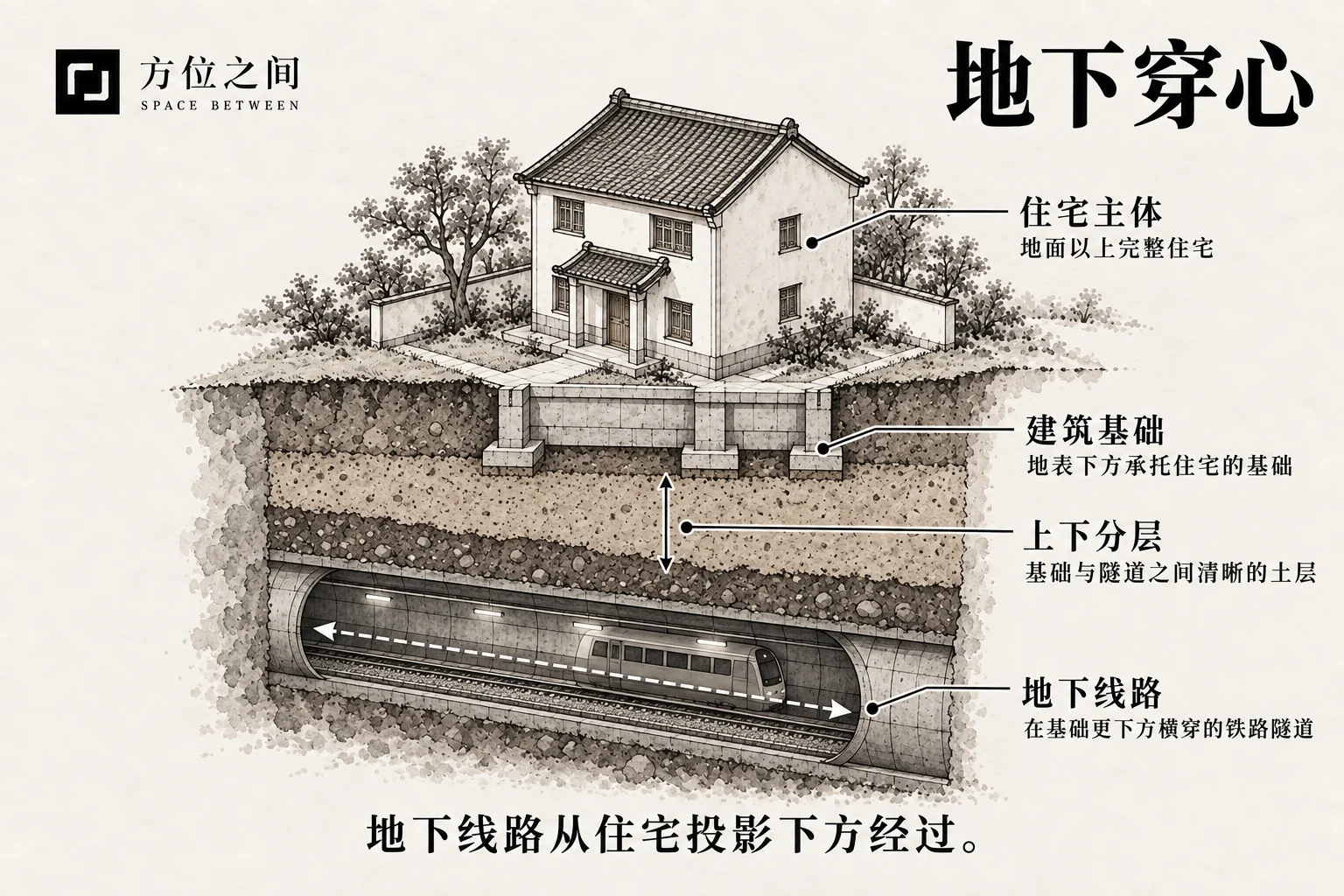
The older term through-heart did not specifically mean underground space: Yang Zhai Cuo Yao describes opposing walls and fences. Modern accounts reuse it for routes beneath buildings. This entry concerns that later usage and the vertical relationship between home and route, keeping foundations, basements and deeper tunnels distinct.
Typical form and comparisons
A line directly beneath the house, beneath a plot corner or beneath a neighbouring street creates three different relationships. Entrances, ventilation shafts and running tunnels may be some distance apart. Where foundations sit above a deeper tunnel, ground and structure still separate them: through-heart describes their projected relationship, not trains entering rooms or basements.
Traditional reasoning and modern observations
Traditional dwelling theory values a stable base and settled inner qi. Repeated traffic below is likened to moving water beneath a quiet home, giving rise to the interpretation that qi is difficult to gather.
In practice, railway sound may travel through air or through ground and structures. Tunnel depth, track, geology and foundations jointly shape the effects; the extent of plan overlap alone cannot determine them.
How to identify it
First establish reliable underground geometry. Verify separately whether the line passes below, where any sound comes from, and the condition of the structure.
- Start with operator or planning-authority alignment drawings, sections and environmental assessments. Note date and scale; tourist network diagrams only provide approximate orientation.
- Overlay the building footprint and actual alignment. Mark tunnel crown, foundation bottom and nearest horizontal separation; state explicitly when depth is unverified.
- In a consistent room, log when sound or vibration starts and stops and whether it matches train times. Distinguish other possible sources such as air conditioning, pumps or construction.
- Ask management or the operator to review the observations and arrange proper measurements if needed. Phone recordings can supply clues but cannot establish structural safety.
Common points of confusion
Through-hall refers to aligned indoor openings; older uses of through-heart may concern facing walls or fences, not underground railways. Construction drilling and operating trains require separate assessment. Noise may merit investigation even beside a line, while a line below does not automatically imply excessive levels. Absence of audible noise is not proof of structural safety.
Effects described in traditional beliefs
Modern folk columns connect underground through-heart with retaining wealth, steadiness of mind and wishes for health, adapting an older name to a new environment. These are the contents of those beliefs, not causal evidence about illness or financial outcomes.
- Difficulty retaining wealth: Fong Heung Yu’s railway column uses continual movement below as the metaphor, while also treating convenient rail access as a source of shop visitors rather than judging every rail-adjacent property alike.
- An unsettled mind: the same column describes scattered attention and values a settled place to sit and rest. Heart here is a folk metaphor for mental steadiness, not a claim that a tunnel passes through a bodily organ.
- Wishes for health: modern accounts include it among reasons for household protection using symbols such as gourds. The illness warnings in Yang Zhai Cuo Yao refer to the older wall-and-fence form, so the subjects must remain distinct.
Traditional remedies and practical improvements
Residents generally cannot move an underground route. Responses therefore concern room use, actual sound or vibration, and household customs. Begin with the most affected room and consider specialist engineering where needed.
- Move resting places toward quieter areas: compare existing rooms during train passages and, where useful, relocate beds, reading chairs or work desks. Choose by actual experience rather than drawing forbidden seating zones from a line map.
- Treat airborne sound at openings: if noise arrives through windows from entrances, surface rail or ventilation equipment, review seals and acoustic ventilation. Curtains can manage light and views, but they do not interrupt vibration transmitted through the ground.
- Coordinate ground-borne sound measures: bring recurring hum or vibration logs to management, the operator or an acoustician to consider track or equipment isolation. Do not cut foundations for symbolic objects or buy costly flooring without a suitable assessment.
- Let shops retain the benefit of access: put displays and wayfinding where station users can see them, with consultations, staff rest and quiet services further inside. Alongside the traditional idea of visitor qi, customers need a visible entrance and room to stay.
- Use gourds and coins symbolically: modern columns associate gourds with health and five-emperor coins with retained wealth. Existing objects can sit securely on a private shelf as a household wish; special antiques, prices or a universally lucky position inferred from a route map are unnecessary.
Illustrative example
Example: a resident confirms a line below the building; an outer room occasionally has a low hum at night, while an inner study is quieter. The bed moves to the more comfortable room and logged times go to management for source investigation; a gourd stays on the shelf as a symbol. This hypothetical case separates rest, professional sound investigation and personal wishes.
Sources and further reading
These sources help clarify the concepts and their origins. Explaining a traditional term does not establish that it can predict outcomes.
- Yangzhai Cuoyao, volume 1, sha forms: facsimile page 44
- Hong Kong Environmental Protection Department: railway noise assessment
- Hong Kong Buildings Department: alterations and additions
- Hong Kong EPD: Northern Link EIA, ground-borne noise
- Fong Heung Yu: Feng Shui Near Railways (modern folk-belief column)