
Name and background
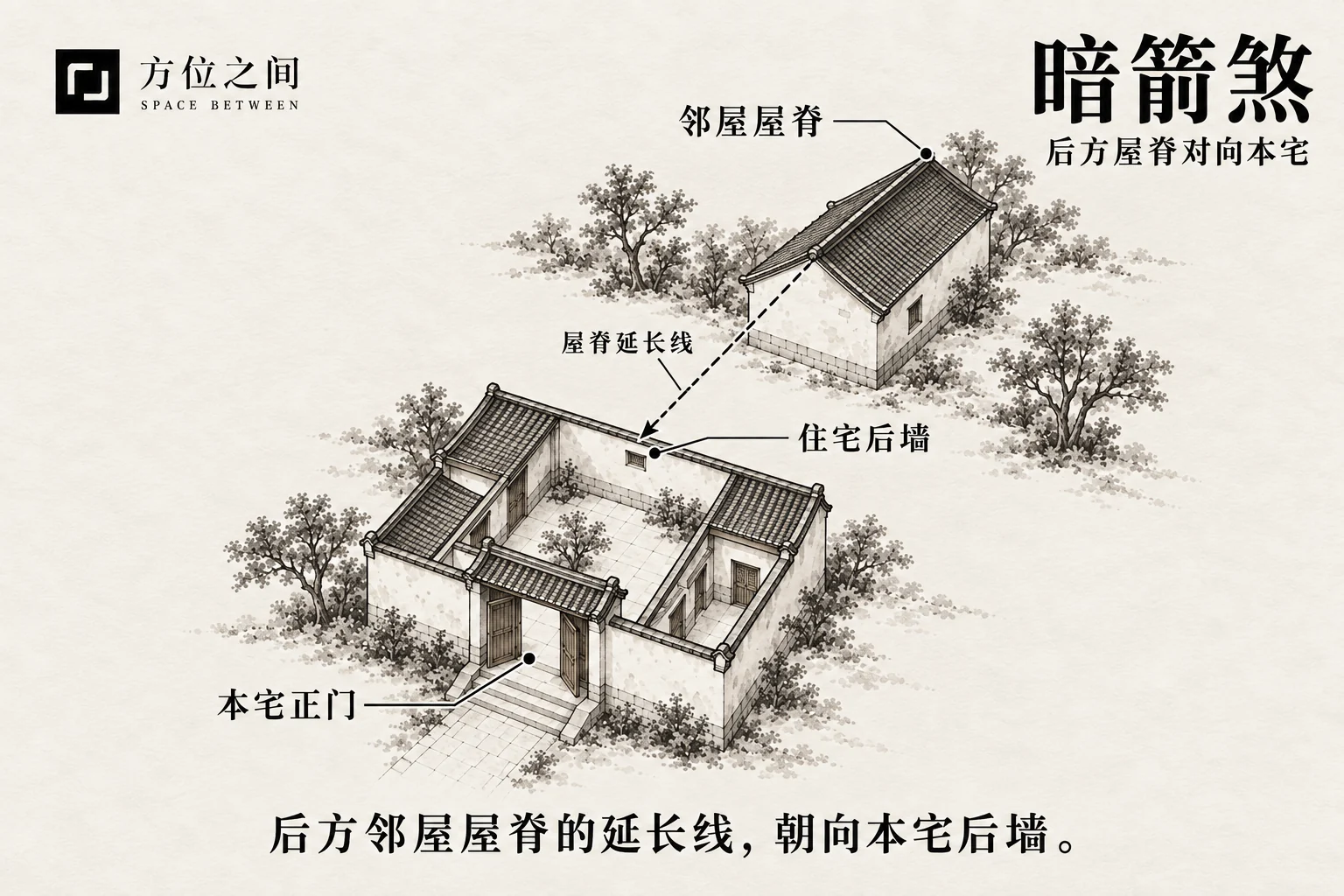
The classical scope is specific: a roof ridge behind the main hall, not any long object. Back-piercing appears as an alias in the same passage and does not exclusively mean an oblique approach. Modern usage sometimes applies hidden-arrow to corridors, roads or furnishings; identify what the arrow actually is. This article keeps the external rear-ridge meaning.
Typical form and comparisons
A typical setting has a pitched-roof outbuilding beyond the rear yard, its ridge extending toward the main home’s back wall or window. A facing gable exposes the ridge endpoint; a ridge parallel to the back wall is merely transverse. Endpoints above the window, below a boundary wall or at window height differ in visibility and obstruction. If the rear structure belongs to the same home, record that rather than assuming a neighbor is responsible.
Traditional reasoning and modern observations
Traditional house imagery treats the front as the receiving face and the rear as support and shelter. A ridge pointing from behind symbolizes disturbance of that support. This concerns relations between buildings, not the direction of a person’s back or an invisible ray passing through walls. Direction, distance and screening together define the arrangement.
Modern assessment concerns daylight at rear windows, maintenance access, and roof and drainage condition. Seeing a ridge does not establish falling tiles, and water need not follow its axis. Check actual defects and runoff separately. If the roof is sound and spacing adequate, a bothersome view can be addressed at that viewpoint without assuming the whole building is structurally unsafe.
How to identify it
Define front and rear by the principal entrance and main layout. For multiple entrances or corner homes, state which face is treated as the front before recording roof relationships.
- Mark the entrance, rear wall and rear windows, then both ridge endpoints to confirm an approaching rather than parallel alignment.
- Check visibility from rear windows and usual yard seats, recording walls, trees, height differences and spacing rather than substituting an unused rooftop viewpoint.
- From safe ground access, look for tile fragments, water traces or blocked outlets; ask management if access is unsafe. Record maintenance evidence, not just a projected ridge line.
Common points of confusion
A straight rear road is rear-road sha; a roof peeking above a foreground obstruction is a different pattern. A ridge aimed toward the side of a yard should not be drawn through a bed, and changing a room’s use does not change its direction. Hidden-arrow and back-piercing are aliases in the cited text, not obligatory straight-versus-oblique categories.
Effects described in traditional beliefs
Yangzhai Cuoyao explicitly names a ridge pointing at the back of the main hall hidden-arrow, also back-piercing, followed by predictions of poverty, illness and early death. This provides historical context for the name. The two groups below explain that folklore, not residents’ finances, diagnoses or lifespans; the passage prescribes no required set of objects.
- Financial hardship: poverty expresses an old fear of an insecure household foundation, not a mechanism by which a rear ridge reduces savings or causes business losses.
- Health and household members: illness and early death reflect historical fears, not a reliable mapping from a particular rear window to a family member or disease.
Traditional remedies and practical improvements
Begin by making the rear area usable and maintainable, then buffer the view where needed rather than placing all attention on one ornament.
- For a rear-window reading or rest seat facing the endpoint: move it sideways or use another window in the same room. Reduce prolonged direct views without turning all furniture away and losing daylight or usable space.
- With adequate private rear-yard space: screen the endpoint from seating using a short screen or open planting, keeping the rear door, maintenance path and drains clear. Planting provides visual buffering, not protection from falling tiles.
- For a narrow rear alley or upper rear window: use interior blinds or translucent curtains instead of placing pots in shared alleys or hanging heavy objects. Move shop staff seating inward while keeping the rear exit usable for access and escape.
- For a blessing tradition: retain a familiar small auspicious object securely within your property as a symbol of shelter and reassurance. The passage specifies no mandatory mirror, coin or beast. Neither neighbor-facing mirrors nor expensive materials are required.
- For tile debris, seepage or peeling finishes: coordinate inspection and repair with management and owners, adjusting use where necessary and avoiding known hazards. Check requirements for canopies or window alterations; hiding the ridge does not repair the roof.
Illustrative example
Example: a house has its entrance to the south. A small building beyond the northern rear yard has a north–south ridge pointing at the rear window. That establishes the rear relationship. The resident shifts the desk and uses a light curtain, retaining drainage and maintenance access. Another ridge running east–west behind the yard is not counted as a second hidden arrow merely because it is also at the rear.
Sources and further reading
These sources help clarify the concepts and their origins. Explaining a traditional term does not establish that it can predict outcomes.