
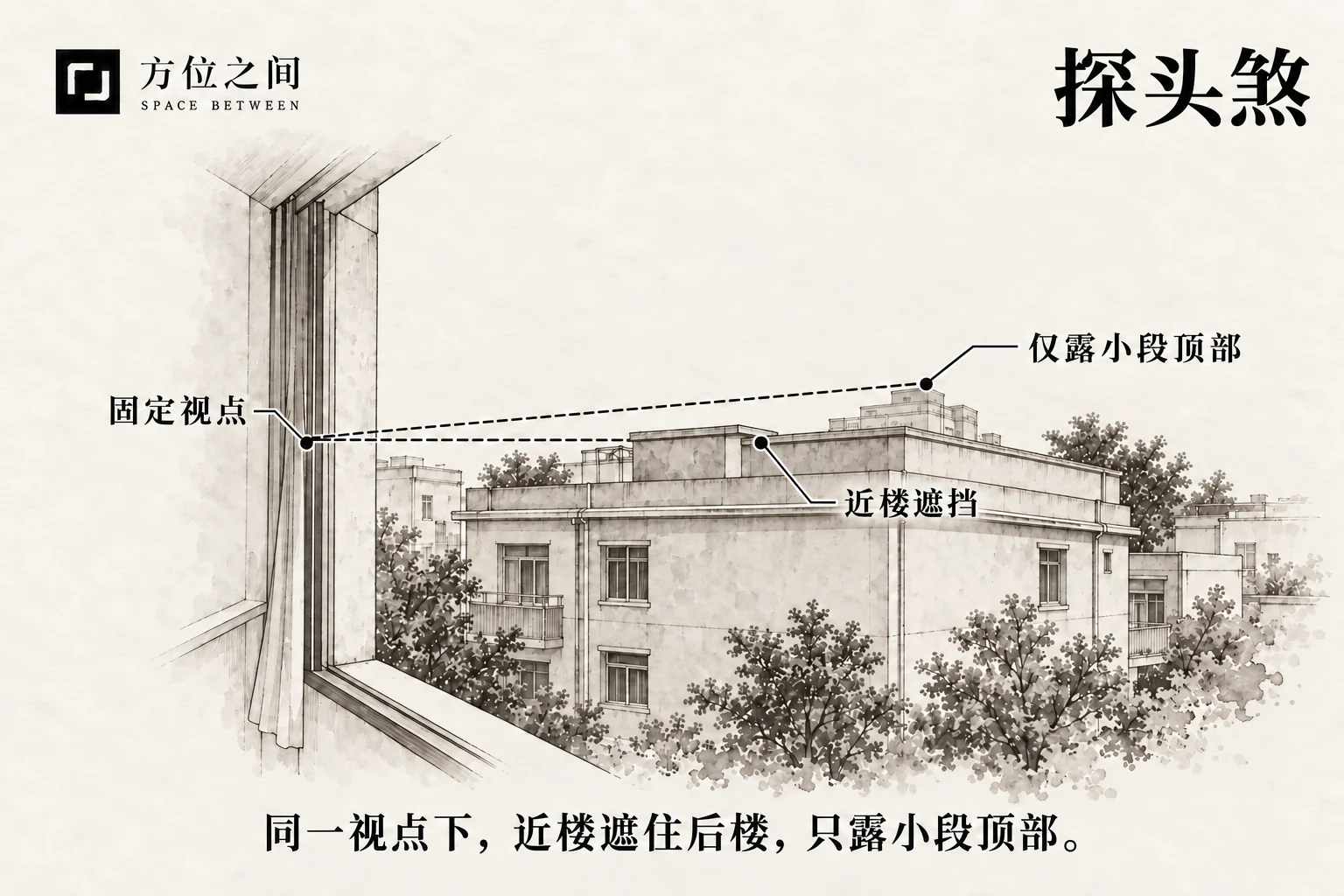
Name and background
The name borrows the image of a head emerging from behind a screen. Modern guides include rooftop tanks and projecting plant rooms, so two complete buildings are not essential. The petty person is a figure in the folklore, not evidence that neighbours are watching or behave badly.
Typical form and comparisons
The typical view has three layers: the observer’s opening, a continuous nearby roofline, and a small mass projecting above it. A fully visible background building calls instead for a comparison of distance and size. Removing the foreground block changes the overlap. Whether the visible portion is a wall, equipment or an occupied window determines what to address.
Sitting and standing at one window give different views. An upward shot beside the glass may exaggerate the projection, while it may disappear deeper inside. Start with everyday views from the sofa, desk or bedside, then add context rather than judging the whole home from a contrived angle.
Traditional reasoning and modern observations
Traditional symbolism reads a partial projection behind a foreground as covert watching and favours a calm, continuous outlook. Yangzhai Cuoyao also uses the image of peeking, but for front corridors and a shade structure; the modern rooftop usage applies that metaphor to a different arrangement.
Modern observation separates an unwelcome silhouette from an actual disturbance. A blank wall does not create mutual overlooking; exposed windows warrant checking sightlines into occupied areas. Shading depends on orientation, height, setback and time, so a small visible roof does not itself establish a dark interior.
How to identify it
First establish what conceals what, then whether the exposed part relates to an occupied position.
- Take a normal-angle view from a usual seat and mark both layers; avoid telephoto distance compression.
- Compare an adjacent room or standing position and identify windows, equipment or a blank wall behind.
- Log the place and time of overlooking, light or plant noise separately; record when only a roof is visible too.
Common points of confusion
An isolated tower compares one building with its neighbourhood; peeking compares overlapping foreground and background. A ridge aligned with a window concerns direction, while a leaking tank concerns equipment. These may coexist but require separate responses. A distant peak above a roof is also different from a neighbour adding a nearby structure.
Effects described in traditional beliefs
The old arrangement in Yangzhai Cuoyao carries a litigation association; Ailan’s modern account mentions malicious people and theft. These are folk narratives, not evidence of events caused by neighbouring buildings.
- Interpersonal trouble: peeking is associated with gossip and hidden obstruction, expressing anxiety about unseen relationships.
- Property loss: modern folklore links watching with theft; actual access, locks and management determine entry vulnerabilities.
Traditional remedies and practical improvements
Begin with a small, specific change; improving a view need not mean blocking the whole window.
- For an unwelcome silhouette, turn the sofa or desk toward a more continuous view while preserving window light and access.
- For facing windows, use adjustable slats or partial frosting at seated sightlines; recheck with lights on at night rather than assuming daytime privacy persists.
- If visible plant causes confirmed noise or light, tell management which equipment, times and rooms are involved so the source or lighting direction can be addressed; plants do not replace sound control.
- Those who value protective customs can consider the author’s symbolic use of a Shanhai Zhen plaque. An existing item may be placed securely in a permitted private spot; purchase is unnecessary, and it should not reflect into neighbours’ windows.
Illustrative example
Suppose a living room overlooks half of a lift plant room above a nearer roof, while the bedroom cannot see it. Turning the sofa slightly toward a courtyard removes it from the main outlook. At night, the real disturbance proves to be plant-room lighting, so management is asked to redirect it. This hypothetical case separates visual preference from a specific light source without blaming the neighbours.
Sources and further reading
These sources help clarify the concepts and their origins. Explaining a traditional term does not establish that it can predict outcomes.