
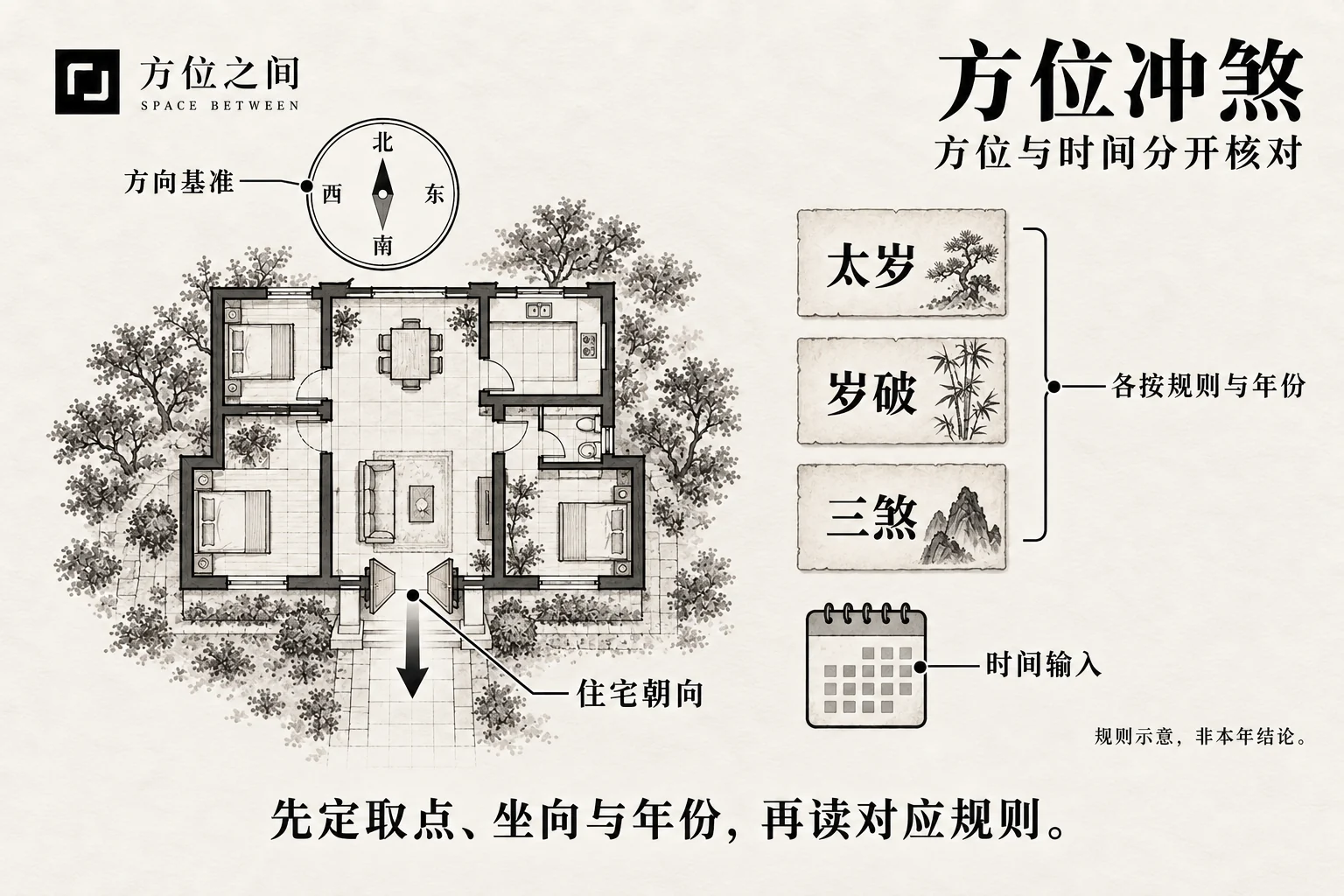
Definition and subject
Fangwei chongsha broadly labels a direction treated as unfavorable in a traditional system. The supplied examples, Taisui and the Three Sha, concern time-dependent directional rules. This differs from a road, door, or corner physically facing an opening. First establish whether the subject is a label on a chart or two objects on site: each needs different evidence and a different kind of diagram.
How to identify it
Before reading a chart, establish the measurement reference, the home's observation point, sitting and facing, and whether the system uses eight directions, twelve branches, or twenty-four mountains. Then record the year, month, and time boundaries. A direction may have different names in different systems. Page-up is not necessarily north, and the direction before a person, before a house, and on a compass are not interchangeable.
Versions, folk interpretations, and source limits
Taisui, Suipo, and the Three Sha are not the same term. The Xieji Bianfang Shu lists the relevant categories separately and should be read using their respective rules. Traditional preferences for stillness or avoiding excavation provide cultural context, not proof of a measurable harmful object in a direction. This entry publishes no permanently unlucky direction detached from its year and predicts no lifespan, wealth, or family relationship.
What to check in the actual setting
Practical building and household plans still need checks of structure, equipment, drainage, daylight, and access. A traditional chart label does not mean foundations or utilities have been inspected; a supposedly favorable sector does not guarantee suitability for openings or extensions. Do not block necessary exits to avoid a direction or move equipment somewhere incompatible with its installation requirements.
Practical improvements and the limits of remedies
For cultural records, retain the original chart, bearing, observation point, date, and version. Compare interpretations only after making inputs consistent. Reversible furniture or scheduling preferences can be negotiated; fixed alterations need assessment of the actual site. Repair real damage promptly rather than waiting for a label to change. Symbolic protective objects cannot replace repairs or guarantee removal of an unspecified effect.
Similar names and common confusions
Suipo is the direction opposing Taisui, while the Three Sha follow a separate grouping rule. These should not be interchanged with zodiac clashes, hour clashes, or opposing doors. This page supplies the concept and checking method; detailed calculations belong to the dedicated Taisui, Suipo, and Three Sha entries. A claim naming an unfavorable direction without its time and system is incomplete information, not a reason to immediately alter doors or a stove.
Sources and further reading
These sources help clarify the concepts and their origins. Explaining a traditional term does not establish that it can predict outcomes.