
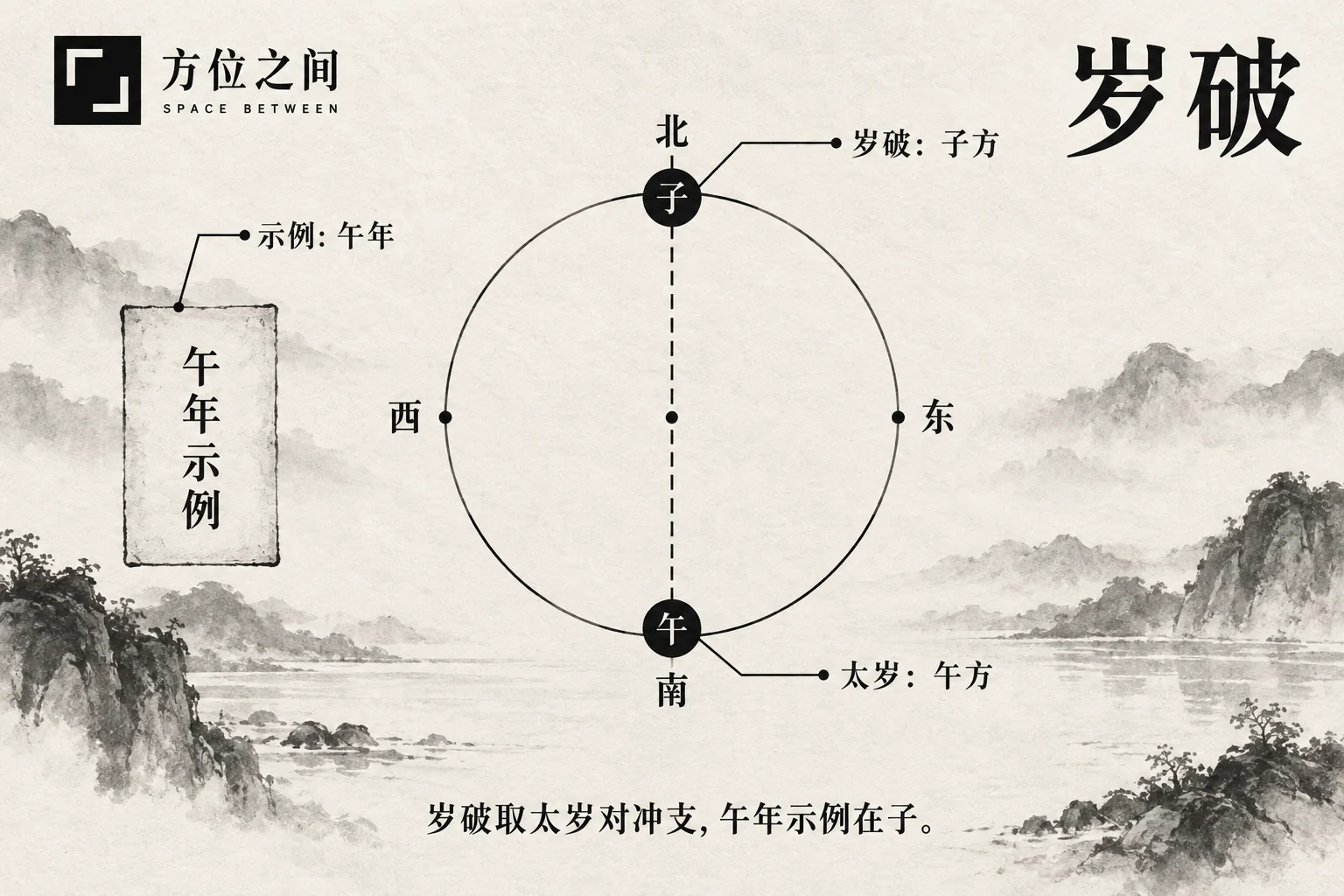
Defining features
On a ring of twelve branches, branches six steps apart oppose each other. Sui Po and Tai Sui form such an axis: Zi–Wu, Chou–Wei, Yin–Shen, Mao–You, Chen–Xu and Si–Hai. This is a symbolic directional assignment, not a physical path of impact through the building.
How to recognize it
Inputs include the target date, year boundary and orientation method. In an established Wu year, Tai Sui is Wu and Sui Po is Zi; in a Zi year they swap. Applying this to a plan also requires measured north and a chosen center. Dates between Lichun and lunar New Year require an explicit choice of year convention.
Common confusions
Sui Po is not each person’s zodiac clash, a road aimed at a home, or a cracked wall. Xieji Bianfang Shu links Da Hao with Sui Po in this system, but Da Hao in another astrology table may mean something else. Shared names do not justify merging different rules or treating an entire floor as one direction.
Folklore and sources
Volume 3 of Xieji Bianfang Shu defines Sui Po through the branch clashing with Tai Sui and gives Wu in a Zi year as an example. Its references to building, stores and wealth belong to traditional prohibitions. The source supplies a checkable placement rule, not modern evidence that living in that direction must cause loss.
Traditional responses and practical improvements
Tradition often advises caution with excavation and disturbance in this direction; this can remain a voluntary custom. Check permits, structural loading, waterproofing and effects on neighbors. Do not delay necessary repairs solely because of Sui Po. Furniture adjustments should preserve comfort and access, without blocking doors or windows or requiring expensive objects.
Sources and further reading
These sources help clarify the concepts and their origins. Explaining a traditional term does not establish that it can predict outcomes.