
Defining features
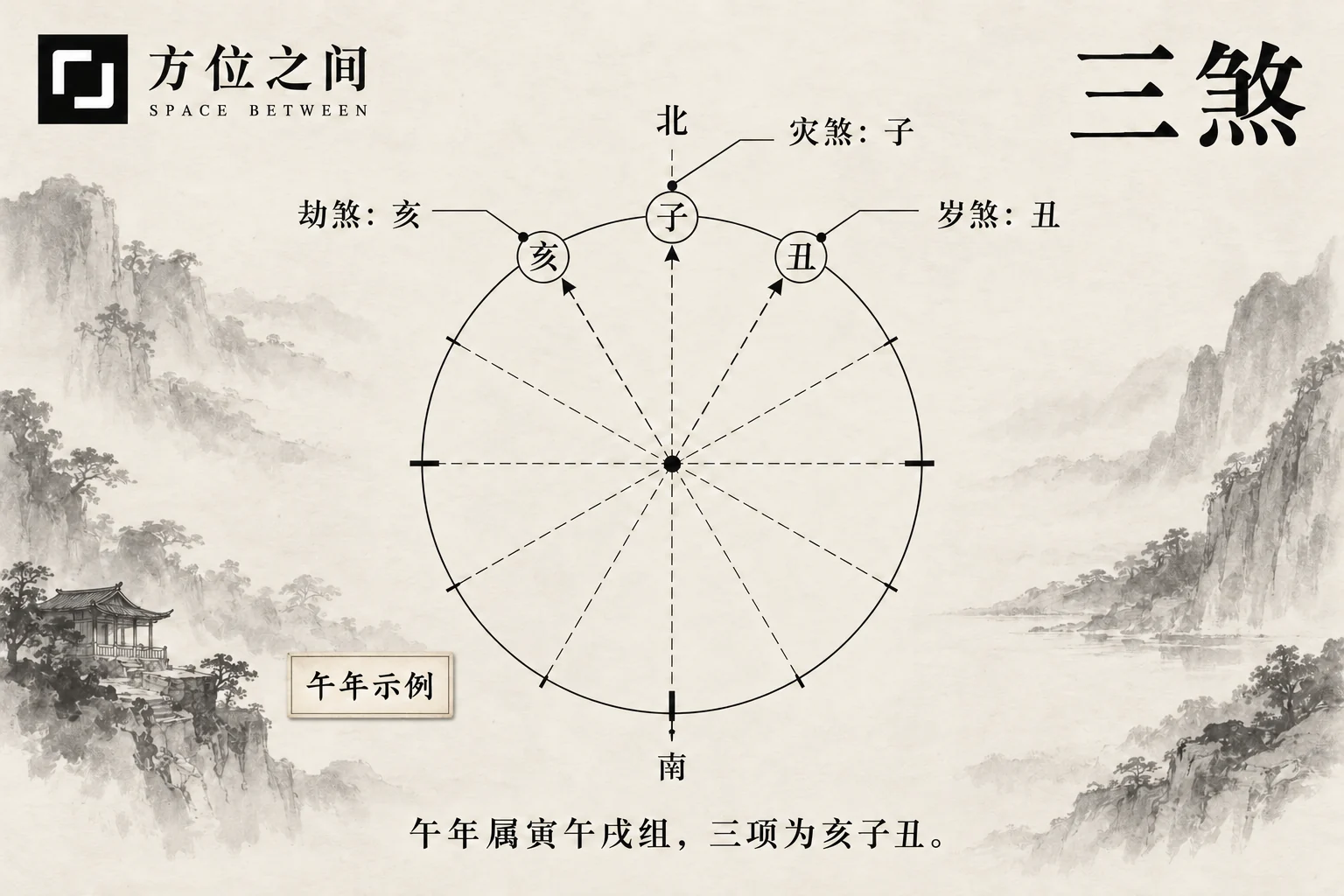
Xieji Bianfang Shu gives these positions in Jie, Zai, Sui order: Shen–Zi–Chen years → Si, Wu, Wei; Yin–Wu–Xu → Hai, Zi, Chou; Hai–Mao–Wei → Shen, You, Xu; Si–You–Chou → Yin, Mao, Chen. Their order matters. Summarizing them merely as south, north, west or east loses the individual assignments.
How to recognize it
Establish the year branch and boundary before choosing its group. A Wu year belongs to Yin–Wu–Xu, giving Jie at Hai, Zai at Zi and Sui at Chou. If the year changes at Lichun, keep the transition time and zone; do not mix in a lunar New Year table. Mapping the result also requires a plan center and north reference.
Common confusions
Annual Three Sha, monthly Three Sha and personal variants using a birth branch have different inputs. This table covers only the annual rule. The twenty-four mountains include intervening stems and trigrams, so do not silently expand three branch positions into a precise angular band. Sui Sha is also not Sui Po merely because the names resemble each other.
Folklore and sources
Volume 3 of Xieji Bianfang Shu lists the three separately and discusses competing explanations. Volume 3 of San Ming Tong Hui treats Jie and Zai Sha in personal astrology. Shared terminology does not imply identical use. Their associations with excavation taboos or misfortune are documented traditions, not inevitable disasters endorsed here.
Traditional responses and practical improvements
Customs include avoiding particular times and directions, limiting disturbance or displaying symbolic objects; none guarantees safety. Real projects require checks of buried services, structure and worksite protection. Arrange home use around noise, circulation and maintenance. If retaining the custom, favor reversible, inexpensive choices that do not obstruct essential repairs.
Sources and further reading
These sources help clarify the concepts and their origins. Explaining a traditional term does not establish that it can predict outcomes.