
Defining features
Shen Shi Xuan Kong Xue associates Five Yellow with Lian Zhen and earth; the center is its basic correspondence, but its distributed position changes. Annual, monthly, period, mountain and facing charts serve different purposes. A single number grid cannot determine an entire room’s fortunes, and traditional distinctions between timely and untimely stars must not be omitted.
How to recognize it
Using the forward palace sequence in Xieji Bianfang Shu, a One White center gives center 1, Qian 2, Dui 3, Gen 4 and Li 5. Five Yellow is therefore south in Li. This illustrates the rule without naming a Gregorian year. Actual year and month charts require declared boundaries, a time zone, and the same center and north reference.
Common confusions
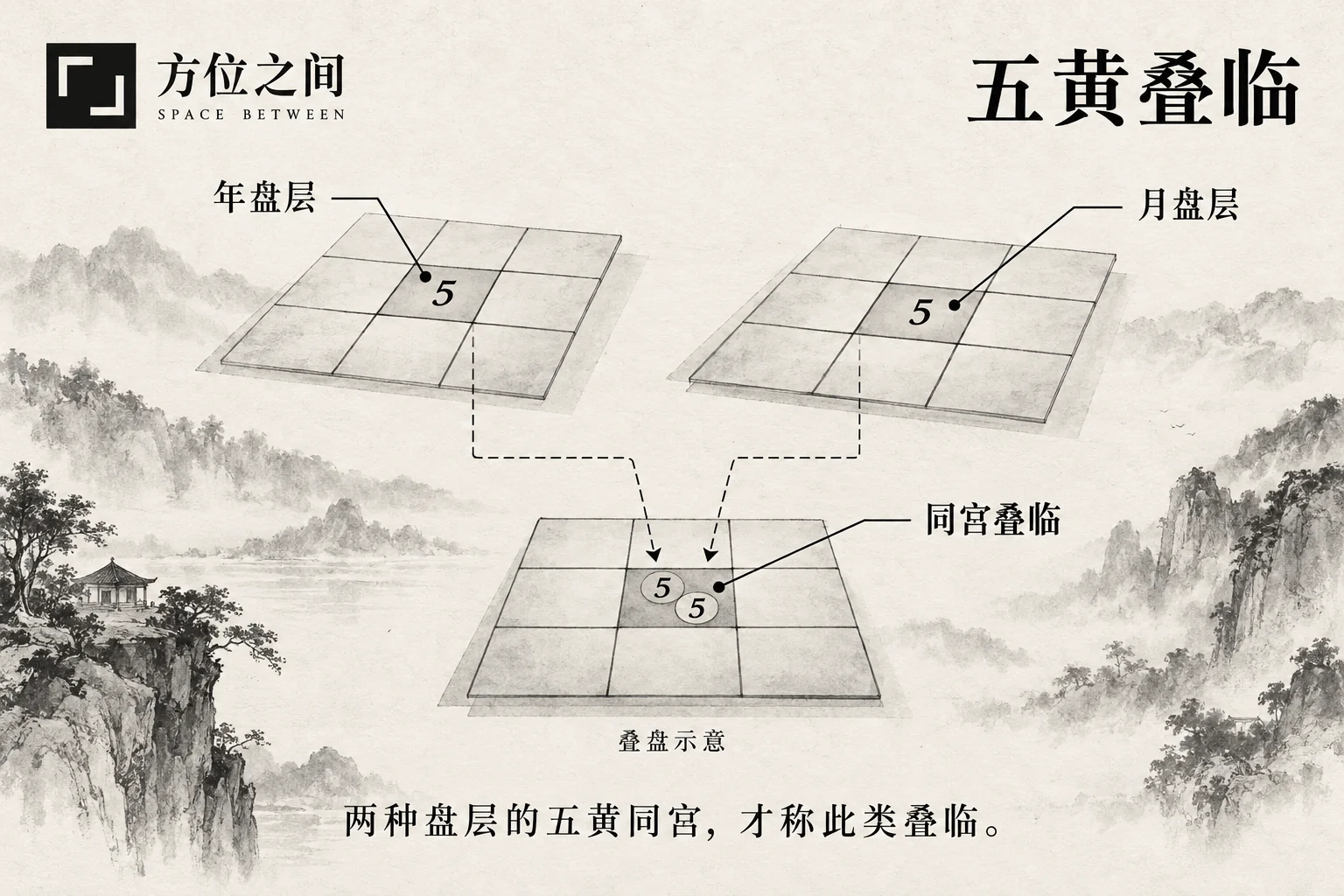
An overlap should specify, for example, annual Five Yellow and monthly Five Yellow in the same palace, or another named pair of layers. A lone 5 is not an overlap. Counting the center’s fixed association with 5 and an arriving 5 as two stars duplicates the symbol. Visits to the same palace in different months are not simultaneous overlaps.
Folklore and sources
Volume 8 of Xieji Bianfang Shu supplies annual and monthly sequences; volume 4 of Shen Shi Xuan Kong Xue explains correspondences and distribution. Treating untimely Five Yellow as unfavorable belongs to Xuan Kong interpretation, not physical pollution classification. Even matching symbols on two charts do not justify predicting someone’s illness or a building accident.
Traditional responses and practical improvements
Popular practice uses metal objects through the symbolic idea that earth produces metal, or advises less disturbance. This does not give copper objects the power to absorb disaster. Check leaks, wiring, falling objects and access routes first. Quiet and tidiness are reasonable; refusing repairs, creating noise or purchasing costly charms is unnecessary.
Sources and further reading
These sources help clarify the concepts and their origins. Explaining a traditional term does not establish that it can predict outcomes.