
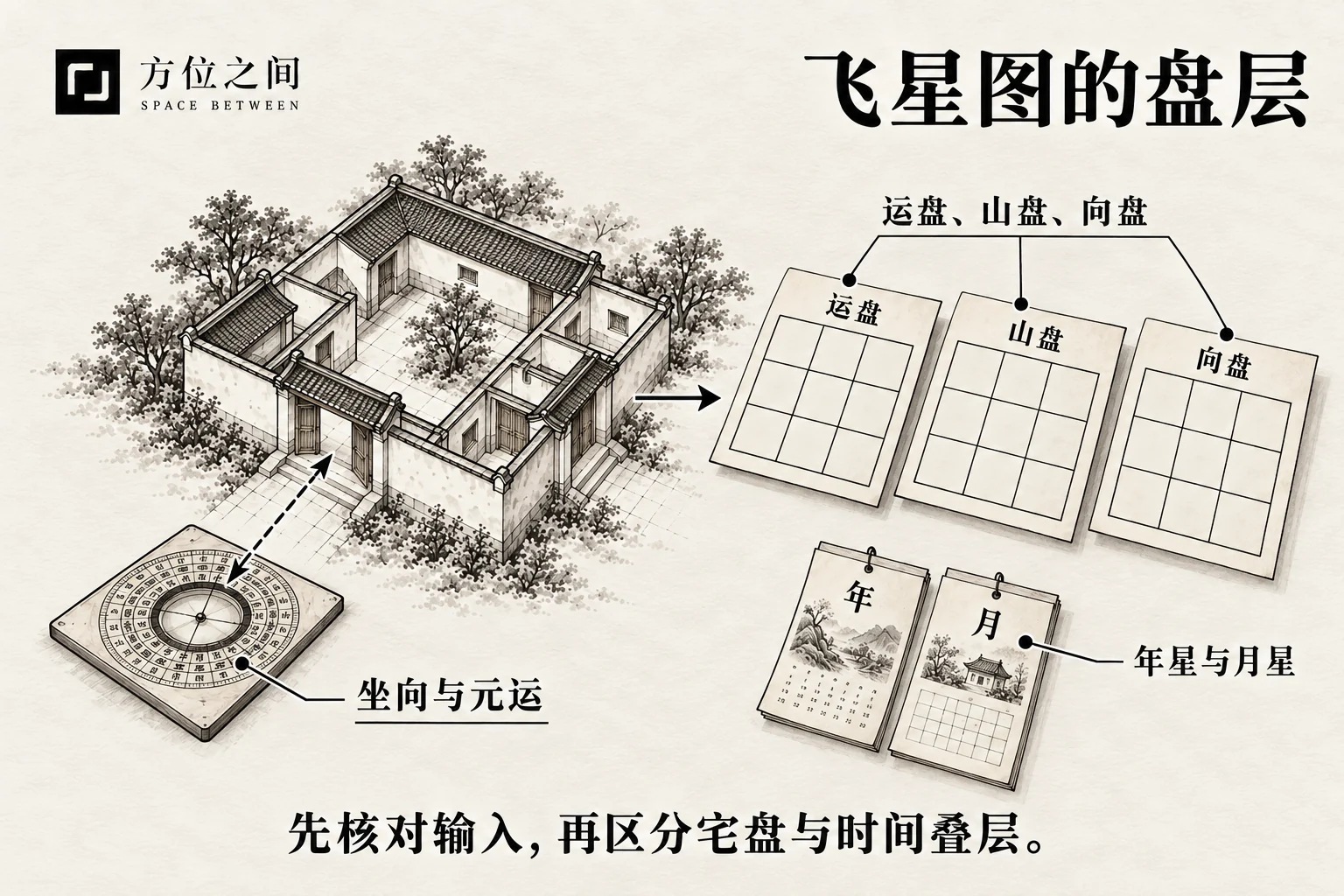
Start with the input record
Record the house-period year and its rationale, raw orientation, true or magnetic north, measured object and twenty-four-direction assignment. A doorway is not automatically the whole house’s facing. State whether the base or replacement-star method is used and why. Near a boundary, preserve the angular range and uncertainty.
Location and content are separate
Palaces denote positions. The period chart supplies a base sequence; mountain and facing charts apply orientation rules; annual and monthly charts are additional time layers. Three numbers in a cell require a legend. Software may put the mountain number on the left or above, so typography cannot identify a layer reliably.
Check the sequence with a period-1 base chart
In the text’s period-1 example, 1 enters the center, followed by Qian 2, Dui 3, Gen 4, Li 5, Kan 6, Kun 7, Zhen 8 and Xun 9. Each digit occurs once. “Forward” follows the Luo Shu sequence, not a clockwise circuit around the outer cells. Rotating the drawing must preserve direction-number pairs.
One example cannot supply every orientation rule
Mountain and facing layers additionally depend on the selected directional group, polarity and forward/reverse rule; replacement stars require further conventions. A correct base does not prove the other layers correct. Compare inputs, starting stars, sequence direction and placement in order. Editing an unfavorable digit destroys traceability.
Correct arrangement does not validate a prediction
The source includes annotations, corrections and fortune claims from different writers. Distinguish text from commentary. An arrangement can be checked against rules without validating claims about wealth, illness or disaster. Real floor-plan assessment still requires evidence on structure, light, ventilation, noise and circulation.
Sources and further reading
These sources help clarify the concepts and their origins. Explaining a traditional term does not establish that it can predict outcomes.