
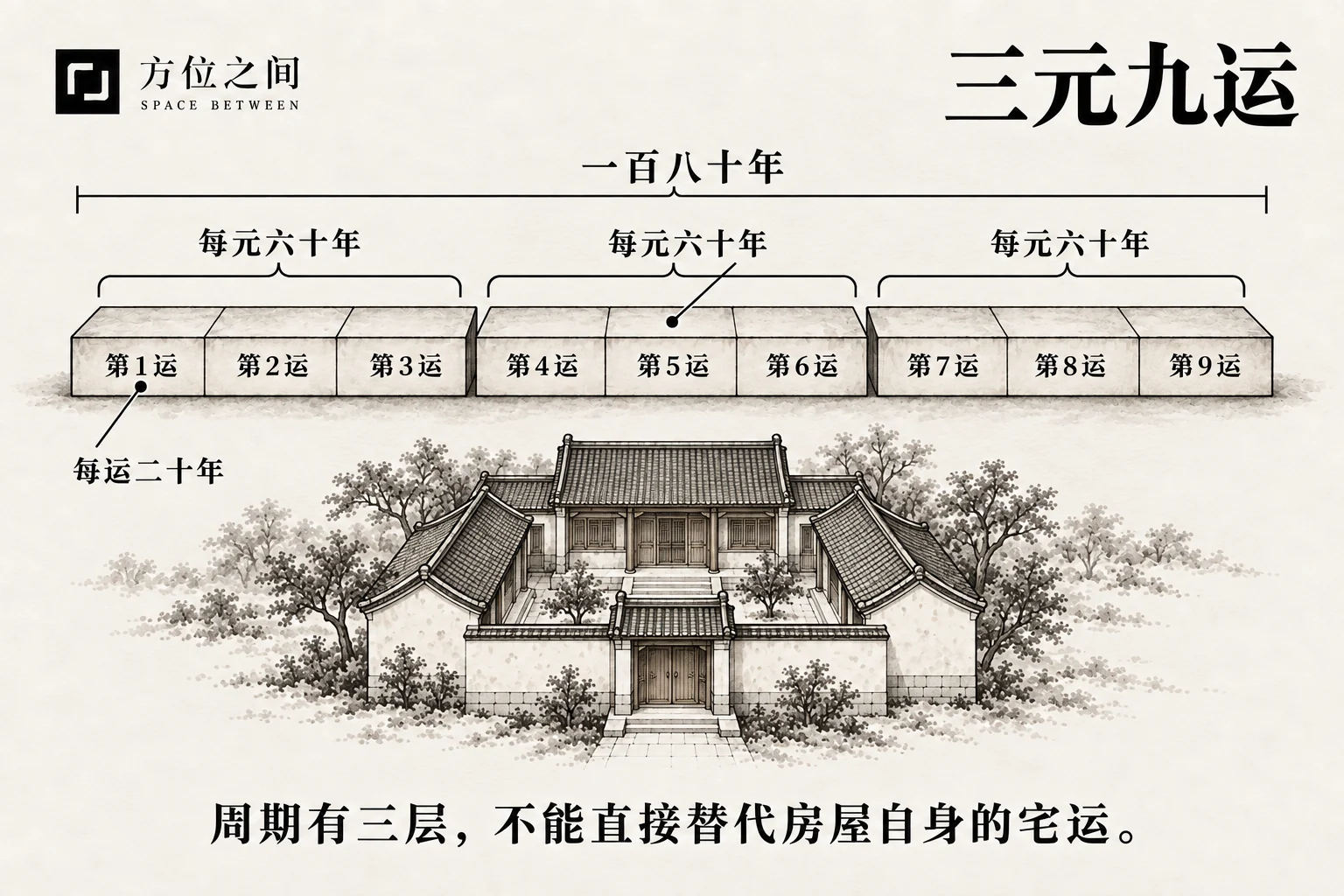
Three nested time scales
Volume 4 of Shen Shi Xuan Kong Xue divides 180 years into upper, middle and lower cycles of sixty years. Each contains three twenty-year periods: 1–3, 4–6 and 7–9 respectively. A sixty-year yuan and a twenty-year yun are distinct, and neither is the ten-year personal luck period used in some natal traditions.
State the starting year
The text uses 1864, the third Tongzhi year, as an upper-cycle start. Extending that reference gives period 7 in 1984–2003, period 8 in 2004–2023 and period 9 in 2024–2043. Each inclusive range contains twenty years. Overlaps or gaps often indicate inconsistent endpoint counting.
A year table does not define the transition instant
“Period 9 begins in 2024” abbreviates a year range. A date near the transition still requires the chosen boundary, such as Start of Spring, and time zone. Keep the actual event time and the boundary rule separate; do not alter a date to obtain a preferred period.
Different house records can coexist in one year
Suppose a documented convention uses 2012 as a house’s start: that date belongs to period 8. In 2026 retain it, while recording the current period 9 and annual layer separately. “Now in period 9” does not mean “built in period 9.” Rules for construction, occupation or major rebuilding differ and require evidence.
A period label is not a real-world guarantee
The original uses periods interpretively; it does not establish synchronized industry cycles, property prices or personal outcomes. Twenty years is not a structural inspection or equipment replacement standard. Separating theory, evidence, calculation and site observations avoids letting a single “timely” label replace a housing assessment.
Sources and further reading
These sources help clarify the concepts and their origins. Explaining a traditional term does not establish that it can predict outcomes.