
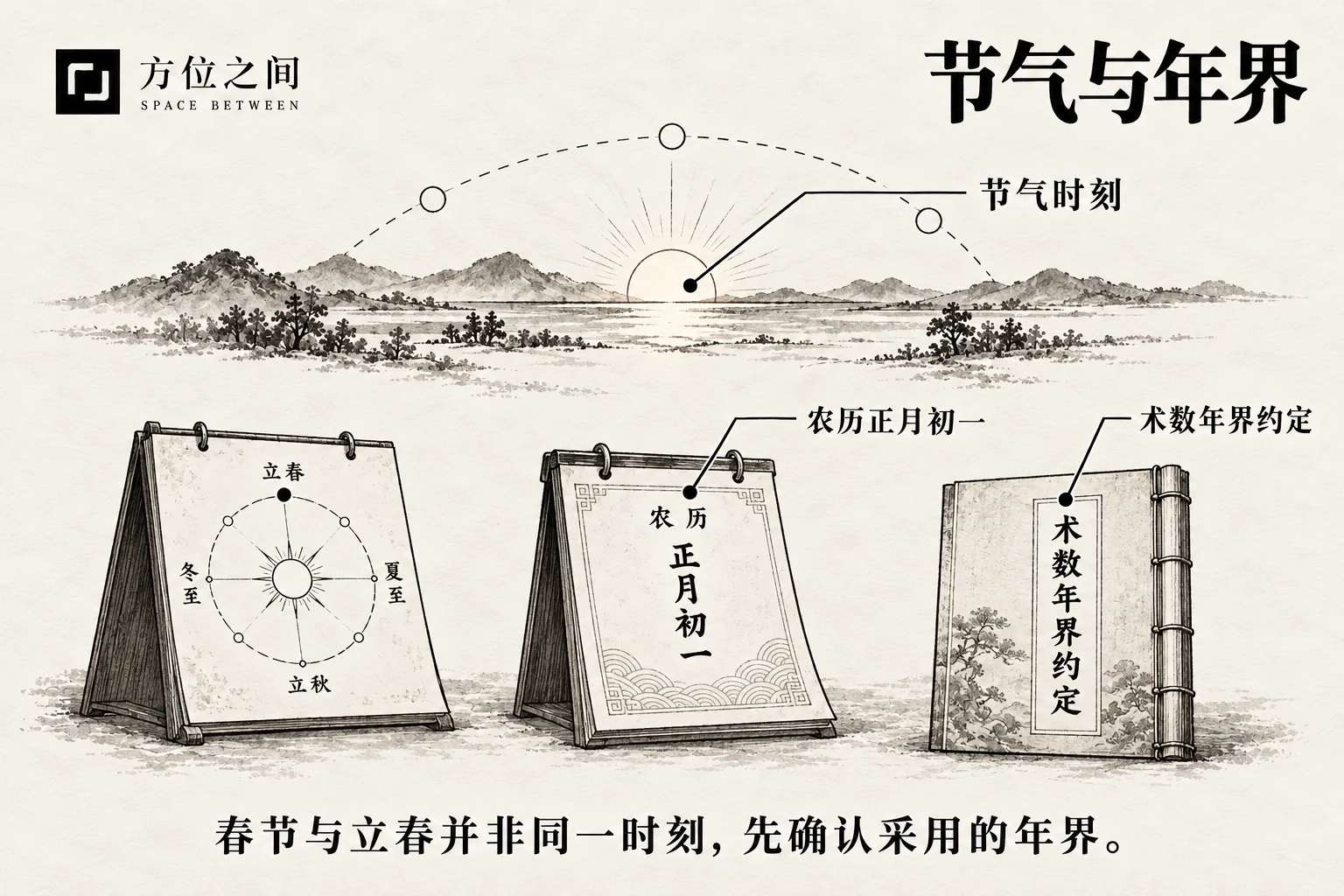
Solar terms are astronomical instants
The terms mark the Sun’s apparent ecliptic longitude at 15° intervals around 360°. The spring equinox is 0°, summer solstice 90° and Start of Spring 315°. Astronomical tables can verify their times. Their seasonal names reflect regional experience, not identical weather or biological changes worldwide.
Lunar months and solar-term months have different boundaries
Lunar months begin on new-moon days, with solar terms helping coordinate months and seasons and leap months added when required. A common Four Pillars convention instead divides months at twelve jie: Start of Spring to Awakening of Insects is Yin month. Rain Water lies within it; not every solar term changes the pillar month.
Compare two dates in 2018
The Hong Kong Observatory identifies 4 February as Start of Spring and 16 February as Lunar New Year in 2018. On 10 February, the lunar-year convention still gives Ding-You, while a Start-of-Spring convention gives Wu-Xu. Both need their conventions recorded; choosing the preferred answer without its basis is misleading.
A date alone is insufficient on a transition day
A term occurs at a specific instant, expressed in local time through a time zone. “Born on Start of Spring” is insufficient to locate the birth on either side. Keep local time, zone and almanac version; historical records also require their timekeeping context. Missing time must not be silently replaced by midnight.
Separate astronomy from interpretive conventions
Solar-term times can be cross-checked; choosing a boundary for a divinatory chart is a convention. Align inputs and conventions before comparing algorithms. Calendar precision does not validate fortune interpretations, and solar terms do not replace observations of local weather, sunlight or indoor comfort.
Sources and further reading
These sources help clarify the concepts and their origins. Explaining a traditional term does not establish that it can predict outcomes.