
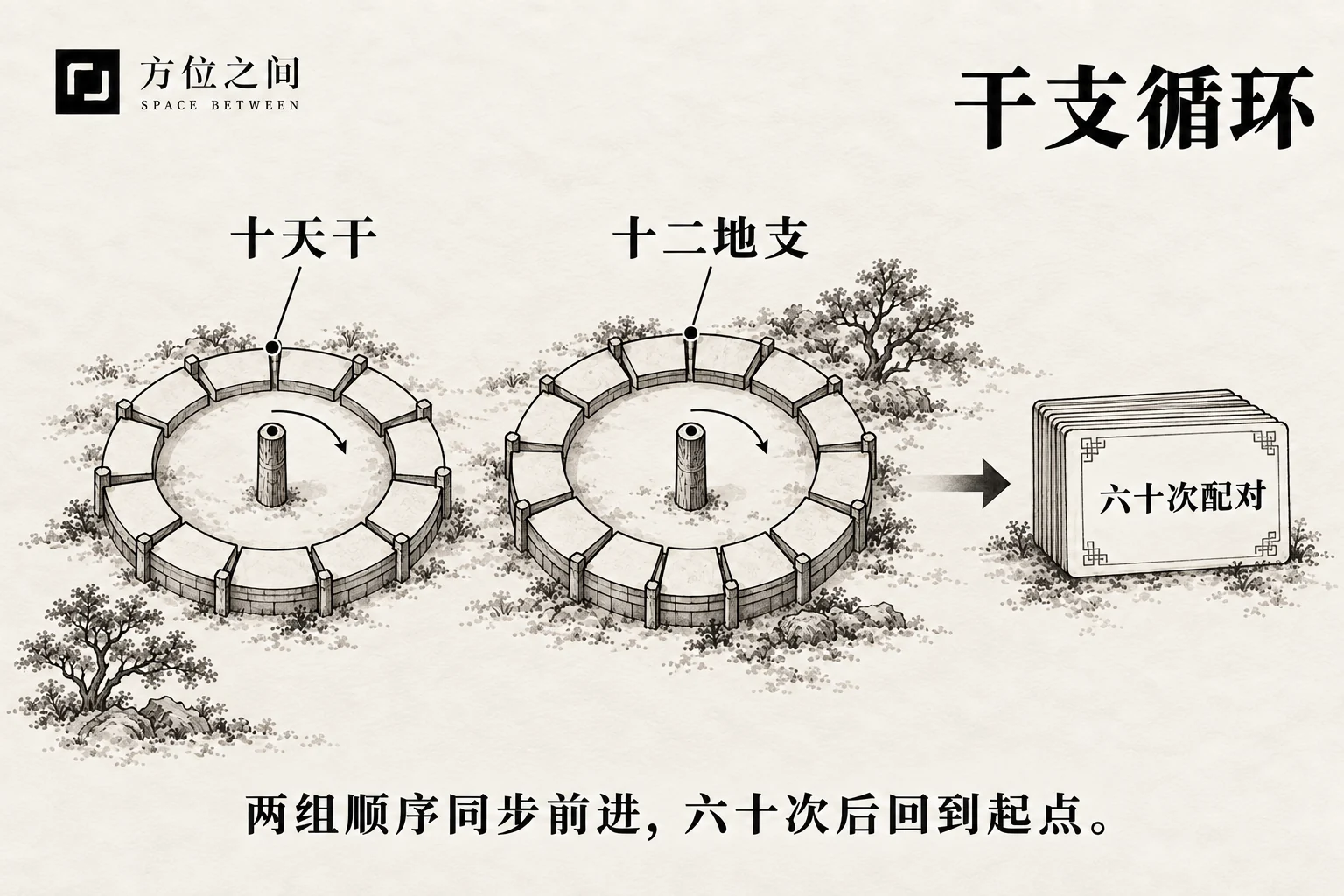
Two sequences advance together
The ten stems run from Jia to Gui and the twelve branches from Zi to Hai. Both advance one position at a time, producing Jia-Zi, Yi-Chou, Bing-Yin and so on. They return together after sixty steps, the least common multiple of ten and twelve. This is an ordered cycle, not every possible combination of the two lists.
Parity helps detect mistakes
In this sequence Jia, Bing, Wu, Geng and Ren pair with Zi, Yin, Chen, Wu, Shen and Xu; the other five stems pair with the other six branches. Jia-Zi and Jia-Xu occur, but Jia-Chou does not. An impossible pair should prompt a check for transcription, OCR or column errors before a new interpretation is proposed.
Check the tenth and eleventh entries
Number Jia-Zi as entry 1: entry 10 is Gui-You and entry 11 is Jia-Xu. The stem restarts while the branch continues. Entry 60 is Gui-Hai; entry 61 returns to Jia-Zi. Two lists suffice to verify this by hand and expose software that incorrectly resets both after ten entries.
The same label is not the same instant
Years, months, days and hours use these labels through different conversions. An era name or Gregorian year resolves the repeating sixty-year ambiguity. Month stems depend on the year stem; hour stems depend on the day stem. Identify the time scale of Jia-Zi, and never infer a complete pair or four pillars from an animal sign alone.
Keep a traceable conversion record
Save the original date, calendar, time zone and year/day boundaries together. A lunar date also needs its leap-month status. Mark unknown times as unknown rather than silently using midnight. The numbering is reproducible; claims about character, marriage or wealth are a separate interpretive layer that the calculation does not establish.
Sources and further reading
These sources help clarify the concepts and their origins. Explaining a traditional term does not establish that it can predict outcomes.