
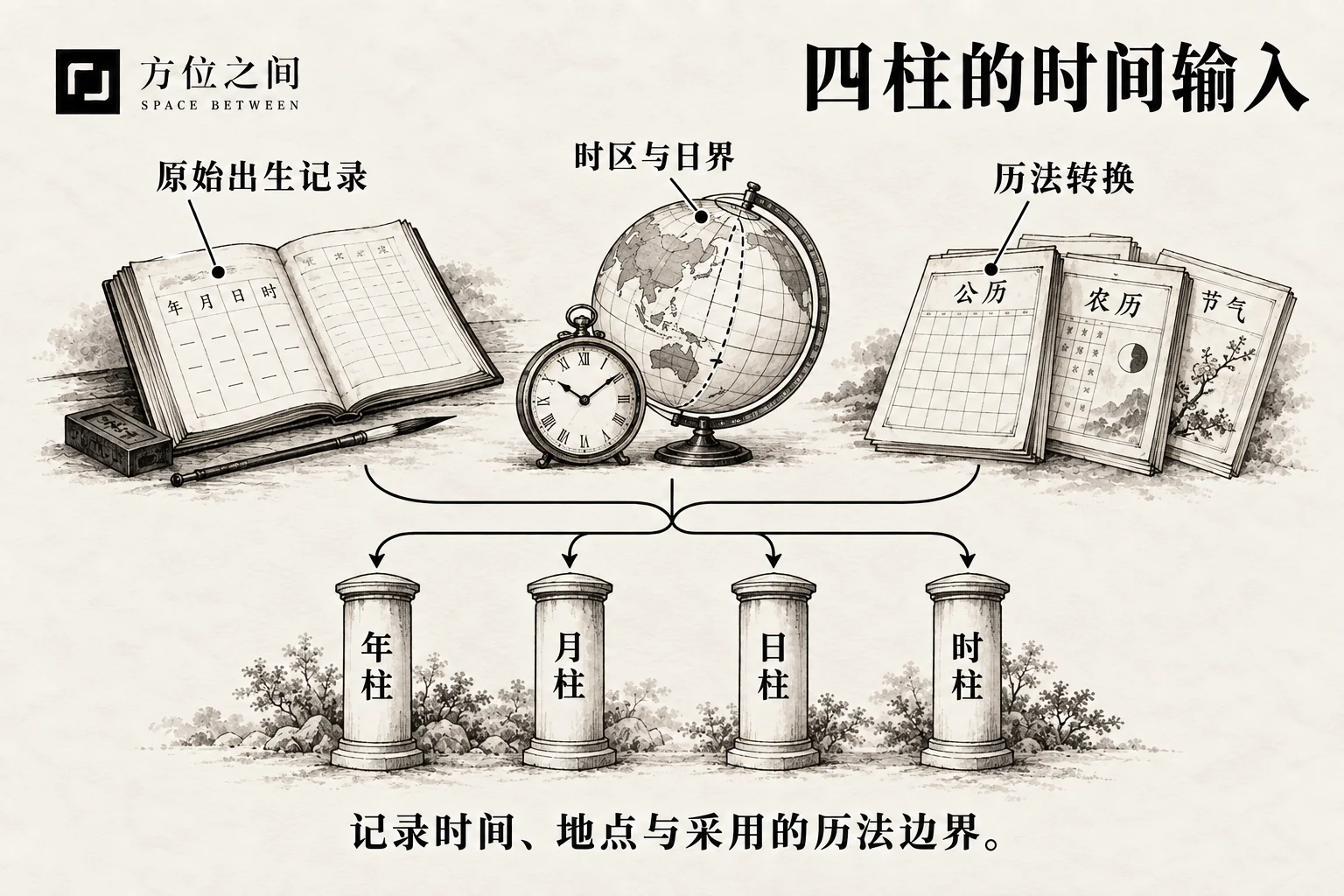
Inputs must contain more than eight characters
Keep the original date, time, birthplace, calendar and applicable time zone; lunar input needs a leap-month flag. Accepted input is not necessarily unambiguous. Mark oral recollections as approximate, and flag uncertainty about historical daylight saving, local timekeeping or conversion versions.
Year and month pillars are not copied from the civil calendar
Some Four Pillars traditions change the year at Start of Spring and the month at twelve jie. These are not 1 January, civil month starts or lunar new moons. After finding the month branch, derive its stem from the year stem. Renaming civil months with branches is insufficient; check the source’s convention.
The day boundary can also change the hour stem
The twelve double-hours commonly place Zi at 23:00–01:00. The start of Zi and a stem-branch day boundary are not identical in every school: conventions use 23:00, distinguish early/late Zi, or handle midnight separately. Since the hour stem depends on the day stem, a boundary change can affect both pillars.
Verify one conversion step at a time
In the Observatory’s table 4, Yin month of a Jia or Ji year takes Bing, giving Bing-Yin. Table 5 gives Jia-Zi for Zi hour on a Jia or Ji day. The first uses the year stem; the second uses the day stem. These check table lookup, not a complete personal chart without a full date.
Do not present defaults as birth facts
Keep unknown times blank or show a range. Any apparent-solar-time correction needs a stated basis and the original civil time retained. Do not adjust inputs to obtain a preferred interpretation. Four Pillars can index historical texts; consistent calculation is not reliable evidence about health, career or relationships.
Sources and further reading
These sources help clarify the concepts and their origins. Explaining a traditional term does not establish that it can predict outcomes.