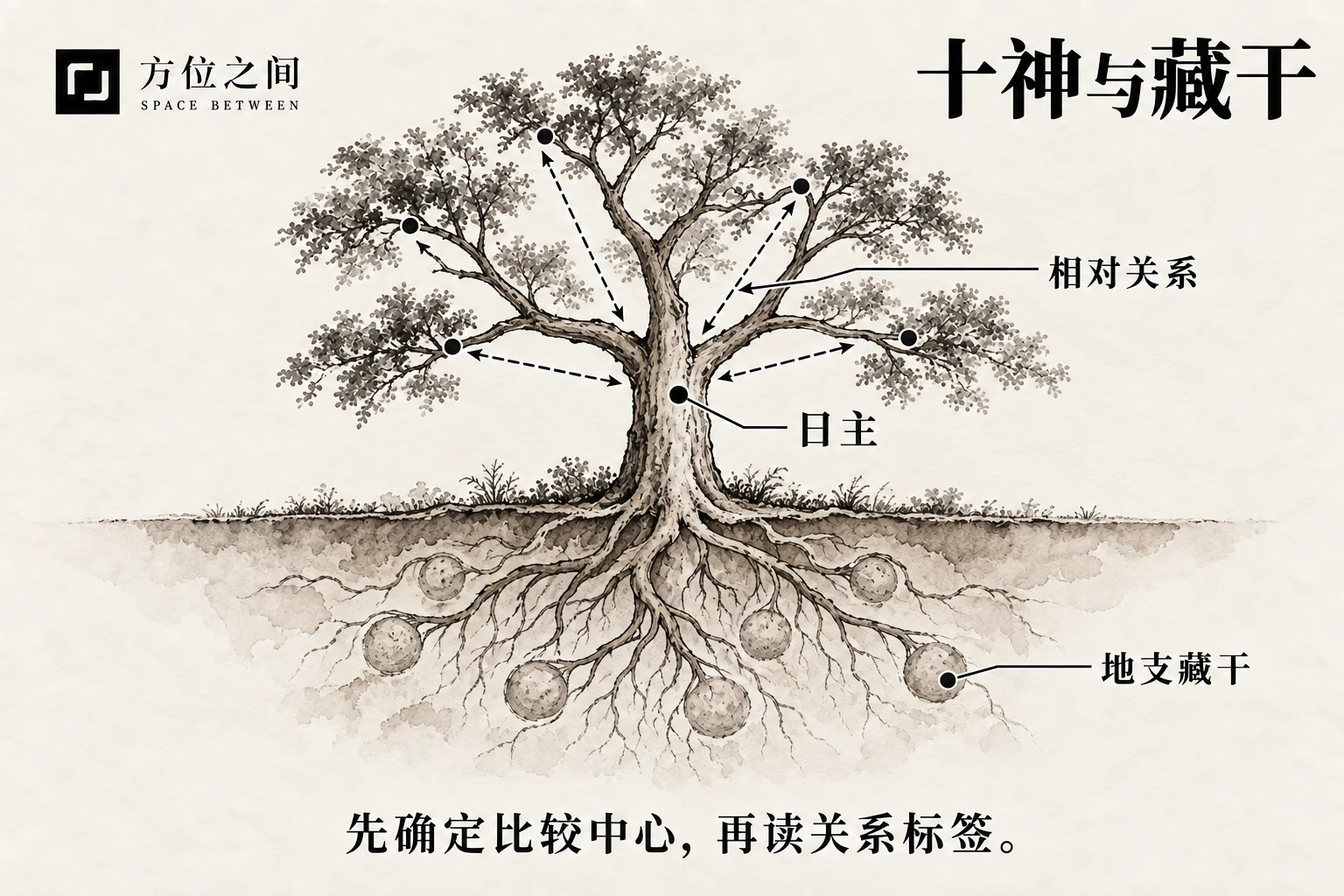
Ten Gods and hidden stems: identify the reference first
Compiled by the Space Between editorial team4 min readContent library updated
Enlarge diagramOriginal Space Between diagram. Lines explain spatial or rule relationships; see the article for the conditions.
Separate the day stem, phase direction, polarity and concealed stems to understand relational labels.
Direct Officer and Seven Killings are relational outputs, not identities. Write down the day stem and the other stem’s phase and polarity. Changing the reference can change the label assigned to the same stem.
Five relations, then polarity
Relative to the day stem, distinguish same phase, generated by me, controlled by me, controlling me and generating me, then split by polarity. The conventional ten names use social metaphors: Peer, Rob Wealth, Eating God, Hurting Officer, Indirect/Direct Wealth, Seven Killings, Direct Officer and Indirect/Direct Resource. They are not occupations or danger diagnoses.
Jia meeting Geng or Xin
With Jia Wood as the day master, both Geng and Xin Metal control Wood. Jia and Geng are yang, giving Seven Killings, also called Indirect Officer; yin Xin gives Direct Officer. Volume 5 of San Ming Tong Hui distinguishes them. This verifies nomenclature, not a civil-service career, litigation or personality.
Hidden stems form another layer within branches
Hidden-stem tables associate a branch with one or more stems, often classified as principal, middle and residual qi. Compare each with the same day stem rather than assigning one Ten-God label from the branch’s phase alone. Ordering and inclusion vary; record the table instead of treating a software display as universal.
A hidden-stem list is not a seasonal day-allocation table
The text’s discussion of renyuan sishi allocates activity within a month. That temporal interpretation is not automatically a static hidden-stem table, nor do its day counts describe bodily element percentages. Before comparing lists, ask whether they identify included stems or the times assigned to them.
Check premises before counting labels
A label’s frequency alone establishes neither strength nor a configuration or outcome; further traditional judgments have separate premises. Audit day stem, other stem, phase direction, polarity and label, preserving gaps and disagreements. Assess people through actual conduct and context, not terminology.
Sources and further reading
These sources help clarify the concepts and their origins. Explaining a traditional term does not establish that it can predict outcomes.