
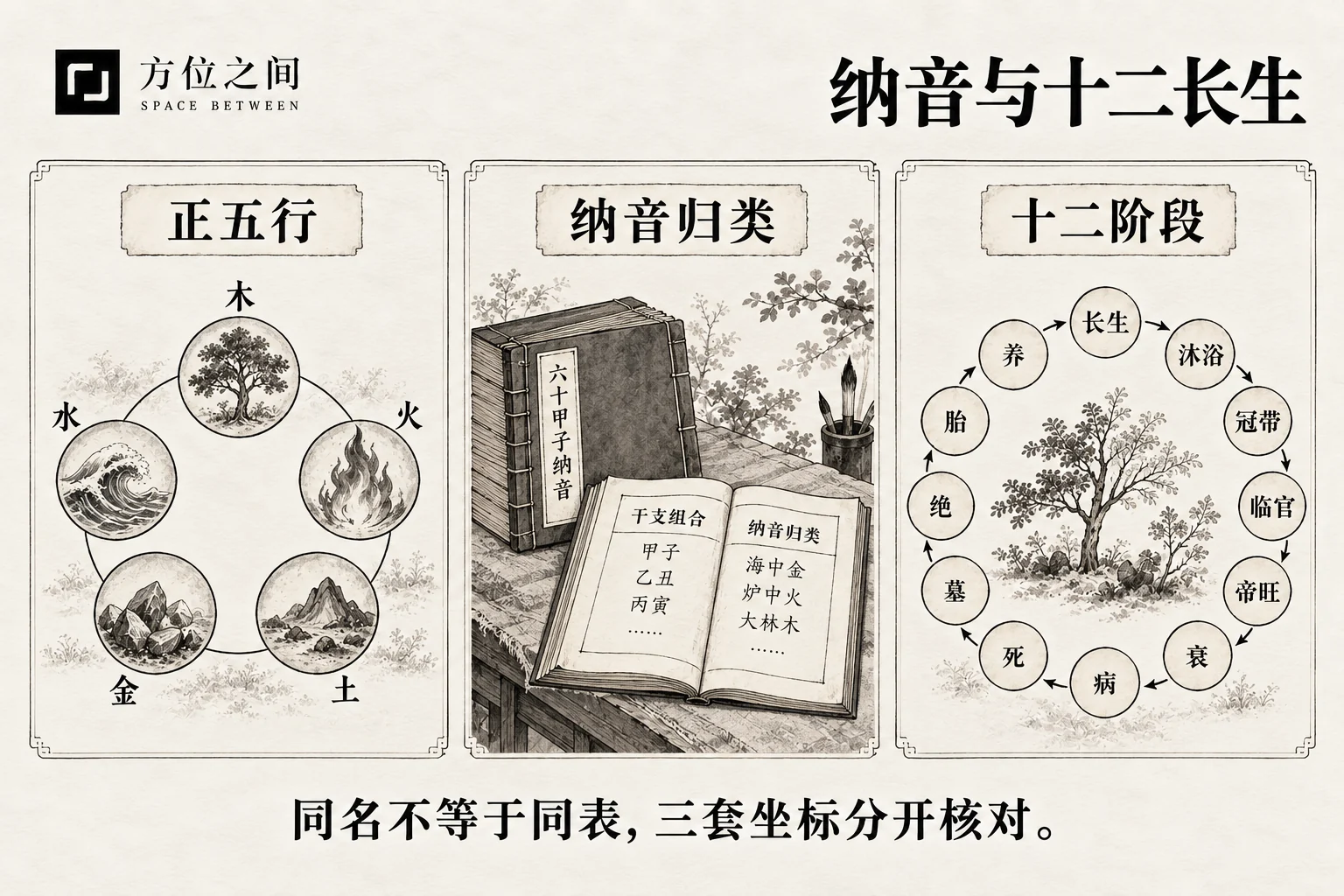
Nayin classifies complete pairs
Nayin pairs neighboring entries of the sixty-part cycle into thirty groups with a phase and image-name. Volume 1 of San Ming Tong Hui discusses Jia-Zi and Yi-Chou as Metal in the Sea. A stem or branch alone is insufficient; a phase such as Metal cannot uniquely identify the original pair.
Jia-Zi can carry Wood, Water and Metal
In Jia-Zi, Jia is Wood and Zi is Water in the ordinary phase mapping, while the pair’s nayin is Metal. These labels refer to different objects. Display them separately. Rewriting “Jia-Zi has Metal nayin” as “the stem Jia is Metal” wrongly transfers a pair-level property to one component.
The twelve stages describe a relative position
The sequence is Growth, Bathing, Cap and Belt, Taking Office, Peak, Decline, Illness, Death, Tomb, Severance, Embryo and Nurture. A result needs a reference stem or phase, a queried branch and a direction. “Peak” alone does not identify whether it compares day stem with month branch, a pillar with itself or a nayin scheme.
The same phase may have different starting points
Volume 2 places Jia Wood’s Growth at Hai and Yi Wood’s at Wu. “Wood grows at branch X” therefore omits essential context. Phase-configuration and nayin schemes use other conventions, especially for Earth. Compare table names, starting positions and direction before transferring a result.
Do not read stage names as literal life diagnoses
Illness, Death and Tomb are sequence names, not medical conditions, death dates or burial locations. Metal in the Sea does not prescribe metal objects or seawater. Keep the source context and edition, separating lookup from imagery. These labels alone should not decide housing, health or finances.
Sources and further reading
These sources help clarify the concepts and their origins. Explaining a traditional term does not establish that it can predict outcomes.