
Eastern and western are group names
Ba Zhai Ming Jing groups Kan, Zhen, Xun and Li as eastern, and Kun, Qian, Dui and Gen as western: numbers 1, 3, 4, 9 versus 2, 6, 7, 8. “Eastern” does not mean only due east. Record the actual trigram before its group so directional information is not lost.
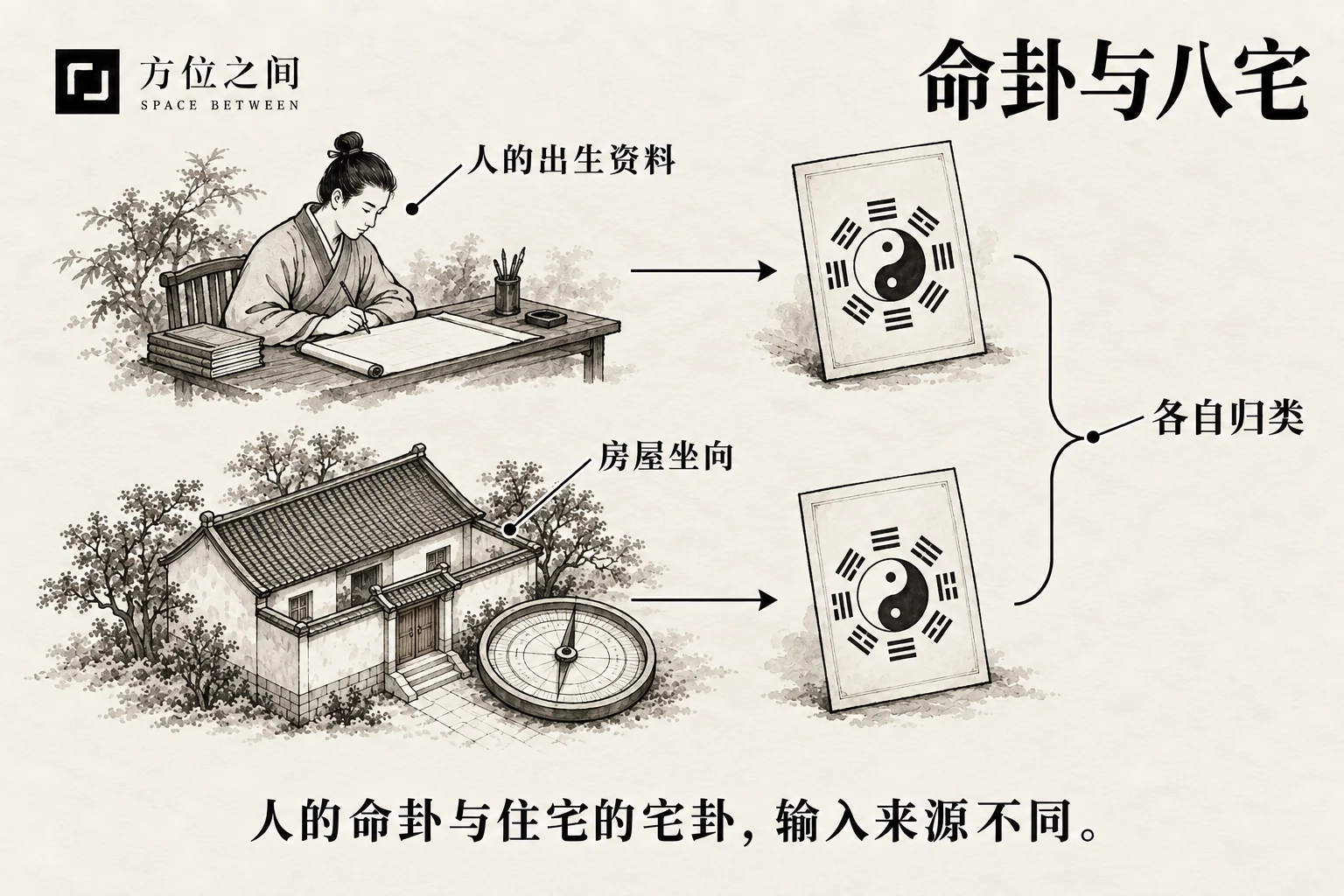
Keep personal and house inputs separate
Personal tables commonly use birth year and historical male/female counting rules, with a stated year boundary. These are conventions, not measures of identity or worth. House methods must specify building, dwelling or room, and whether sitting or a doorway-based rule is used. A shared “Eight Mansions” label does not erase methodological differences.
Check central reassignment at a textual starting point
In the original upper-cycle Jia-Zi example, the male sequence begins at Kan 1 and the female sequence at central 5. Since the center has no separate trigram, a female 5 is assigned to Gen 8 and a male 5 to Kun 2. Preserve both the intermediate number and reassignment rule; do not discard 5 or replace it identically in both sequences.
Do not transfer labels between systems
Fu Wei, Sheng Qi, Tian Yi and Yan Nian classify trigram relations in Eight Mansions. Its Sheng Qi is not automatically “the other generates me” in a five-qi scheme, nor Xuan Kong timeliness. The same word can belong to different tables. Identify the reference gua, compared direction, table version and derivation.
A symbolic match does not assess a home
A household can include different personal gua and shared or private rooms. A grouping should not justify exclusion, family conflict or ignoring practical needs. Historical auspiciousness claims are not guarantees. Assess dimensions, accessible circulation, light, quiet and shared routines before discussing cultural preferences.
Sources and further reading
These sources help clarify the concepts and their origins. Explaining a traditional term does not establish that it can predict outcomes.