
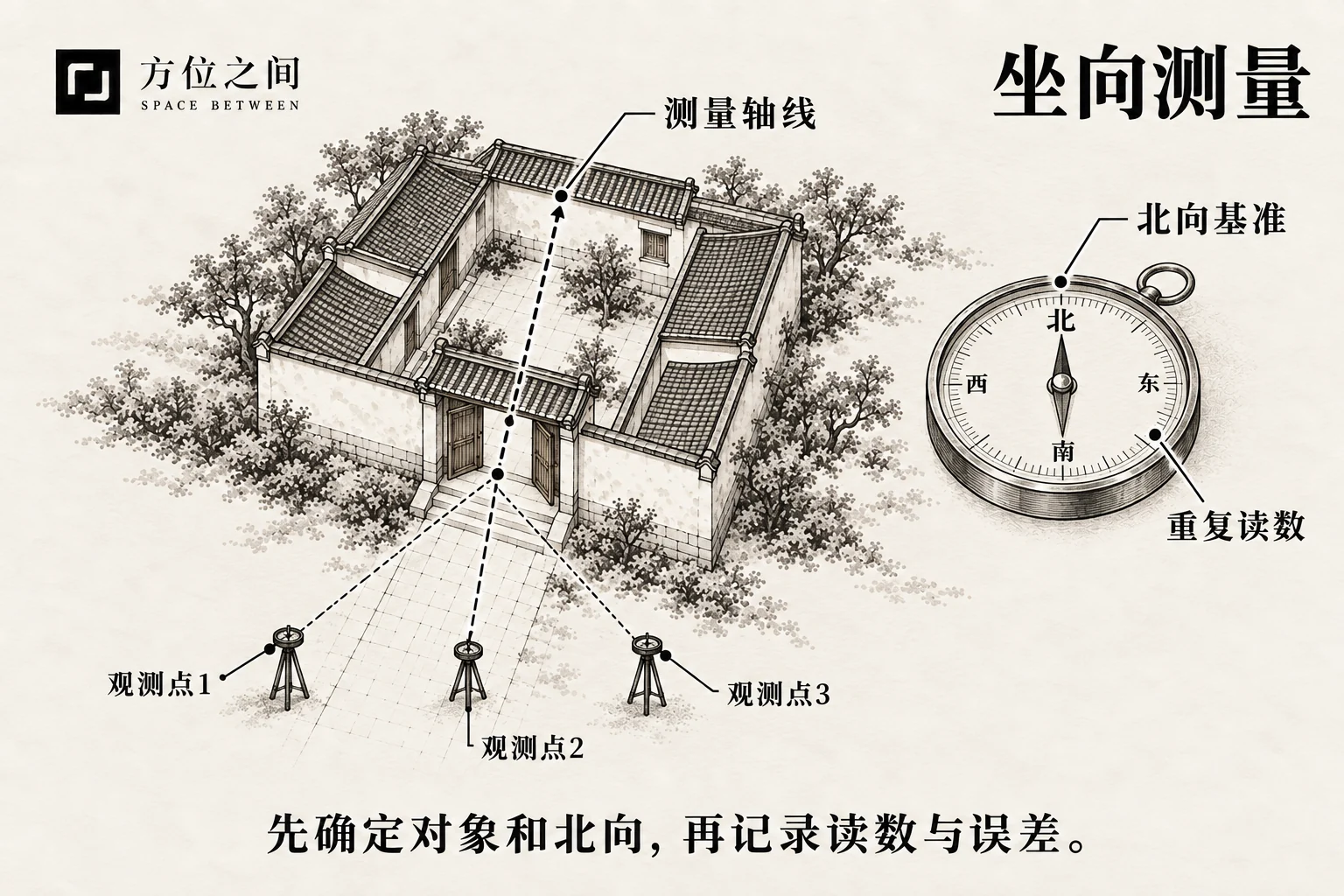
Define the object being measured
Sitting and facing are opposite ends of a specified axis, half a turn apart. A doorway, balcony edge, main facade and whole-building axis may point in different directions; door orientation does not automatically define the building orientation. Mark the start, end and outward arrow on the plan, and identify the object. When comparing traditional approaches, preserve their respective definitions rather than treating a difference in definitions as instrument error.
Prepare a base plan before measuring
Mark the measured door, window or facade on a floor plan and label indoors and outdoors. If the plan has no reliable north reference, do not assume that the top of the screen is north. Choose an axis that can be aligned consistently, then select observation points. Changing from a doorway to a window or facade is a change of subject, even if the readings happen to be similar.
- Device and mode: record the phone or compass model, application, and magnetic- or true-north mode. Write “reference unconfirmed” when uncertain.
- Position and interference: photograph the reading location and note nearby metal doors, appliances or magnetic phone accessories. Keep the axis consistent when repeating measurements.
State whether north is magnetic or true
A compass derives its direction from a magnetic field, while geographic north points toward the geographic North Pole. Magnetic declination, the angle between them, varies with place and time. Check a phone’s true-north setting instead of assuming that devices share a reference. With east-positive and west-negative declination, true bearing equals magnetic bearing plus declination, reduced to one full turn. State separately which reference a traditional method uses.
Check a bearing conversion
Suppose the magnetic bearing is 170° and local declination on that date is 4° west. The true bearing is then 166°, and its opposite is 346°. This illustrates a conversion; the 4° value is not portable to other locations. Readings of 359° and 1° both lie near north, so their ordinary arithmetic average of 180° is misleading. Treat directions as circular and retain the original readings, not just a mountain label.
Preserve uncertainty in the record
Metal structures, magnetic accessories and the surroundings can affect a phone compass. Move away from obvious interference, repeat the same axis from different positions, and record time, device, position and reading range. If a sector boundary is 7.5°, readings from 7° to 8° do not establish a unique category. Extra decimal places cannot remove that uncertainty. Everyday floor-plan records aid communication; construction setting-out requires appropriate surveying methods.
What a reproducible record looks like
Example record: the outward normal of the living-room window on the south side; point A inside the window and point B aligned in the same direction; one device in magnetic-north mode; readings at A of 169°, 170° and 170°, and at B of 170° and 171°; a metal window frame present. “South side” describes the location, not an exact bearing. Preserve the 169°–171° spread and check possible interference instead of choosing one reading as the sole correct value.
Only then convert readings using a stated north reference and compare them with directional sectors, recording the date and location. Keep the window bearing, the building bearing and any dwelling axis selected by a particular tradition as separate records. Later discussions about furniture, sunlight or traditional directions can then refer to the correct axis.
Sources and further reading
These sources help clarify the concepts and their origins. Explaining a traditional term does not establish that it can predict outcomes.