
Where the twenty-four names come from
The ring combines the twelve earthly branches, eight heavenly stems excluding Wu and Ji, and the trigrams Qian, Kun, Gen and Xun. Clockwise from Zi in the north come Gui, Chou, Gen, Yin, Jia, Mao and the remaining positions, returning to Zi. Ren-Zi-Gui mark the north group, Jia-Mao-Yi the east, Bing-Wu-Ding the south and Geng-You-Xin the west. These subdivide directional regions; they are not twenty-four types of house.
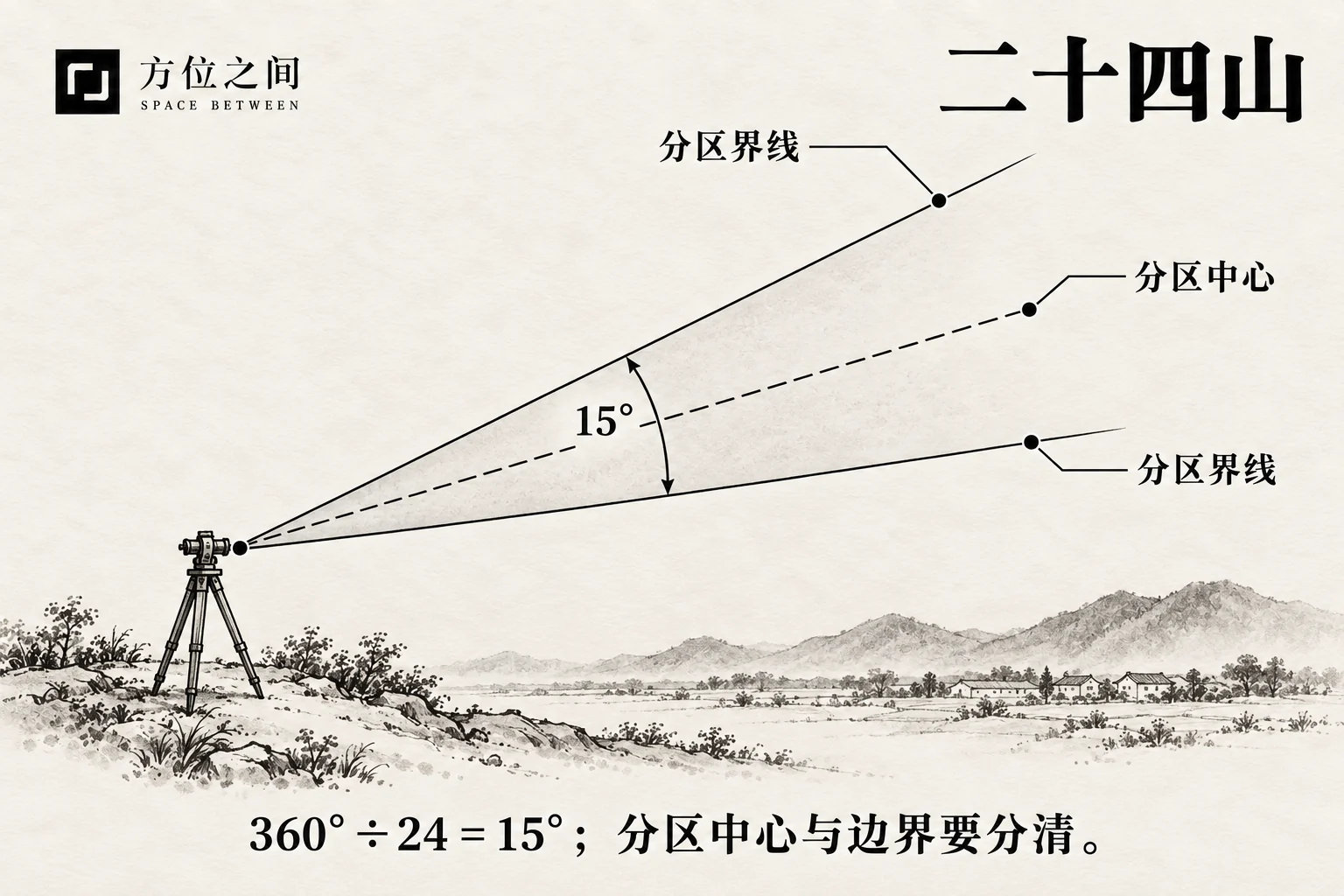
A center bearing is not the whole sector
In an equal division of a modern 360° circle, each mountain spans 15°, and each of eight directional regions contains three mountains spanning 45°. With the Earth Plate’s Zi center at 0°, Mao, Wu and You are centered at 90°, 180° and 270°. A sector extends 7.5° to each side of its center. Thus “Zi is zero degrees” does not mean that only a reading of exactly zero belongs to Zi.
Reading near a boundary
Under this convention, 2° lies in Zi, whereas 8° crosses the 7.5° boundary into Gui. The opposite of a facing bearing of 8° is 188°. If readings fluctuate from 7° to 8°, record the original range and “near the Zi-Gui boundary,” then measure again. The reference table should also state how exact boundaries are assigned. A rounded display value cannot establish an exact classification.
Always identify the plate
A luopan may show the twenty-four mountains on Earth, Human and Heaven plates with different relative positions and traditional uses. Record the angle, plate and north reference before the mountain label and whether it describes sitting or facing. The sectors alone provide no auspiciousness judgment. Najia, paired-mountain and Xuan Kong interpretations each require their own stated system; words from several rings do not make a universal rule.
Distinguish the Three Yuan Dragons from Sanhe polarity
San Yuan Xuan Kong assigns each region’s three mountains to Earth, Heaven and Human Yuan: in the north, Ren is Earth, Zi Heaven and Gui Human. It also uses its own polarity table. Sanhe Najia’s pure-yin and pure-yang categories follow its trigram and Najia associations; San Yuan red/black polarity markings cannot simply be transferred. These Three Yuan Dragons classify mountain positions, whereas Earth, Human and Heaven plates are coordinate layers.
Sources and further reading
These sources help clarify the concepts and their origins. Explaining a traditional term does not establish that it can predict outcomes.