
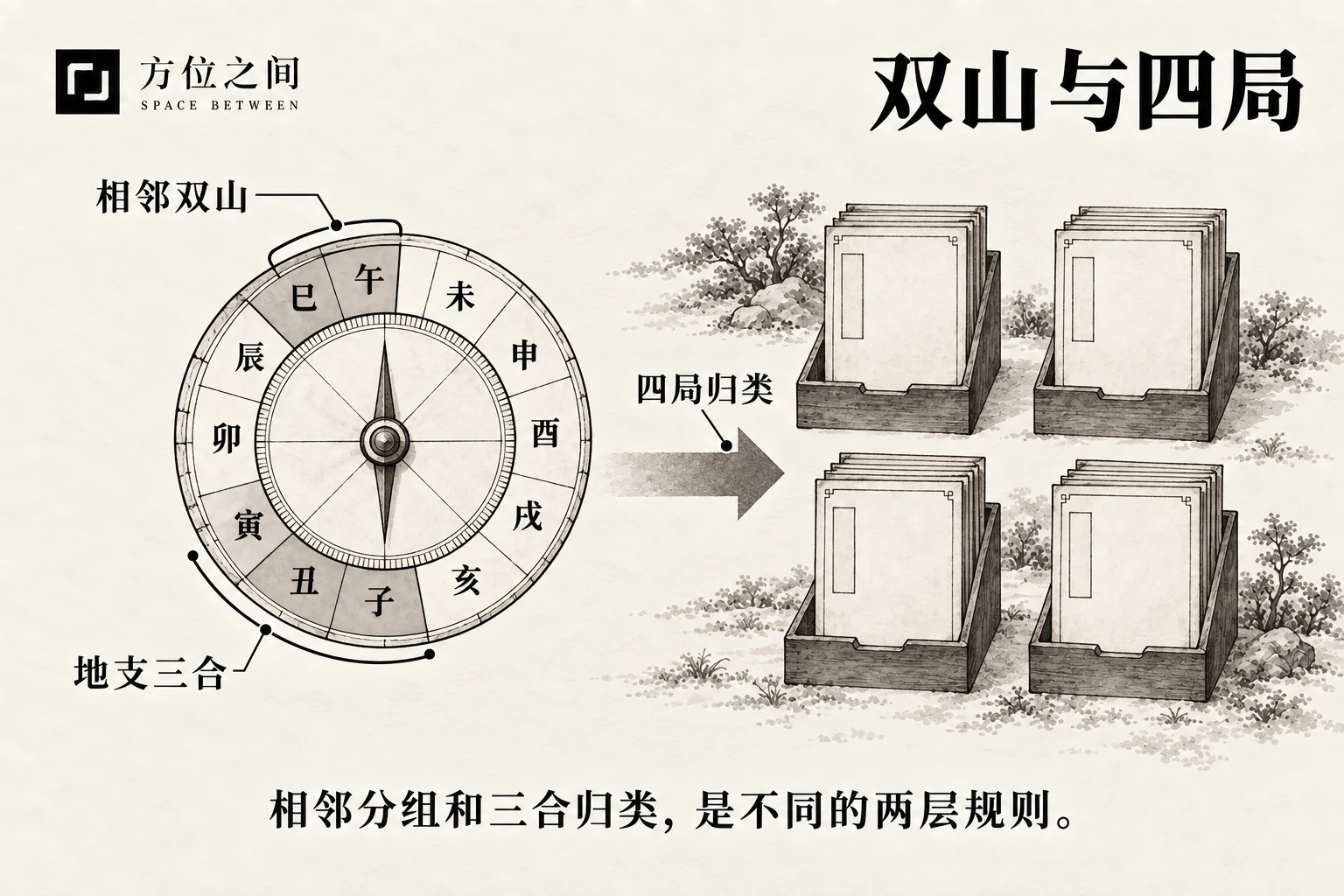
A pair does not mean sitting and facing
Paired mountains commonly group adjacent labels: Ren-Zi, Gui-Chou, Gen-Yin, Jia-Mao, Yi-Chen and Xun-Si, followed around the ring by Bing-Wu, Ding-Wei, Kun-Shen, Geng-You, Xin-Xu and Qian-Hai. These are not opposite sitting/facing ends 180° apart, nor arbitrary adjacent characters. Follow the stated pairing table; it cannot be inferred from the three-mountains-per-palace grouping.
The four formations follow Sanhe groupings
Traditional Sanhe assigns Hai-Mao-Wei to wood, Yin-Wu-Xu to fire, Si-You-Chou to metal, and Shen-Zi-Chen to water. Paired-mountain classification links the branch in each pair, connecting Qian-Hai, Jia-Mao and Ding-Wei, rather than applying a separate standard-phase table character by character. “Wood formation” and “water formation” are system labels, not descriptions of visible timber or rivers.
Check a water grouping step by step
Take Ren-Zi, Kun-Shen and Yi-Chen. First extract Zi, Shen and Chen, then classify them through the Shen-Zi-Chen Sanhe water group. Check the pairing and branch grouping as separate steps. Importing Kun’s earth association from Later Heaven trigram phases would mix conventions. Classification is consistent because its rule is explicit, not because a character must always carry the same attribute.
Grouping does not complete a water-method reading
A practical chart still requires the plate used, whether the object is incoming or outgoing water, how the outlet was chosen and the rule for determining the formation. A paired-mountain label alone cannot finish every Sanhe orientation procedure. Preserve angle ranges near boundaries instead of altering measurements to obtain a tidy category. The four formations are a traditional interpretive structure; drainage, terrain risks and comfort require assessment of actual conditions.
Sources and further reading
These sources help clarify the concepts and their origins. Explaining a traditional term does not establish that it can predict outcomes.