
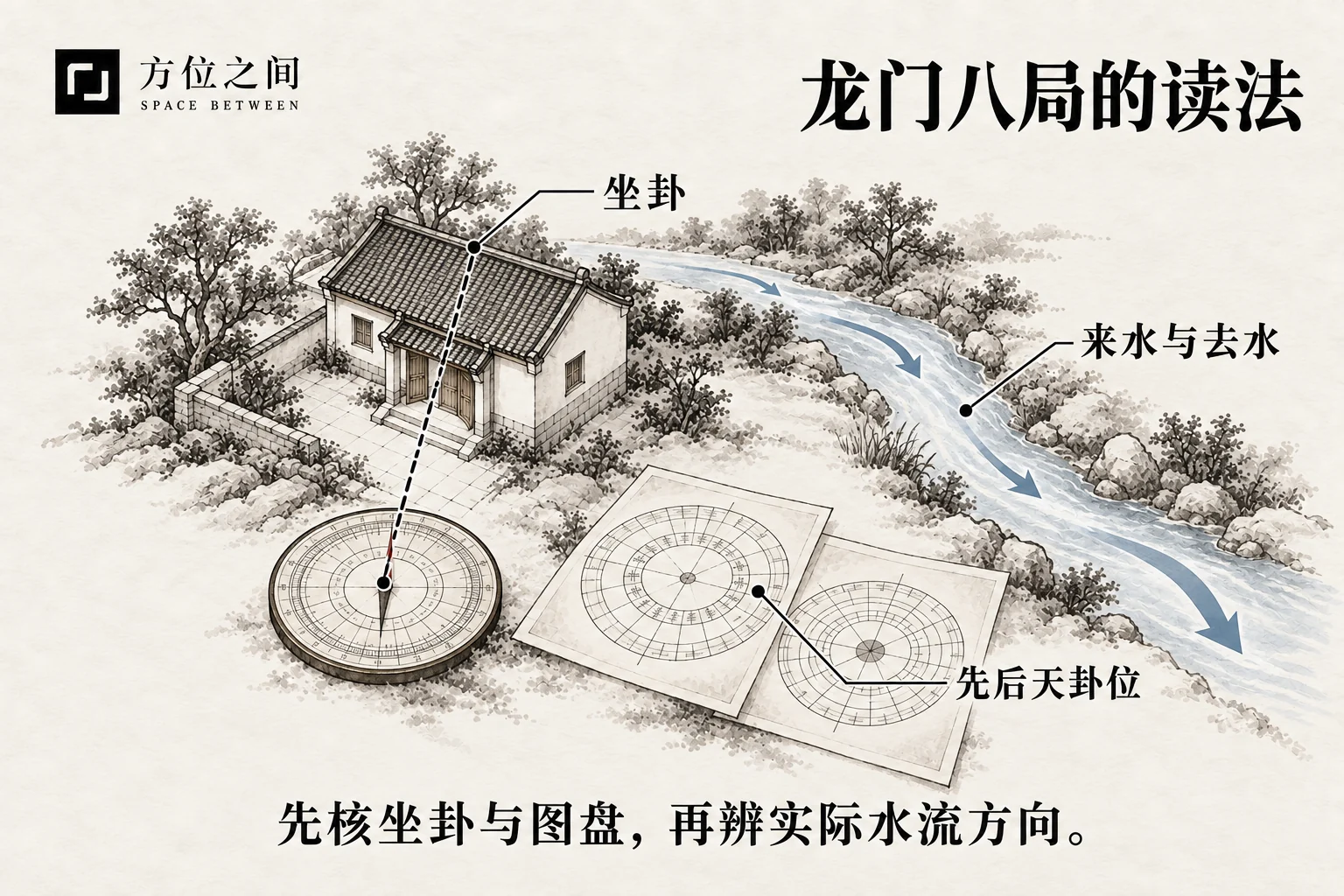
Eight formations are organized by trigrams
Longmen’s eight formations, or Qiankun Guobao water methods, organize formations by the eight trigrams and distinguish Earlier Heaven water, Later Heaven water and other roles. The public table of contents of Dili Qiankun Guobao lists eight trigram formations and separate water categories. Its use of “San Yuan” should not automatically be equated with three cycles and nine twenty-year periods. Interpret the term within the actual chapter.
Locate the sitting trigram and water first
Before reading a formation, record the axis, sitting and facing, mountain-to-trigram rule, observation center, and where water enters and leaves. Earlier and Later Heaven diagrams need a consistent north reference. Also specify the scale used to select the outlet: a courtyard drain, nearby ditch outlet and valley constriction are different objects, even when seen in the same direction.
Use Qian to check the mapping
Qian lies south in Earlier Heaven and northwest in Later Heaven. Comparing the same trigram’s positions therefore gives south and northwest. Comparing the same southern position instead gives Earlier Heaven Qian and Later Heaven Li. These are different questions. The example checks a diagram mapping; it does not imply that incoming water from the south is necessarily auspicious. A complete method must specify how the sitting trigram selects positions and what role each position plays.
Earlier and Later Heaven water are not water-quality classes
Earlier Heaven, Later Heaven, host and guest name relationships within a system, not water’s age or chemistry. Editions may specify different details for position, entry/exit and oblique orientation, so an auspicious label cannot be used in isolation. Narratives of divine transmission or fulfilled predictions in prefaces are historical cultural accounts, not modern causal evidence. Drainage design still requires slopes, channels and capacity; a cultural chart cannot replace observed flow records.
Sources and further reading
These sources help clarify the concepts and their origins. Explaining a traditional term does not establish that it can predict outcomes.