
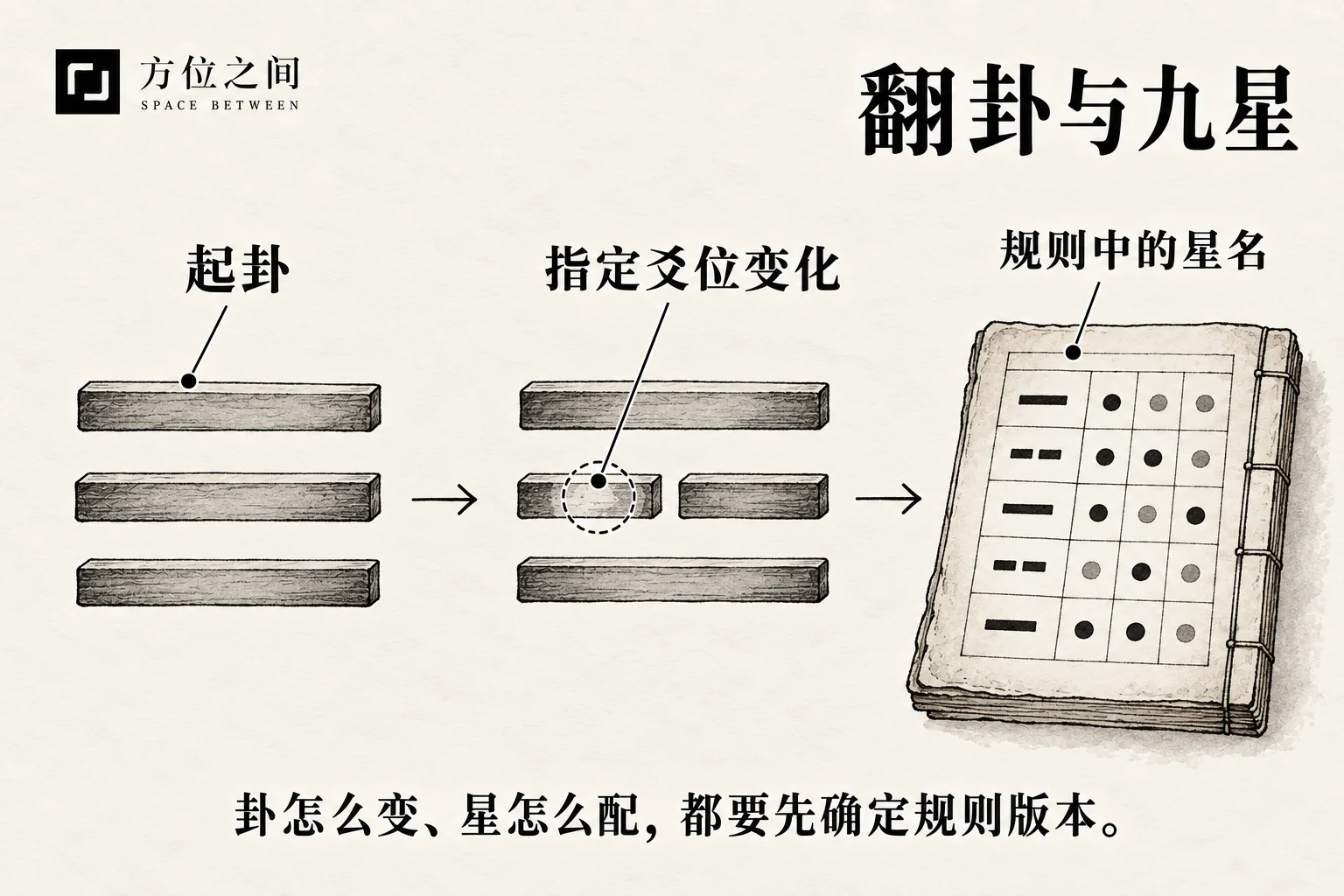
Changing three-line trigrams is a symbolic operation
A trigram consists of lower, middle and upper lines, read from bottom to top, each yin or yang. In fangua, a change generally switches a specified line’s polarity and changes the resulting trigram. It is a symbolic operation, not a spatial rotation of a house. Establish line order before reading a diagram: a left-to-right code is not automatically a bottom-to-top trigram, and reversing the order can produce a different trigram.
Check a single transformation independently
Begin with Qian, whose three lines are yang. Change only the upper line to yin and leave the other two yang: the result is Dui. Then change Dui’s middle line to yin, leaving only the bottom line yang: the result is Zhen. This verifies line transformations but assigns no lucky star to either step. Star names require an additional stated sequence or mapping; they cannot be guessed from the line shapes.
Identify the system behind shared star names
The orientation chapter of Rudi Yan Quanshu describes a transformation order beginning with Fu at the facing position and combining Fu and Bi in one trigram. Its dwelling chapter discusses You Nian names such as Shengqi and Tianyi. Such eight-trigram mappings differ from moving numbers through nine palaces. Star names serve different classificatory roles across texts; shared names do not make Bazhai, Fuxing water methods and Xuan Kong interchangeable.
Write out the starting procedure
A reproducible record states sitting or facing, the trigram selection rule, starting trigram, line-change order, star mapping and source edition. If Najia maps the twenty-four mountains to trigrams, record that convention too. “Nine-star result” alone cannot explain why two outputs differ. Traditional star labels do not describe actual stellar positions at this moment, and their fortune interpretations are cultural claims rather than outcome guarantees.
Record Dimu and Fuxing water methods separately
Dimu fangua commonly develops a diagram from Kun; an application must also explain how the sitting mountain maps to a trigram through Najia. This must not be mixed with Fuxing water methods that start Fu from the facing trigram. Sitting directions and peak positions in one method differ from incoming and outgoing water in the other. The ends of an orientation axis are half a turn apart, so choosing sitting instead of facing can change the starting trigram. Check inputs before treating different results as an error.
Sources and further reading
These sources help clarify the concepts and their origins. Explaining a traditional term does not establish that it can predict outcomes.