
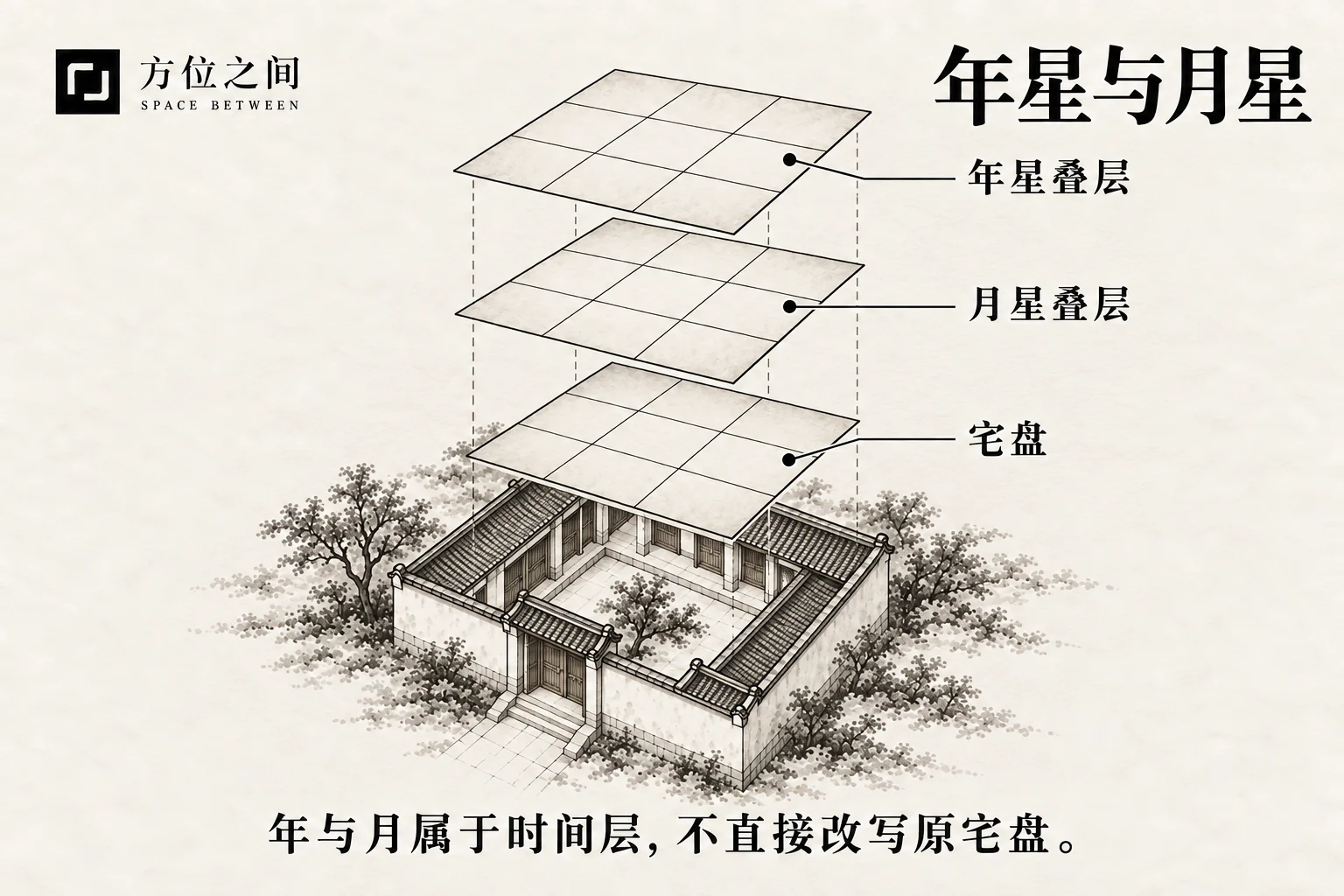
Identify the layers before overlaying them
A Xuan Kong house chart commonly distinguishes period, mountain and facing stars; annual and monthly charts add separate time layers. The three-cycle annual method requires a cycle and its Jiazi starting year. The monthly method also needs the year-branch group and month number. An annual three-cycle method can coexist with twenty-year periods, but they are not the same calculation.
Annual example: count backward, then distribute forward
Volume 8 of Xie Ji Bian Fang Shu starts Jiazi at one-white in the upper cycle, four-green in the middle cycle and seven-red in the lower cycle. The central value steps backward each year, wrapping from one to nine. Thus an upper-cycle Jiazi starts at one and the following Yichou at nine. For that Yichou, place nine, one, two, three, four, five, six, seven and eight in the center, Qian, Dui, Gen, Li, Kan, Kun, Zhen and Xun, respectively.
Monthly example: the year branch sets the first month
The same volume starts the first month at eight-white in Zi, Wu, Mao and You years; five-yellow in Chen, Xu, Chou and Wei years; and two-black in Yin, Shen, Si and Hai years. Values then step backward monthly. In a Wu year, the first three months therefore center on eight, seven and six. This checks the traditional month sequence. A dated calculation must state whether months follow solar-term boundaries or another calendar convention; Gregorian February cannot simply stand for the second month.
Time runs backward; the whole chart does not
A common mistake is to reverse the palace distribution because the annual sequence runs backward, or to treat the annual central number as the current period star. Audit the process in two entries: which star enters the center for that time, and which palace order distributes it. The monthly pattern’s three-year repetition should not be casually equated with the 180-year three-cycle system; they operate at different scales.
An overlay supports cultural reading, not event prediction
A reader can check whether a sequence is internally consistent, but that does not establish that illness, wealth or an accident will occur in a particular month. Record daylight, ventilation, noise and patterns of use separately. Even when a traditional reading emphasizes a palace, translate it into an observable question rather than letting a monthly number determine renovation, relocation or medical decisions.
Sources and further reading
These sources help clarify the concepts and their origins. Explaining a traditional term does not establish that it can predict outcomes.