
Establish names and aliases first
Dutian must be read in context; its name does not establish a single universal algorithm. Annual discussions in Xieji Tongyi associate Wu and Ji in Wuhu Dun with Dutian, while volume 33 of Xieji Bianfang Shu uses names such as Wuji Sha. This supports a historical link between terms, but does not prove that every later twelve-Dutian table uses the same starting rule. Preserve the work, volume and context; an alias does not establish algorithmic equivalence.
Record the start, sequence and mapping separately
To check a rule, identify the stem-branch input, starting point, order of progression and mapping to twelve branches, eight palaces or twenty-four directions. If one version always starts at Jia while another starts from the actual year stem, the difference is in the input, not a final auspiciousness judgment. Distinguish palace labels from page orientation: rotating the whole diagram may leave a rule unchanged, whereas changing its start may alter every placement.
Use Wuhu Dun for a checkable comparison
Set aside complicated palace flight and check the documented Wuhu Dun: at Yin, a Jia year begins with Bing and a Yi year with Wu. The first output is therefore different. Apply the same rule to both years and write the subsequent stems to see whether the source uses the actual year stem or a fixed start. This tests whether the input is honored; it does not establish which Dutian version is older or justify inventing twelve judgments without a source.
Keep disputed versions separate
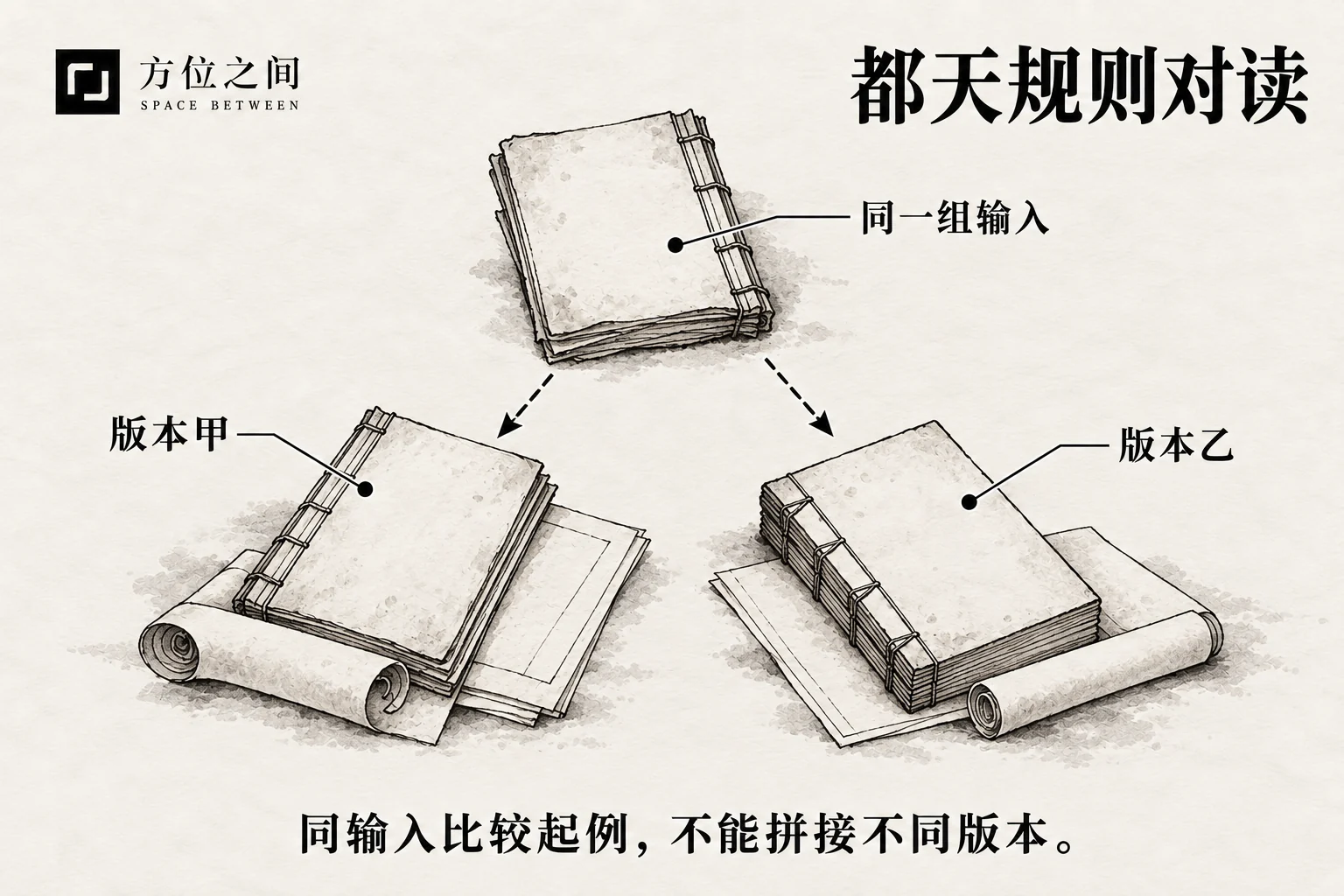
A common error combines a starting point from one book, a direction from another and predictions from an online phrase, producing a table with no single source. Instead, identify each version separately and list located passages, missing steps and reproducible examples. Show differing results side by side and mark unresolved points. Digital transcriptions may confuse Ji, Yi and Si (己、已、巳); check scans when a key character matters. Reproducible textual rules indicate documentary quality, not scientific confirmation of traditional predictions.
Sources and further reading
These sources help clarify the concepts and their origins. Explaining a traditional term does not establish that it can predict outcomes.