
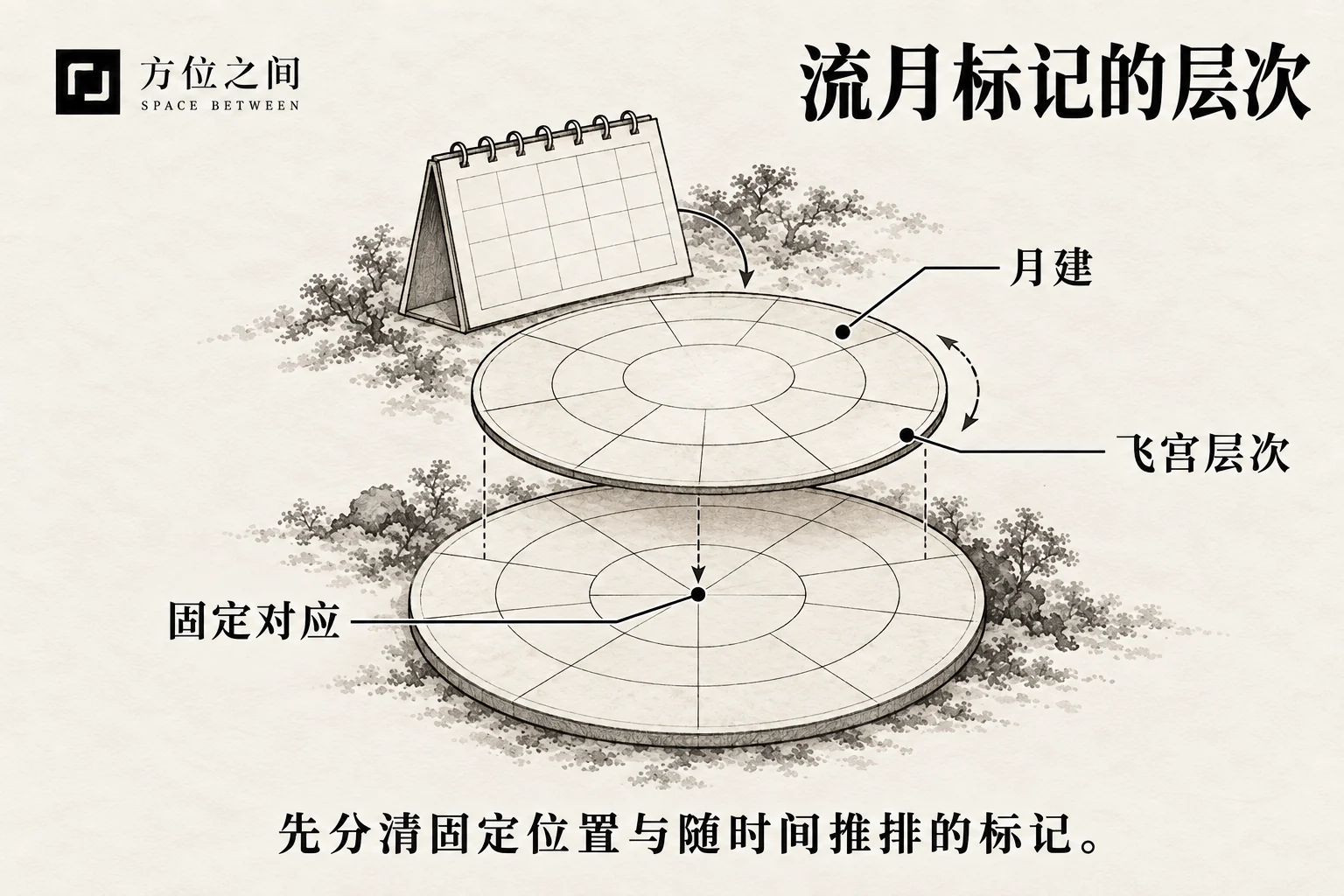
Month-branch positions and flying palaces are separate
Yuejian first links a month to a branch. For an agreed Yin month, Yuejian is at Yin and the opposite position is Shen; no nine-palace flight has yet been used. Xieji Bianfang Shu distinguishes fixed directions from flying-palace discussion under Yuejian, so large Yuejian, small Yuejian and Anjian are not interchangeable because they share a word. Record how the month branch is obtained, the solar-term boundary, starting point and direction. A known month branch does not supply every other layer’s algorithm.
Monthly Five Yellow needs its own time sequence
Monthly Five Yellow belongs to a timed nine-palace number layer. State its year-and-month rule, central number and flight order. Sharing a monthly chart with Yuejian does not make their positions identical, and Five Yellow is not a physical yellow object. For a controlled comparison, keep Yin month and the floor plan fixed, changing only the year group required by the chosen rule. Do not shift the whole diagram and carry every label along. Without a selected version, mark the conditions as undetermined.
Locate Wenchang, Hongluan and Tianxi within a system
Wenchang may mean an astronomical name, a natal entry or a directional symbol; Hongluan and Tianxi also occur in annual, natal and other arrangements. Placement on a monthly page does not prove a monthly starting rule. Tianxi also appears in Xieji Bianfang Shu’s discussion of alternate names in the twelve-officer system, illustrating that a shared name need not mean a shared method. State whether each entry uses a year stem, year branch, birth data or sitting direction, and whether a month is added. Keep different sources visibly separate.
Retain both sides of overcoming relationships
Overcoming relates two attributes; being overcome describes one side, not an independent moving star. Volume 33 discusses annual overcoming through the year’s nayin and the sitting mountain’s benmu nayin, which cannot be reduced to a yearly element color. Preserve both subjects, the phase system and the direction of the relationship. If one table uses standard phase correspondences and another nayin, explain that difference before comparing their final auspicious or inauspicious labels.
Leave uncertain names unresolved rather than invent formulas
Names such as Jianfeng, Duhuo, Guiyuan and Liucai each need a traceable passage. Volume 33 relates Duhuo to annual-stem Wuhu Dun, but that does not supply formulas for neighboring labels, nor turn Liucai into an income prediction. If only a label survives, record its aliases, location and sources to investigate. A responsible monthly chart allows unknowns and version differences. A missing entry does not mean the check is complete, and a complete list of names does not validate its rules.
Sources and further reading
These sources help clarify the concepts and their origins. Explaining a traditional term does not establish that it can predict outcomes.