
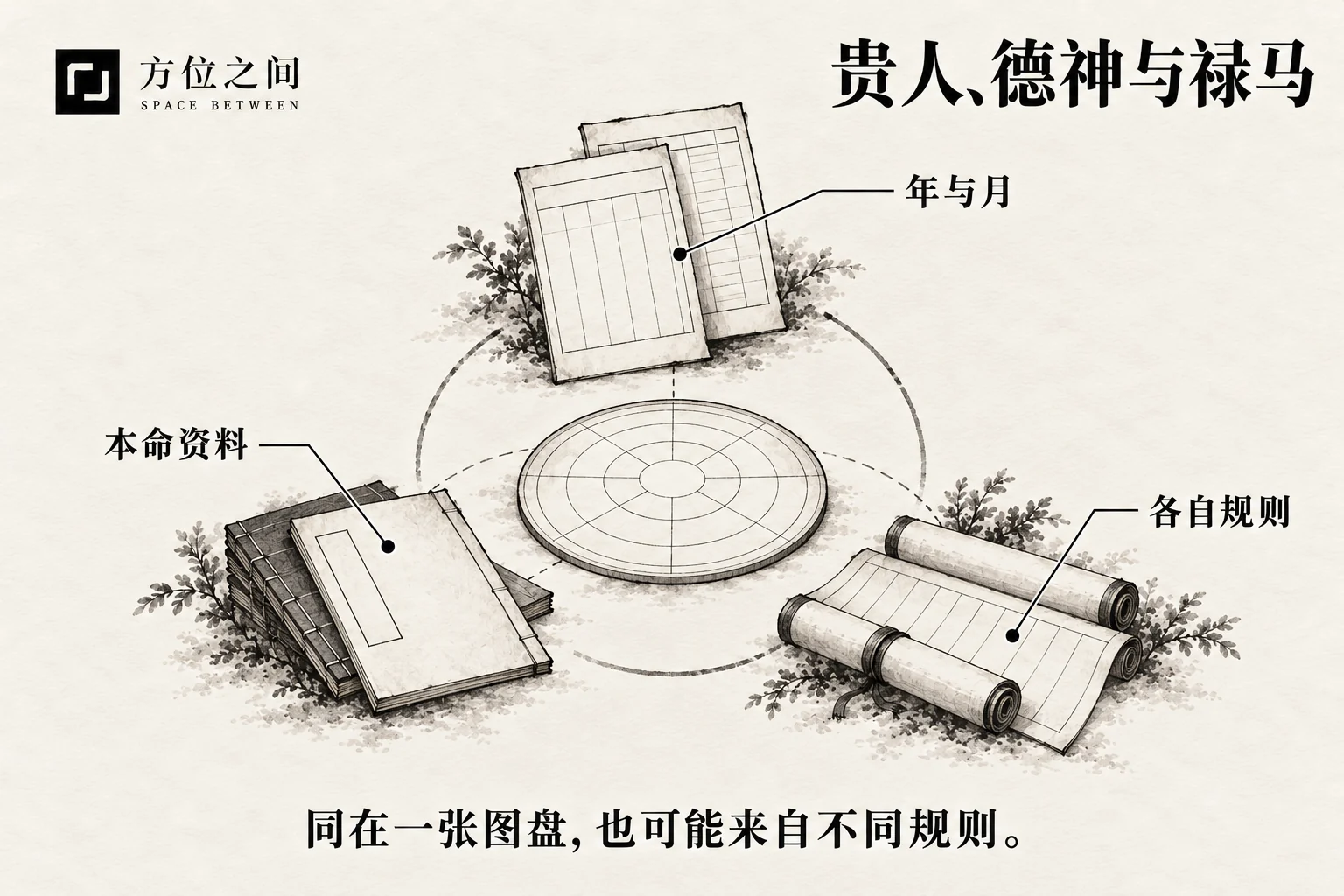
Whose stems and branches are being used?
For annual, monthly or natal noble markers, first establish whether the stem comes from the current year, month, day or a person’s birth data. A qualifier such as annual or natal can change the entire calculation. Tianyi also distinguishes yin and yang nobles; their results cannot be casually merged into one fixed direction. Keep the full rule name, input and applicable period. A lone noble label is insufficient for reproduction and does not predict that a helpful person will appear.
A shared virtue label does not imply a shared algorithm
Suide, Tiande and Yuede are separate entries. Xieji Bianfang Shu treats Suide among annual rules, while Tiande and Yuede have monthly explanations and related combination terms. Check whether the input is a year stem, month sequence or month branch, and whether the output is a stem, branch or trigram position. Their shared virtue label does not make Yuede move with Suide, nor turn a stem used for date selection into a fixed room in a home.
A minimal check against the Suide table
The Suide table in volume 3 provides a direct check: a Jia year gives Jia, while a Yi year gives Geng. Adjacent year stems therefore do not imply adjacent positions. Writing the two input-output pairs side by side distinguishes a lookup from a clockwise shift. When comparing two charts, keep the stem-branch year, year-boundary convention and display layer fixed. Changing birth data, month and facing at the same time makes the source of a difference impossible to isolate.
Separate base Luma positions from relocated results
Lu and Ma have their own starting rules. Names such as true Lu, true Ma or moving Luma may add stem-branch pairing, a month or flying-palace steps. A branch label alone cannot replace the complete rule, and these symbols are not measurements of income or transport. Record original inputs, base positions, additional movements and final display separately; mark missing sources as unresolved. Auspicious entries have no universal additive weights, so cultural interpretation should retain their layers instead of producing a wealth or life score.
Sources and further reading
These sources help clarify the concepts and their origins. Explaining a traditional term does not establish that it can predict outcomes.