
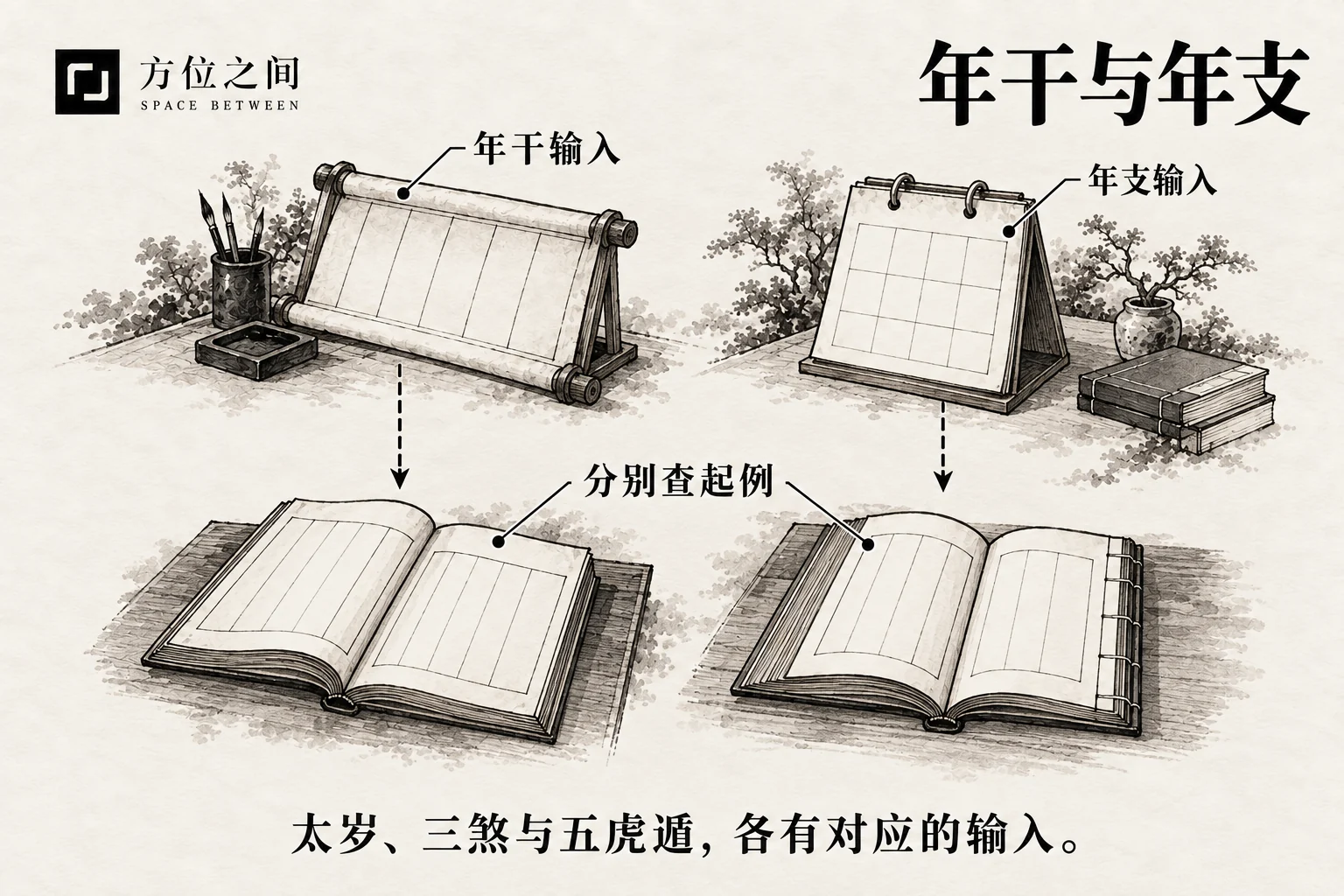
Taisui and Suipo begin with the year branch
In traditional annual direction rules, Taisui occupies the year branch and Suipo the opposite branch. These are symbolic chart positions, not celestial objects to locate with a phone. Record the complete stem-branch year and its year-boundary convention. Lunar New Year and the Start of Spring do not always coincide, so nearby dates cannot be classified by Gregorian year alone. Also specify whether the display uses twelve branches or twenty-four directions; a marker does not define the character of an entire room.
Sansha uses branch groups; it is not another name for Taisui
Sansha commonly groups Jiesha, Zaisha and Suisha, selecting three directional branches from the year branch’s trine group. The Shen–Zi–Chen group, for example, corresponds to Si–Wu–Wei, summarized as southern Sansha. Shading an entire southern sector and marking its three branches use different levels of detail, not necessarily opposing algorithms. If a personal Sansha rule uses a birth-year branch instead, its input has changed; display it separately rather than overwriting the current annual chart.
Separate two calculation paths in a Jiazi year
Take a Jiazi year as a symbolic example. Zi places Taisui at Zi and Suipo at Wu; the Shen–Zi–Chen group places Sansha at Si–Wu–Wei. Wuhu Dun instead reads the Jia stem: Jia and Ji years begin with Bingyin, followed by Dingmao, Wuchen and Jisi. An annual rule using the positions reached by Wu and Ji must also state its directional mapping. One path uses the year branch, the other the stem. Different markers are not quantities that automatically cancel each other.
Check the rule before discussing its traditional use
Xieji Bianfang Shu discusses these names under distinct starting rules; appearing on one compass does not turn them into a combined score. Other errors include imagining Wuhu Dun as five stars or interpreting Wu and Ji as measured soil properties. Keep the source, inputs, expanded sequence and unresolved version differences with the result. These systems illuminate historical calendar culture, but cannot alone establish that a place is uninhabitable in a given year or replace practical decisions about construction and travel.
Sources and further reading
These sources help clarify the concepts and their origins. Explaining a traditional term does not establish that it can predict outcomes.