
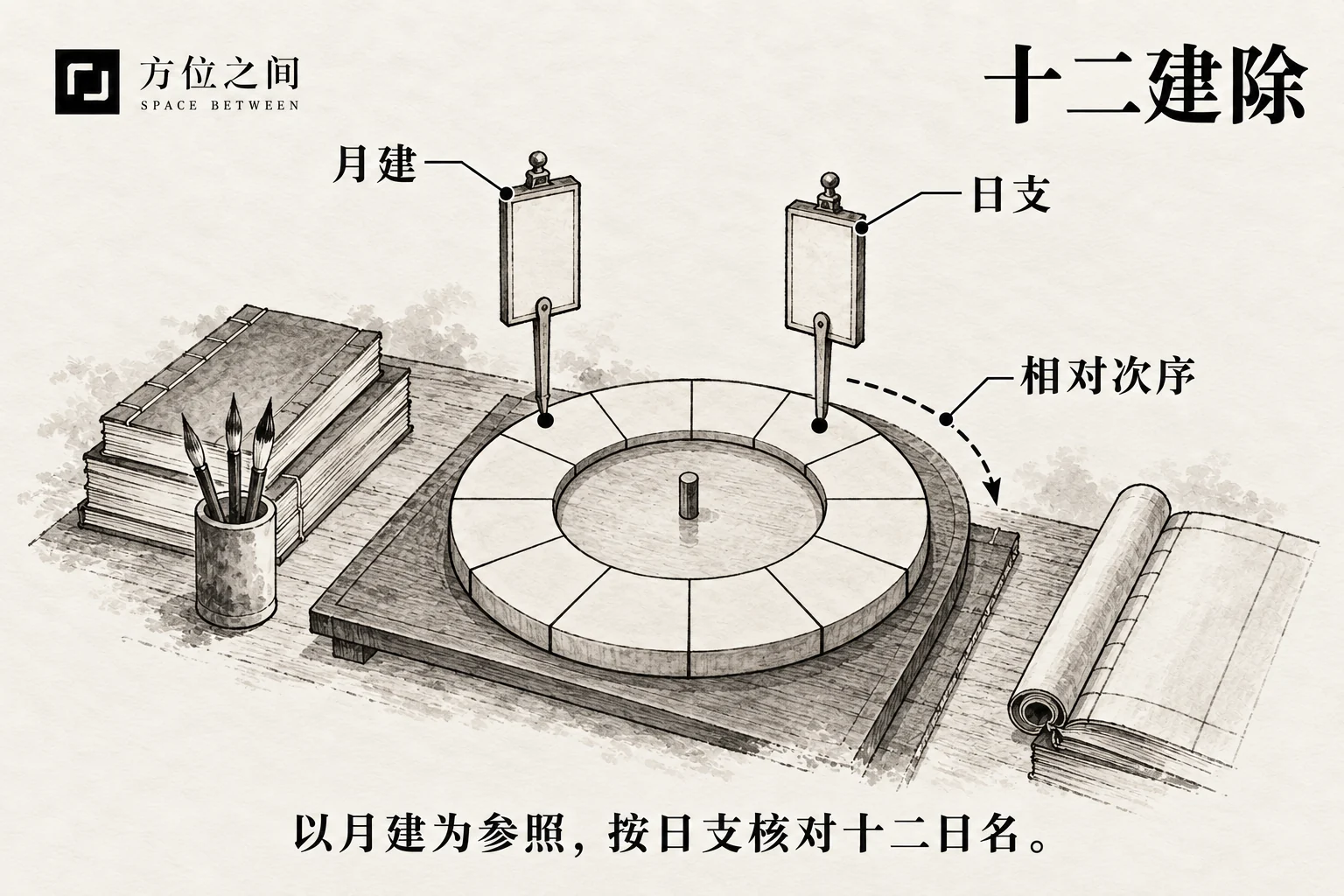
Twelve names form an ordered sequence
The common sequence is Establish, Remove, Full, Balance, Settle, Hold, Break, Danger, Complete, Receive, Open and Close. Volume 4 of Xieji Bianfang Shu lists the twelve officers and discusses alternate names at the same position. Both the branches and officers have twelve entries, but they are different tables: branches locate positions, while officer names depend on the month-branch relationship. Permanently labeling Yin as Establish and Shen as Break discards the required month input.
Count three positions in a Yin month
For a Yin month, Yin days receive Establish, Mao days Remove and Chen days Full; continuing the sequence gives Shen days Break. Write the seven branches Yin, Mao, Chen, Si, Wu, Wei and Shen, then align the first seven officer names. This checks the mapping without any fortune judgment. In a Mao month, Establish starts at Mao, so the same Yin day no longer retains its Yin-month label. The example demonstrates a relationship, not a recommended real-world date.
Real dates also need calendar conversion
Applying the table to a Gregorian date requires reliable day stems and branches and a month-boundary convention. Do not combine solar-term month changes with a restart on the first lunar day; near a solar-term transition, state the local-time convention too. The officers are not an independent twelve-day wheel repeating unchanged across months. Recheck the start at a month change. If two almanacs differ, compare their date, month branch and boundary convention before arguing over a single label.
A label does not replace purpose or practical conditions
A frequent mistake treats Open or Complete as universally favorable and Break or Danger as unsafe for every activity. Traditional date-selection texts also consider the type of activity, other entries and rules for resolving conflicts; a single word is not a universal score. Read the calculated name beside its original entry, distinguishing the label, interpretation and advice. Moving, construction and events still depend on people, weather, premises and contractual conditions; historical day names guarantee no outcome.
Sources and further reading
These sources help clarify the concepts and their origins. Explaining a traditional term does not establish that it can predict outcomes.