
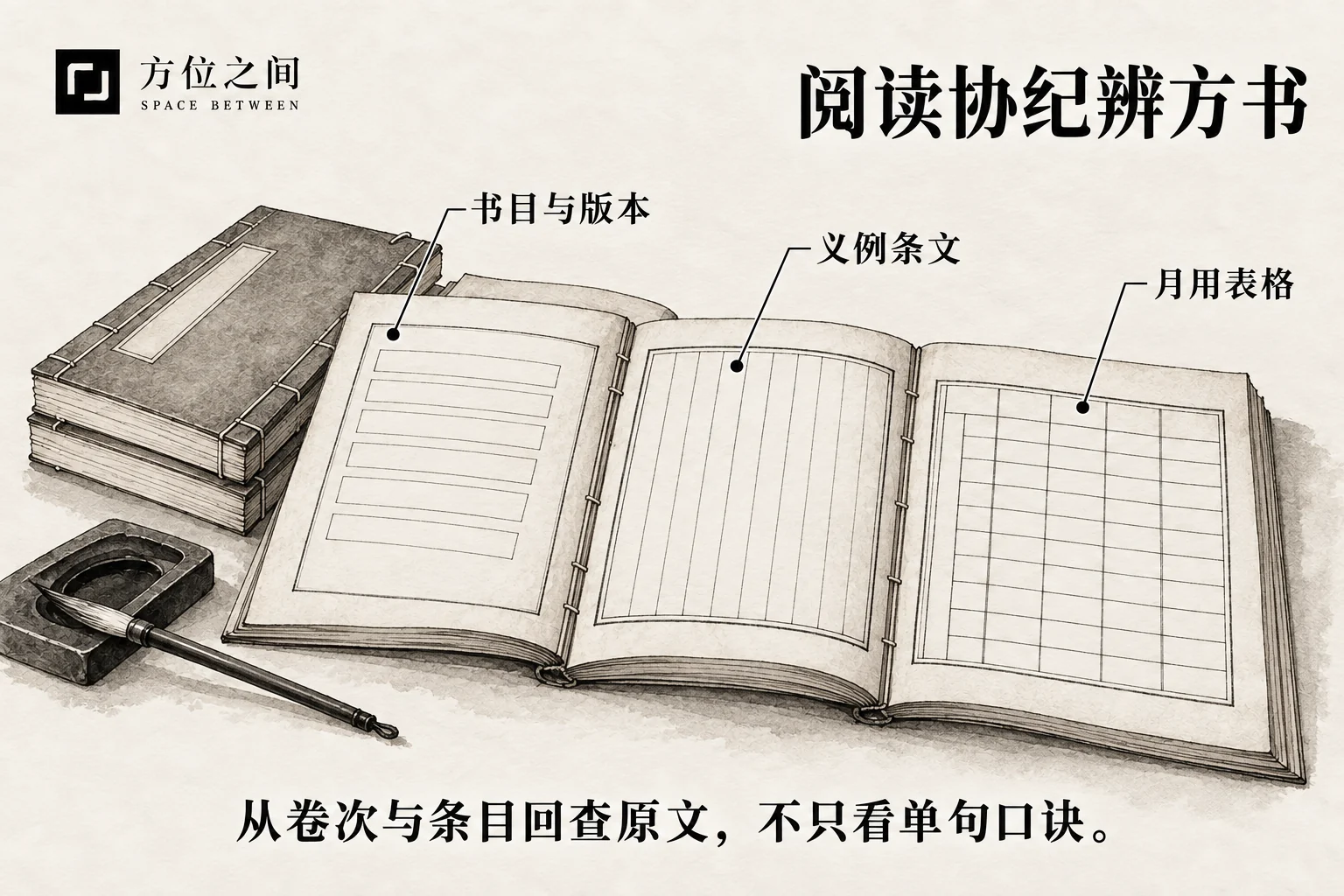
A compilation responding to disagreement
Xieji Bianfang Shu is a thirty-six-volume compilation commissioned in the Qing period. Its preface and memorials describe inconsistent rules and conflicting recommendations in earlier date-selection books, prompting revision and explanation. A quoted view is therefore not necessarily endorsed, and an editorial note may be disputing the preceding passage. Distinguish earlier claims, the compilers’ judgments and unresolved material rather than treating a search result as the conclusion of the entire work.
Read explanations, tables and activity entries together
The foundational chapters introduce concepts, rule chapters explain starting procedures, ready-reference tables aid lookup, and suitability and activity sections organize uses. Annual, monthly and daily tables unfold rules over time. For an unfamiliar term, first find its inputs and relationships in the explanations, then its table entry and relevance to the activity being studied. Tables alone can hide conditions; abstract explanations alone may not show how to look things up. Preserve volume and section names as coordinates for retrieval.
Sixty day types do not make a sixty-day month
The opening of volume 20 explains monthly tables that expand sixty stem-branch day types for each of twelve months. Sixty means combinations, not the length of a lunar month. As a lookup exercise, locate the Yin month, check its opening entries placing Yuejian at Yin and Yuepo at Shen, then find the required day pair. Twelve month types times sixty day types gives 720 index combinations, not a forecast for 720 consecutive days or 720 distinct prohibitions.
Leave a trail back to the source page
A checkable note records the edition, volume, section, passage location and your interpretation, with a scan link when needed. Missing characters, variants and broken table rows in digital transcriptions can alter a reading; do not turn unchecked text into a definite rule. Public explanation may reorganize the language but should distinguish the original from teaching examples. Imperial compilation describes a historical institutional setting, not modern scientific validation of traditional prescriptions.
Sources and further reading
These sources help clarify the concepts and their origins. Explaining a traditional term does not establish that it can predict outcomes.