
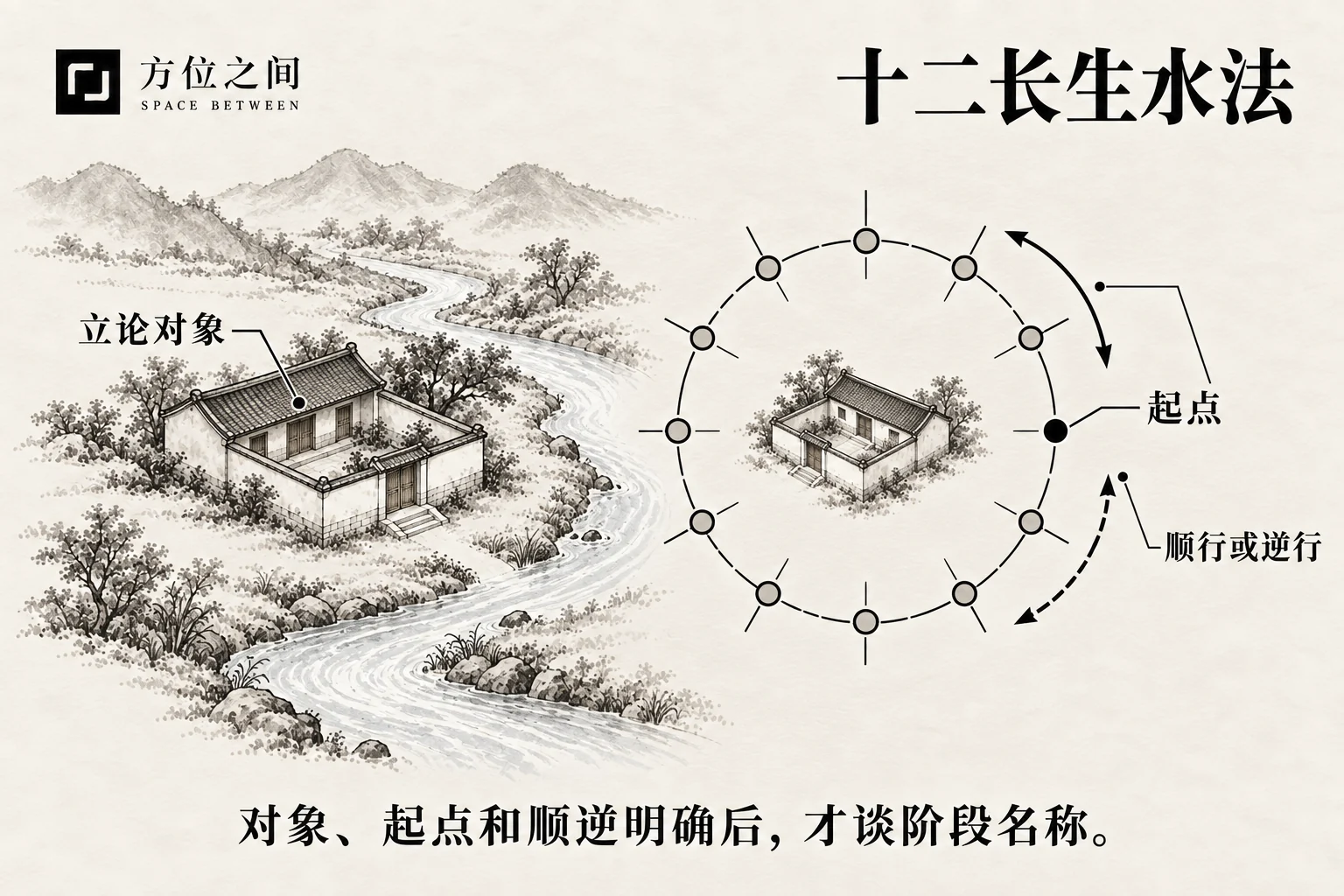
Twelve stages form a cycle
The common order is Changsheng, Muyu, Guandai, Linguan, Diwang, Shuai, Bing, Si, Mu, Jue, Tai and Yang, then back to Changsheng. Traditional names borrow life stages as metaphors. They are neither a health examination nor the literal age of water. Treat them first as ordered labels: establish where the sequence begins and how it proceeds before interpreting meanings assigned in a particular text.
Specify the starting convention
The Sanhe context of Dili Wujue distinguishes landform and water readings, using phases and polarity in its starting rules. Fate-calculation texts such as Sanming Tonghui also discuss twelve growth palaces, but classify different objects. A heavenly-stem table from that context cannot automatically replace a water-method chart. Record formation, Changsheng starting position, progression direction, plate and whether the object is incoming water, outgoing water or incoming landform.
Count through a water example
For yang water starting Changsheng at Shen and proceeding in earthly-branch order: Shen is Changsheng, You Muyu, Xu Guandai, Hai Linguan and Zi Diwang. Moving four steps from Shen reaches the fifth stage, because the starting point counts as the first. This checks order; it does not mean that all water in Zi can be called flourishing water. A different starting point or progression direction requires a fresh arrangement.
Sequence direction is not physical flow direction
Forward or reverse arrangement on a plate is symbolic order, whereas water flowing left to right is a site observation. Further interpretation requires separate records of entry, exit, turns and orientation, not a judgment based on one Diwang or Mu label. This article presents a checkable traditional sequence. Fortune interpretations are not drainage-engineering conclusions and cannot replace checks for ponding, erosion or blocked channels.
Ziwu Xieliu is not the twelve-stage cycle
Public versions of the Ziwu Xieliu formula describe a different rule: it starts from the sitting mountain and uses paired positions to interpret dwelling locations. “Liu,” or flow, does not mean water literally running diagonally, and does not justify sharing a starting rule with the twelve stages. Likewise, twelve generals, monthly generals and other twelve-position tables require their own objects and starting rules. This is terminology guidance, not a combined algorithm or a real-world safety assessment.
Sources and further reading
These sources help clarify the concepts and their origins. Explaining a traditional term does not establish that it can predict outcomes.