
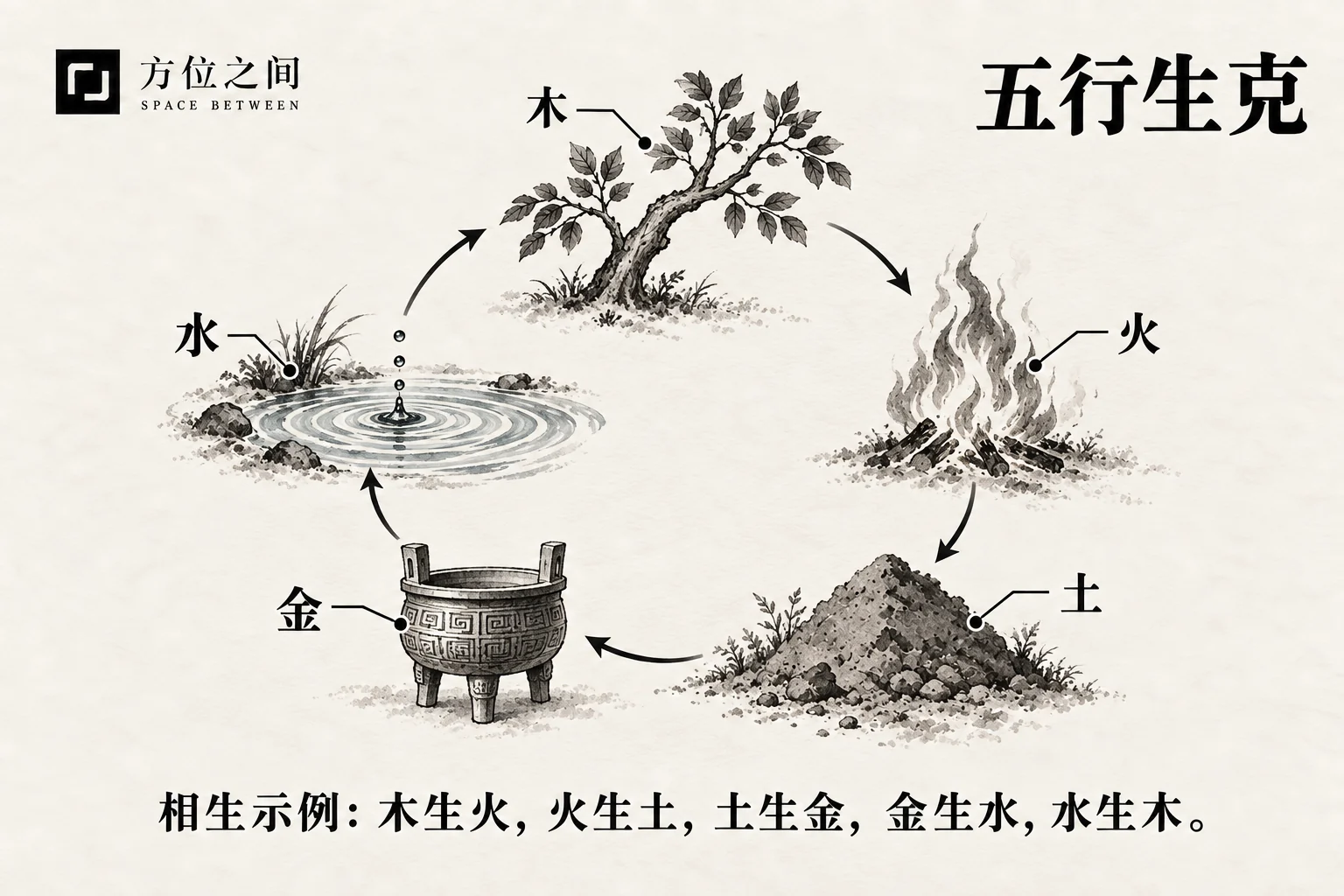
The five phases are not a modern materials taxonomy
The Hongfan chapter of the Shangshu lists water, fire, wood, metal and earth. Later traditions developed varied correspondences and relationship schemes. Here wood or metal may classify a season, direction, trigram or symbol rather than a physical material. A wood-associated trigram does not mean that its direction contains only timber; a metal furnishing does not establish the classification of an entire room. First state what is being classified.
Both cycles have a direction
The common generating cycle is wood → fire → earth → metal → water → wood. The controlling cycle is wood → earth → water → fire → metal → wood. Both are directed. In “I generate,” the current object is the starting point; in “generates me,” it is the endpoint. Objects in the same category are often described as sharing a phase, but this is a classification result, not a completed overall assessment.
Changing the subject changes the relationship
Suppose object A is assigned wood and B fire under an explicitly stated rule. From A, B is what “I generate”; from B, A “generates me.” Add an earth object C: A controls C, while C is controlled by A. Writing object names at the arrow’s two ends makes the relation checkable. “Wood and fire generate” omits its direction. Combining three pairwise relationships into an overall score would require additional defined rules.
Do not splice together different correspondence tables
Standard phase assignments, Nayin and paired-mountain Sanhe classify different objects on different grounds. A character receiving different phases in different tables is not automatically a contradiction. Keep the object, table name, source and relationship direction together before comparing equivalent results. Classical generating and controlling are not mechanisms of structural loading, air quality or health. “Control” cannot simply mean physical harm, nor justify promises that rearranging objects changes destiny.
Sources and further reading
These sources help clarify the concepts and their origins. Explaining a traditional term does not establish that it can predict outcomes.