
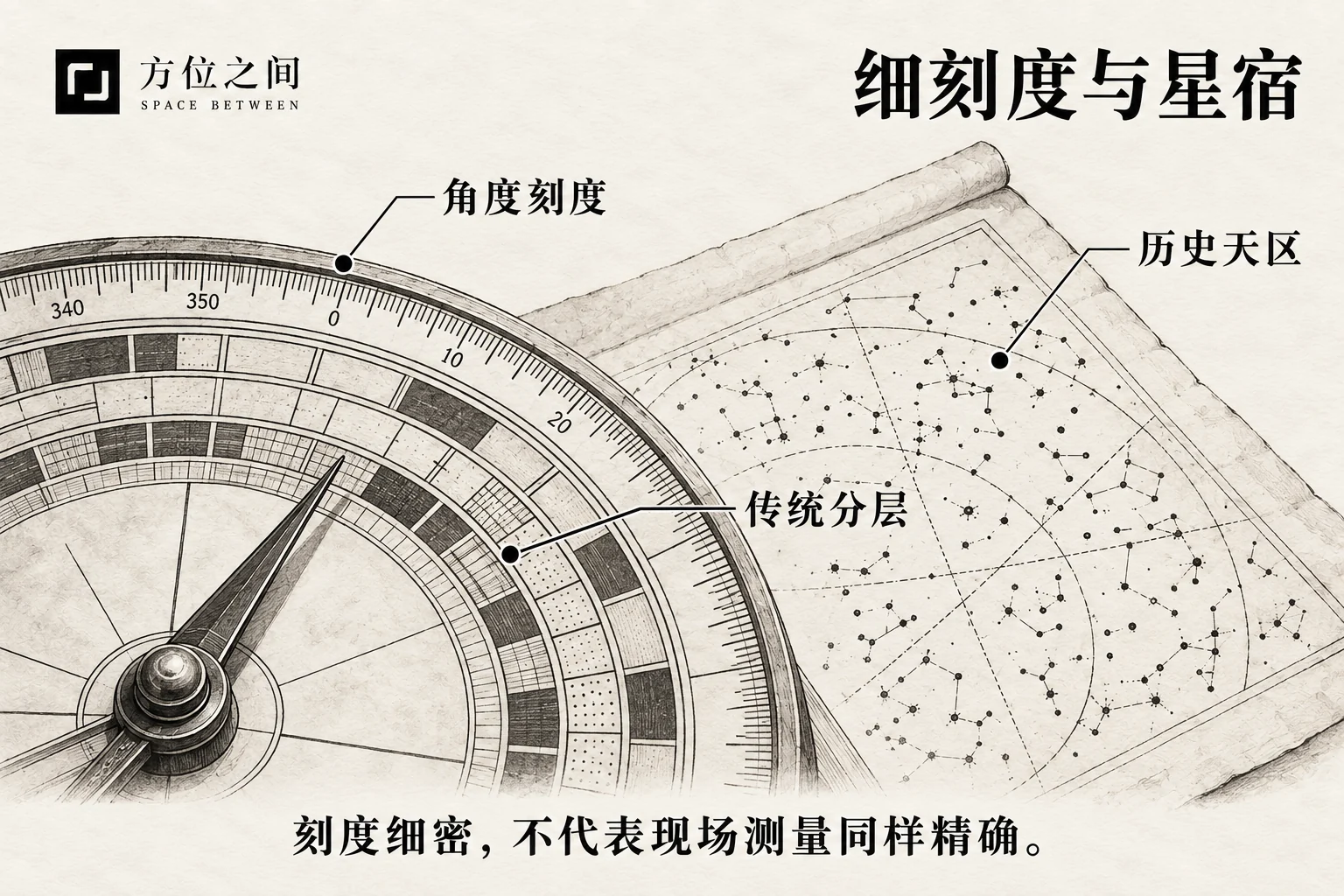
Identify the layer before its subdivisions
Fenjin refers to luopan layers assigning names and traditional attributes to finer divisions; there is no single division scheme on every plate. Luojing Toujie separately lists seventy-two dragons, sixty dragons, fenjin, Nayin and twenty-eight lodges. Similar names do not guarantee equal division counts, starting points or uses. Establish the plate design and the layer’s bounds before interpreting a small segment’s label.
Calculate an equal-division example
If a teaching plate explicitly divides a 360° circle into 120 equal parts, each part spans 3°, and five fit in a 15° mountain sector. That is simply the geometry of the stated scheme. If measurements vary across a 2° range, drawing still finer boxes does not produce more reliable directions. The number of boxes defines display resolution; measurement uncertainty comes from the device and conditions.
Lunar lodge layers have separate origins
The twenty-eight lodges began as traditional divisions of the sky, later receiving mountain and phase associations on the luopan. Luojing Toujie separately lists lodge positions, degree-related phase associations and correspondences between twenty-eight lodges and twenty-four mountains. One label cannot replace all of these. Lodge names do not imply twenty-eight equal circular segments. Check the edition’s values, origin and layer instead of inventing equal angles.
Decimal places do not create certainty
To check a fenjin result, retain at least the original angle, north reference, plate version and full layer name. Compare these inputs before comparing results across editions. If a table omits its origin or boundaries, leave a result unresolved rather than guessing a segment. These examples explain scales, not promises of wealth or health from selecting a division. Home design still depends on dimensions, daylight, circulation and construction.
Sources and further reading
These sources help clarify the concepts and their origins. Explaining a traditional term does not establish that it can predict outcomes.