
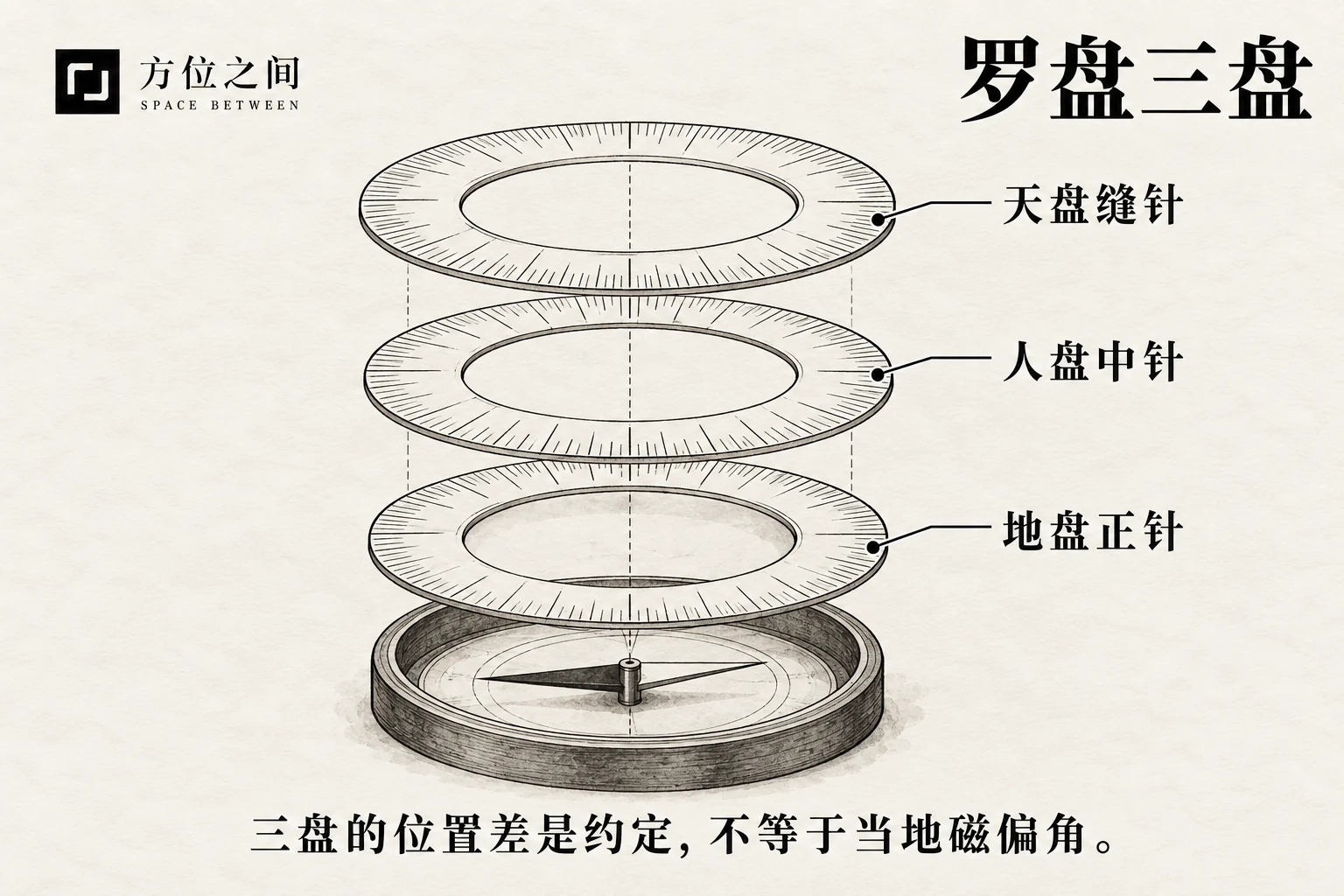
Three plates are distinct directional rings
Traditional luopan texts distinguish the Earth Plate or Zhengzhen, Human Plate or Zhongzhen, and Heaven Plate or Fengzhen; Luojing Toujie treats them separately. Common Sanhe practice associates Earth with orientation, Human with interpreting surrounding landforms, and Heaven with water, but detailed procedures depend on the edition. They are not three magnetic needles pointing to different norths or an average of three measurements.
A fixed plate offset differs from measurement variation
Common three-plate diagrams offset the Human and Heaven rings from Earth by half a mountain, or 7.5° when a mountain spans 15°. Check the side of the offset and the direction of increasing values: rotating the printed ring and rotating the reading axis are opposite operations. Plate offsets are construction conventions. Magnetic declination varies with location and time. One cannot substitute for the other or be applied twice.
Check a reading with an offset example
Suppose a teaching diagram places a second ring’s zero line at 7.5° on the reference ring, with both angles increasing clockwise. A reference reading of 10° then becomes 2.5° on the second ring: 10° minus 7.5°. This changes coordinates, not the building. If another diagram puts zero 7.5° on the other side, addition is required. Checking the zero line is more reliable than memorizing “add half a mountain.”
Keep the plate and interpretation rule in the record
Record the original bearing, north reference, plate and object, such as a particular water outlet measured on the Heaven Plate, rather than retaining only a mountain character. A peak measured on the Human Plate cannot silently be read through an Earth Plate table. Combining layers means combining defined steps; more rules do not inherently improve precision. Historical plate names establish a tradition, not the modern predictive validity of its fortune judgments.
What Laigong landform reading and the twelve generals examine
In xiaosha, “sha” generally refers to surrounding peaks or other landforms. Laigong xiaosha compares sitting and landform directions using its particular phase assignments, not automatically the standard five-phase table. The twelve generals use a separate starting-star and directional arrangement, requiring both sitting direction and peak position. Sharing the Human Plate does not make the two methods identical. Names may overlap with the twelve monthly generals, so check the starting rule; traditional attribution is not established invention history.
Sources and further reading
These sources help clarify the concepts and their origins. Explaining a traditional term does not establish that it can predict outcomes.