
Questions and answers
Do Zhouyi, Yijing and Yixue mean the same thing?
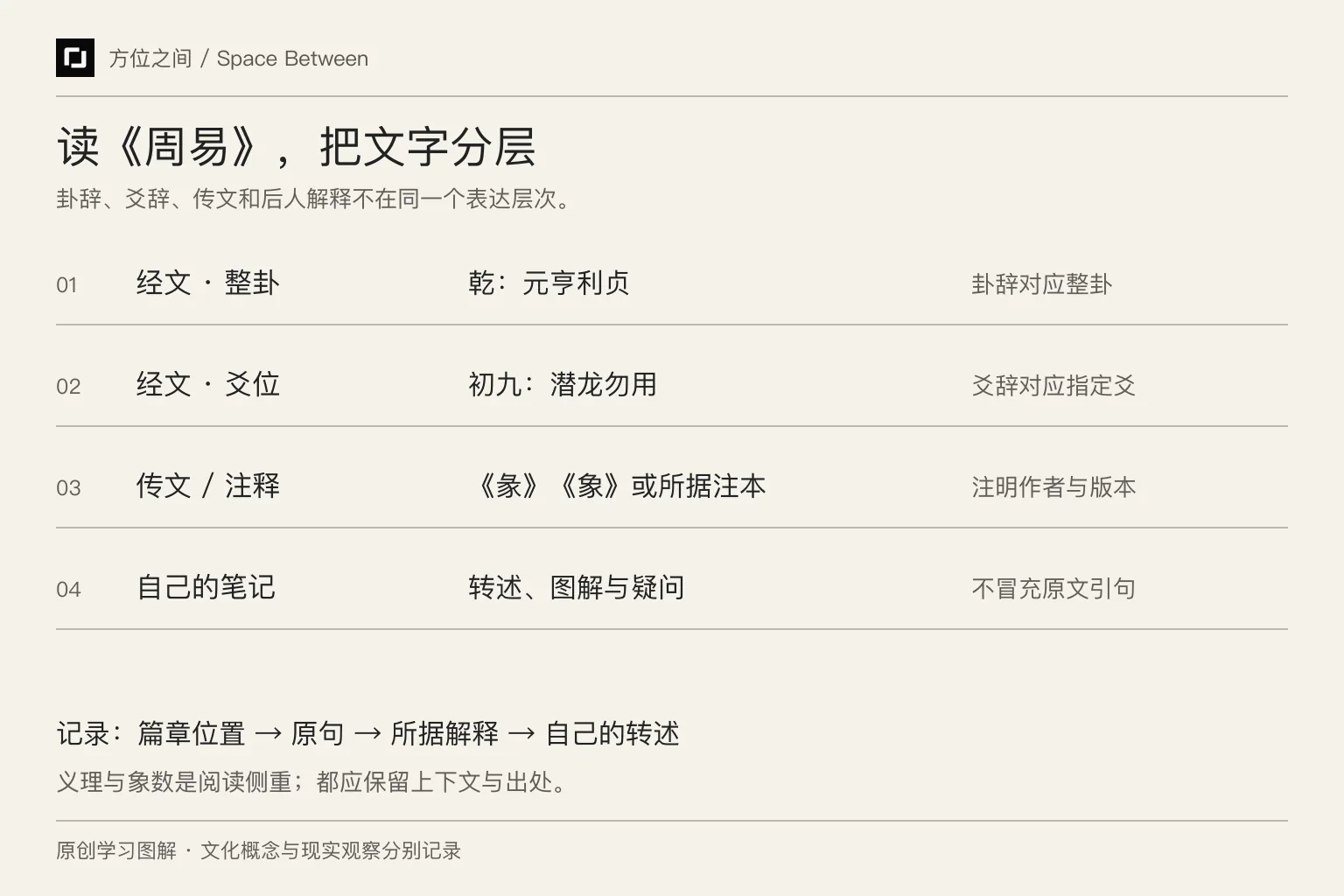
The Zhouyi core text is organized around 64 hexagrams, their names, judgments and line statements. The Ten Wings refer to commentarial texts such as Tuan, Xiang and Xici. Editions may interleave these layers; later notes should be identified separately.
Read the full explanationAre the six lines read top-down or bottom-up?
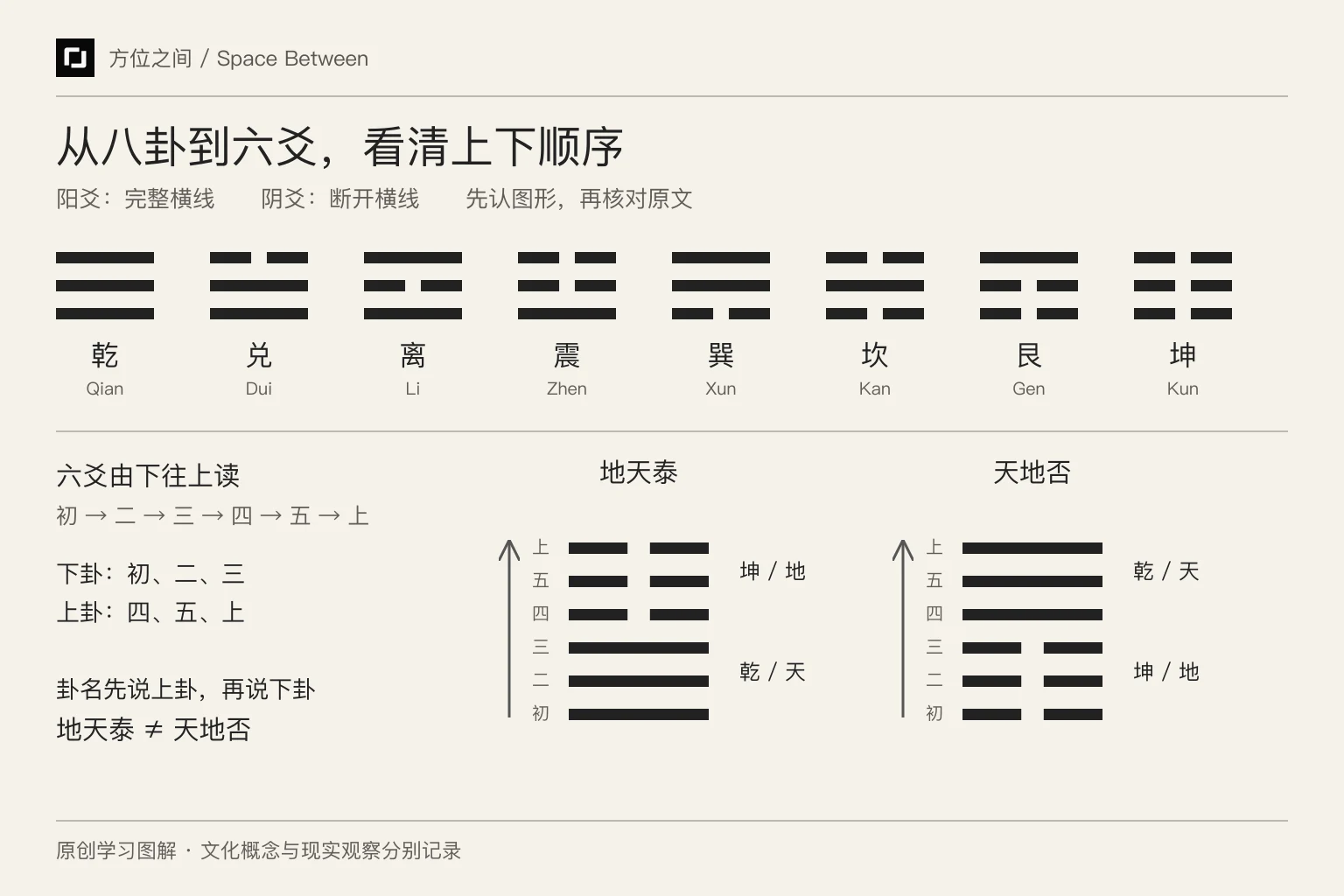
A hexagram has a lower and an upper trigram. The lower occupies positions 1–3 and the upper 4–6; eight by eight gives 64 combinations. Line statements use nine for yang and six for yin, as in initial nine or six in the second place. These are line labels, not floors or compass degrees.
Read the full explanationHow do Earth–Heaven Tai and Heaven–Earth Pi differ?
Tai has Qian below Kun: three yang lines below three yin lines. Bottom to top, its labels are initial nine, nine in the second, nine in the third, six in the fourth, six in the fifth and top six. The name Earth–Heaven Tai lists the upper trigram first, unlike the order for reading lines.
Read the full explanationZhouyi, Yijing and the study of change
 Enlarge diagram
The Zhouyi core text is organized around 64 hexagrams, their names, judgments and line statements. The Ten Wings refer to commentarial texts such as Tuan, Xiang and Xici. Editions may interleave these layers; later notes should be identified separately.
In everyday usage, Yijing often means the Zhouyi, sometimes including its commentaries. Yixue is the broader study of the texts, interpretation, images and numbers. State the intended scope; shared terminology is not proof of a single author or a direct origin for every later practice.
Learn the line patterns before directions
A yang line is unbroken; a yin line is broken. Three positions with two possibilities give eight combinations. Here 1 means yang and 0 means yin, read from bottom to top. This is a modern checking notation, not ancient binary terminology.
- Qian ☰: 111; Dui ☱: 110; Li ☲: 101; Zhen ☳: 100.
- Xun ☴: 011; Kan ☵: 010; Gen ☶: 001; Kun ☷: 000.
- For Zhen, 100 places yang at the bottom and yin above it. Reversing the reading order gives Gen.
Six positions: first at the bottom, top last
A hexagram has a lower and an upper trigram. The lower occupies positions 1–3 and the upper 4–6; eight by eight gives 64 combinations. Line statements use nine for yang and six for yin, as in initial nine or six in the second place. These are line labels, not floors or compass degrees.
Exercise: why Tai and Pi differ
Tai has Qian below Kun: three yang lines below three yin lines. Bottom to top, its labels are initial nine, nine in the second, nine in the third, six in the fourth, six in the fifth and top six. The name Earth–Heaven Tai lists the upper trigram first, unlike the order for reading lines.
Pi reverses the arrangement: Kun below Qian. Sharing the same two trigrams does not make the hexagrams identical. Label upper, lower and all six positions before consulting the text. This checks diagram reading; it does not establish an outcome for a home, relationship or investment.
Patterns, sequences and direction charts
Qian retains three yang lines in both earlier- and later-heaven charts; its placement changes. The received hexagram sequence, trigram arrangements and Najia assignments serve different purposes. Record the chart, its orientation and its rule rather than assuming the top of a screen is north.
A small reading exercise
Choose one hexagram and record the edition, upper/lower trigrams, six line types and text location. Draw it before checking the source. Liuyao may mean six line positions or a Najia divination method using host/respondent, six relations and changing lines; diagram recognition alone does not teach the latter.
Sources and further reading
These sources help clarify the concepts and their origins. Explaining a traditional term does not establish that it can predict outcomes.