
Questions and answers
What inputs do spatial, natal, divinatory and date-selection methods need?
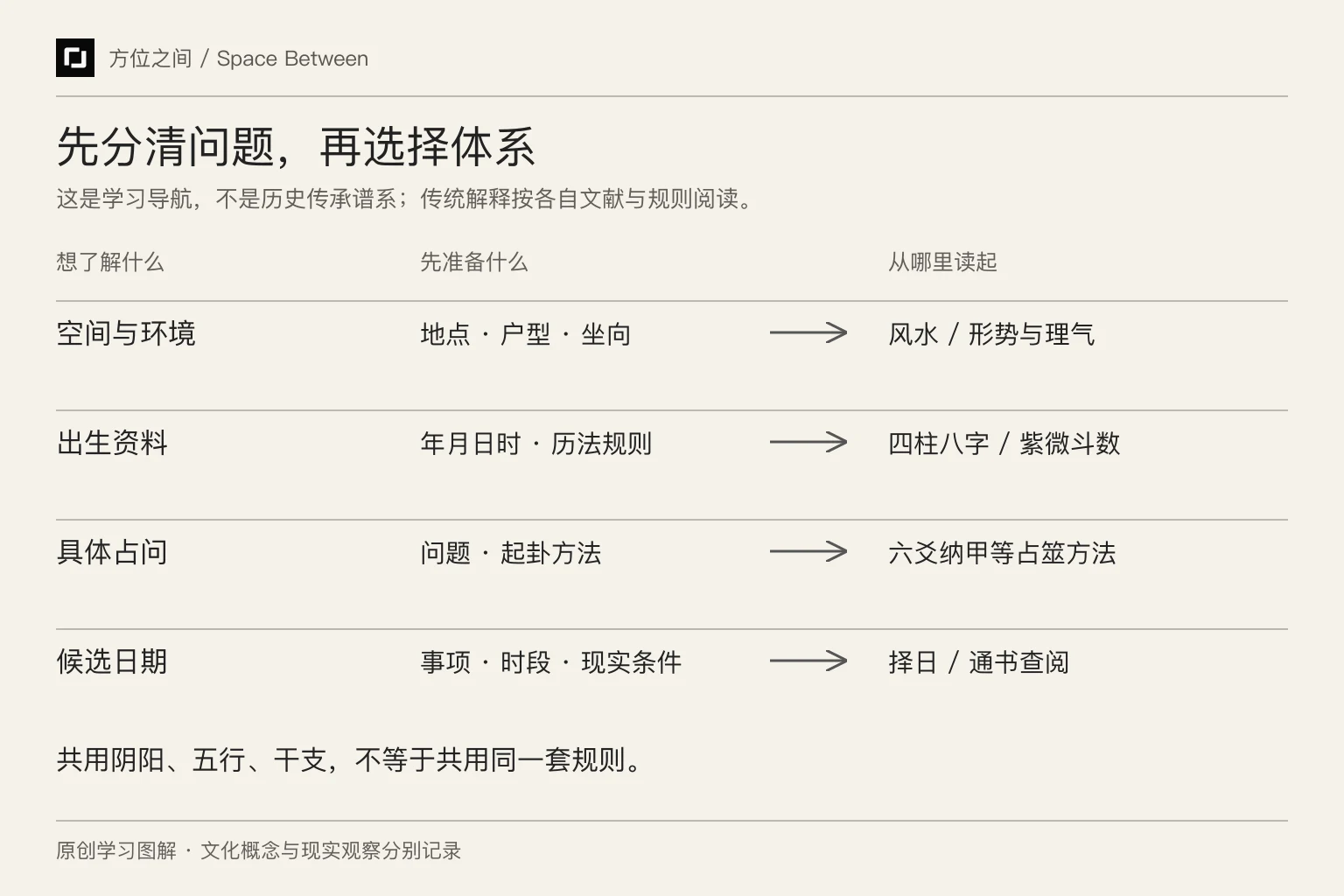
Spatial questions begin with place, surroundings, a plan, an axis and a north reference. Natal methods begin with birth records and calendar conversion. Divination begins with a specific question and an elicitation method; date selection begins with an activity, practical constraints and candidate times. A move can involve all four, but one conclusion cannot replace another method’s required inputs.
Read the full explanationDo Eight Mansions, Sanhe and Xuankong share one rule set?
Form methods examine terrain, water, roads, buildings and spatial relationships. Directional methods organize bearings, numbers or time under a chosen tradition. Observing a curved road, assigning a measured angle to a mountain sector and interpreting a chart are separate steps that need separate records.
Read the full explanationWhere should a beginner start?
Start with yin–yang, five phases, stems/branches and trigrams, then choose spatial observation or textual study. For homes, continue with 24 mountains, measured orientation, three plates and plan observation. For texts, practice line patterns and text layers before comparing technical terms. The learning categories do not confer professional qualifications.
Read the full explanationHow do wealth position, Wealth star, Wealth line and Wealth palace differ?
A wealth position is a location selected by a stated spatial method; BaZi Wealth is the phase controlled by the Day Master, split by polarity; a Liuyao Wealth line is controlled by the palace phase; Ziwei Wealth palace is a topic field. Jia wood references earth as Wealth, while Qian metal references wood as Wealth. Different references explain the difference. None alone establishes income, investment returns or property status.
Read the full explanationFour question types and their inputs
Spatial questions begin with place, surroundings, a plan, an axis and a north reference. Natal methods begin with birth records and calendar conversion. Divination begins with a specific question and an elicitation method; date selection begins with an activity, practical constraints and candidate times. A move can involve all four, but one conclusion cannot replace another method’s required inputs.
Within feng shui: form and directional methods
Form methods examine terrain, water, roads, buildings and spatial relationships. Directional methods organize bearings, numbers or time under a chosen tradition. Observing a curved road, assigning a measured angle to a mountain sector and interpreting a chart are separate steps that need separate records.
Eight Mansions commonly uses house/person gua and wandering-star relations; Sanhe traditions may use stems/branches, paired mountains, formations and water methods; Xuankong Flying Stars uses period and facing conditions. These are reading cues, not exhaustive definitions. Record the book and rule because each tradition also contains variants.
Bazi and Ziwei share birth inputs, not chart rules
Bazi represents year, month, day and hour as stem–branch pairs, taking the day stem as day master. Ziwei uses its own calendar and placement rules for life/body palaces, twelve palaces and named stars. Volume two of Ziwei Doushu Quanshu records these placements. Traditional star labels are not real-time astronomical positions.
Liuyao and date selection: the matter and its timing
Najia Liuyao adds six relations, host/respondent, changing lines and day/month rules to the diagram. The Yongshen chapter of Zengshan Buyi selects a focus by the question asked. Date selection starts with the intended activity, then checks calendar/directional assumptions and practical schedules; an isolated favorable label is insufficient.
Moving example: keep four records distinct
For a new home, map doors and windows, measure a defined axis and record noise and sunlight. Keep any natal or divination discussion separate with its own input, version and question. Date selection must also fit handover, transport and lift bookings. Missing data remains uncertainty rather than being filled with terminology from another method.
Choose a manageable reading path
Start with yin–yang, five phases, stems/branches and trigrams, then choose spatial observation or textual study. For homes, continue with 24 mountains, measured orientation, three plates and plan observation. For texts, practice line patterns and text layers before comparing technical terms. The learning categories do not confer professional qualifications.
How do wealth position, Wealth star, Wealth line and Wealth palace differ?
 Enlarge diagram
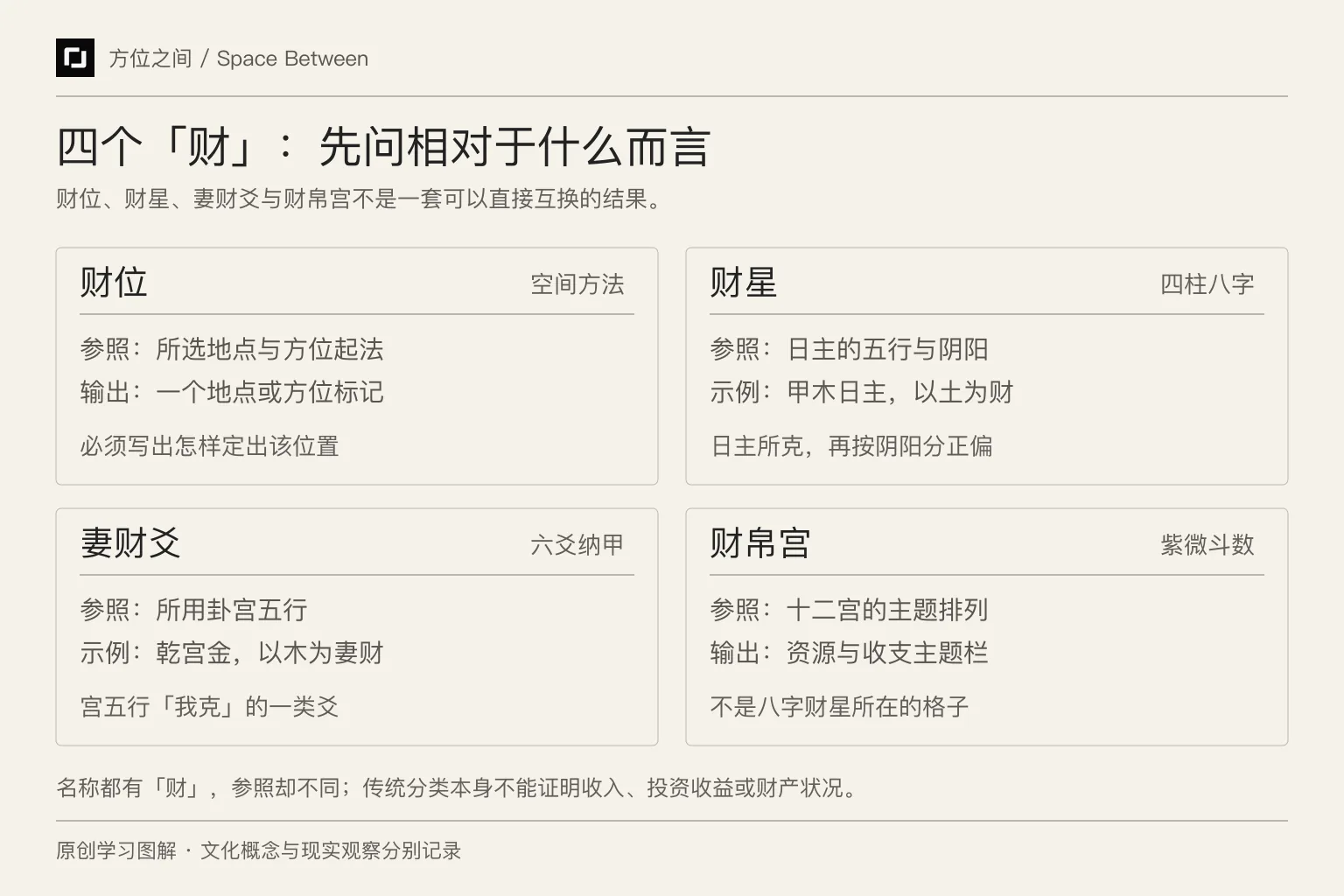
A wealth position is a location selected by a stated spatial method; BaZi Wealth is the phase controlled by the Day Master, split by polarity; a Liuyao Wealth line is controlled by the palace phase; Ziwei Wealth palace is a topic field. Jia wood references earth as Wealth, while Qian metal references wood as Wealth. Different references explain the difference. None alone establishes income, investment returns or property status.
Sources and further reading
These sources help clarify the concepts and their origins. Explaining a traditional term does not establish that it can predict outcomes.