
Questions and answers
What does men–zhu–zao mean in the text?
Volume 1 relates entry, dwelling and cooking to men, zhu and zao, interpreting their relationship through five-phase, yin–yang and wandering-star conventions. Generation and control are categories within that tradition, not measured energy exchanged by household installations. Record the book, chapter and starting rule together; do not interchange Eight Mansions labels with a different flying-star chart.
Read the full explanationMain room: does zhu always mean the main bedroom or owner?
Not automatically. The cited volume-1 transcription describes the principal room in terms of building prominence and height, reflecting a courtyard setting. Later apartment explanations often map it to a main bedroom or principal living space. State which interpretation you use; do not switch from bedroom to living room to obtain a preferred result. A person’s gua is a separate input.
Read the full explanationAre stove position and stove facing the same thing?
A modern kitchen includes a hob, sink, refrigerator, extraction and worktops. First mark the kitchen boundary and the hob’s actual position, then identify the edge or operating direction used to record its facing. A gas connection, controls and kitchen door are not interchangeable directions. An induction hob has no fire-feeding mouth like an old wood stove; do not force an analogy from its shape.
Read the full explanationIf door and window bearings differ by 90°, is the measurement wrong?
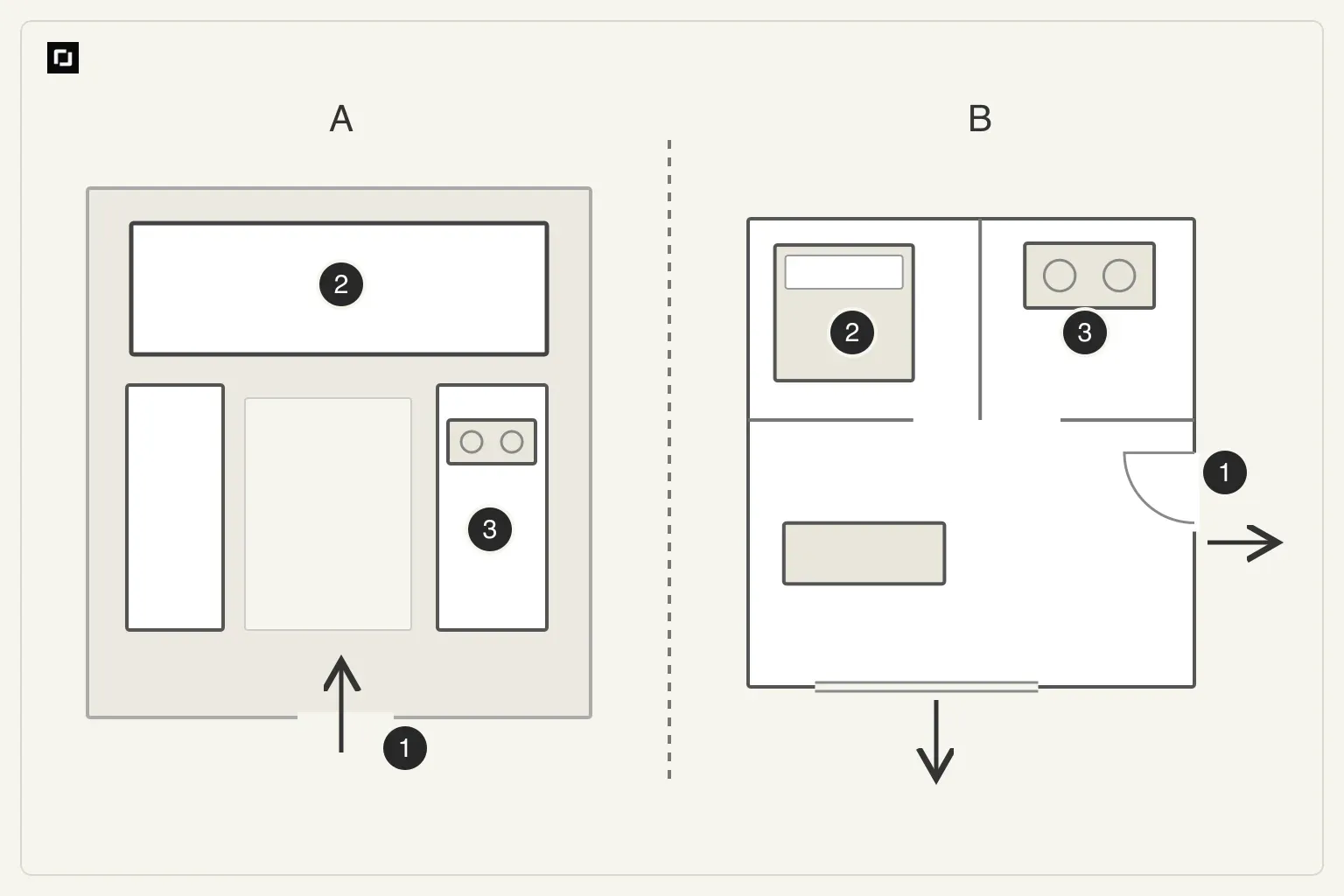
In the diagram, A is a courtyard concept and B is a fictional apartment, not a customer case. In B, ① is the unit entrance, ② the main bedroom provisionally selected for this discussion and ③ the kitchen. Mark the positions and explain the choice of ②. If the entrance faces 90° and the living-room window 180° using the same north reference, they are different axes, not a 90° device error.
Read the full explanationWhat does men–zhu–zao mean in the text?
Volume 1 relates entry, dwelling and cooking to men, zhu and zao, interpreting their relationship through five-phase, yin–yang and wandering-star conventions. Generation and control are categories within that tradition, not measured energy exchanged by household installations. Record the book, chapter and starting rule together; do not interchange Eight Mansions labels with a different flying-star chart.
Door: distinguish estate, building and unit entrances
An apartment may be reached through estate, building and unit entrances. These belong to different scopes: do not use the estate gate’s bearing with the unit plan’s centre for other locations. Outline the dwelling being discussed and mark the opening, door swing and actual route. Also distinguish a doorway’s location relative to a centre from its outward-facing direction.
Main room: does zhu always mean the main bedroom or owner?
Not automatically. The cited volume-1 transcription describes the principal room in terms of building prominence and height, reflecting a courtyard setting. Later apartment explanations often map it to a main bedroom or principal living space. State which interpretation you use; do not switch from bedroom to living room to obtain a preferred result. A person’s gua is a separate input.
Cooking space: record kitchen, stove position and facing separately
A modern kitchen includes a hob, sink, refrigerator, extraction and worktops. First mark the kitchen boundary and the hob’s actual position, then identify the edge or operating direction used to record its facing. A gas connection, controls and kitchen door are not interchangeable directions. An induction hob has no fire-feeding mouth like an old wood stove; do not force an analogy from its shape.
Traditional water–fire categories are separate from leaks, heat, electrical loads and gas safety. Before moving appliances, check the equipment instructions and site conditions. Do not alter extraction ducts, gas pipes or structural elements merely to satisfy a directional label.
Example: a traceable apartment record
In the diagram, A is a courtyard concept and B is a fictional apartment, not a customer case. In B, ① is the unit entrance, ② the main bedroom provisionally selected for this discussion and ③ the kitchen. Mark the positions and explain the choice of ②. If the entrance faces 90° and the living-room window 180° using the same north reference, they are different axes, not a 90° device error.
After mapping positions, record practical issues such as door–cabinet conflicts, detours while cooking or extraction performance. Keep these observations separate from traditional interpretation. If the starting rule or meaning of the main room is unresolved, mark it as unconfirmed rather than filling in a convenient direction.
Limits of traditional interpretation and home changes
Men–zhu–zao helps explain a traditional dwelling classification; it cannot establish that a household will lose money, become ill or have relationship problems. State what a change actually improves, such as circulation, privacy or kitchen usability. Work affecting construction, equipment or common areas needs appropriate professional review; cultural preferences alone are not a basis for alterations.
Sources and further reading
These sources help clarify the concepts and their origins. Explaining a traditional term does not establish that it can predict outcomes.